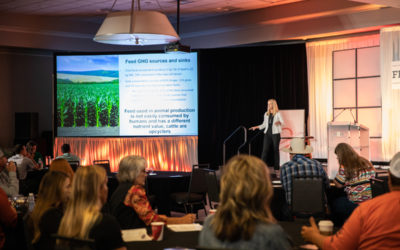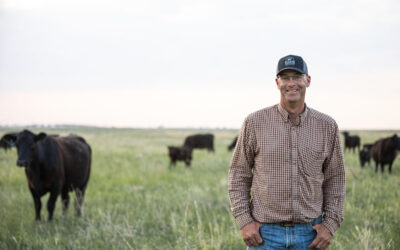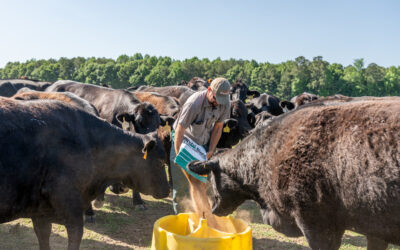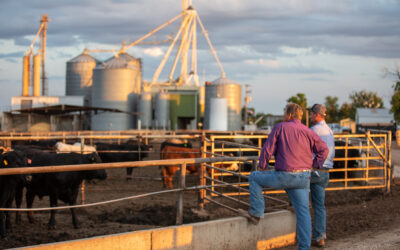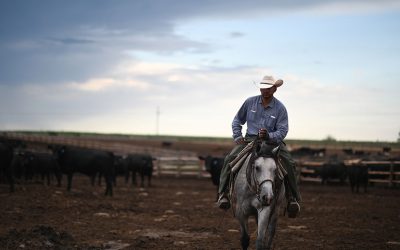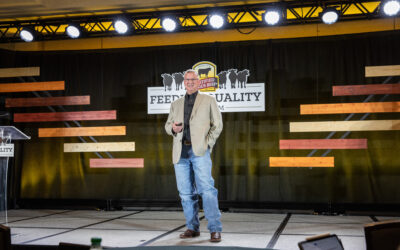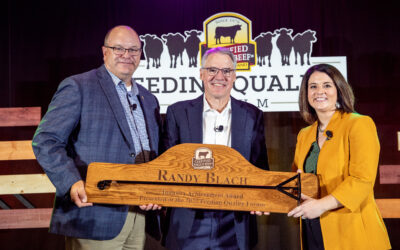
Game changers met at Angus Convention

“When the time to perform arrives, the time to prepare has passed.”

The National Angus Convention wrapped up over a week ago yet that quote from speaker Howard Putnam, former Southwest Airlines CEO, sticks in my head.

Perhaps that one-liner could sum up the reason more than 2,000 attendees came to the educational event. To learn, to prepare. To make sure we’re on the cutting edge.

But looking at the cattle prices as of late, perhaps it rings all too true.

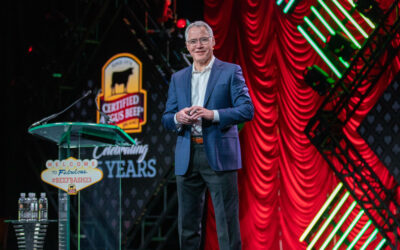
Keynote speaker Howard Putnam, former Southwest Airlines CEO, shared a lot of wisdom that would be applied to any area of life….including your cattle business.

“When the time to perform arrives, the time to prepare has passed.”

Two years ago we were telling you to take advantage of high prices to set your herd up for success in leaner times.

High prices diluted the premiums. When all cattle were worth more, the extra you got for quality grade was less of the total paycheck, but now?

That time of differentiation is here. Just last week the 5-area weighted USDA average reported premiums and discounts showed a $10 high for the Certified Angus Beef ® (CAB®) brand premium. That’s like a tenth of your total payout when prices are hovering around $100/cwt. Average USDA-reported grid premiums for the brand have never been higher.

At the same time, all cattle have improved. In 1997, 54% of cattle graded Choice and Prime. Today, that tally is 76%. When the average continues to rise, you have to improve or you’ll be left behind.

“When the time to perform arrives, the time to prepare has passed.”

If you haven’t paid any attention to end-product traits, it’s not too late, but you’ll be playing catch up.

Several underscored the importance of keeping an eye on the consumer, but Iowa Angus breeder Dave Nichols might have summed it up best when addressing his cohorts.

If you don’t think marbling matters, you’re wrong, Dave Nichols, of Nichols Farms, said.

He recalled what experts tell his customers, “If you don’t feed out your own calves, then don’t pay any attention to marbling. Don’t pay any attention to carcass, because you’re selling your calves at weaning and you’re not getting paid anything for them.’’

He counters, “That’s not true. I say to our bull buyers, ‘Everybody feeds them out, and somebody ends up eating them. By golly, everything is worth weight times the money, and so we breed our cattle as if we were going to retain ownership on them and end up eating them.’

“If any of you think that you can make this work and you aren’t selling bulls that will gain and grade and produce Certified Angus Beef®, you’re going to be in for a big disappointment.”
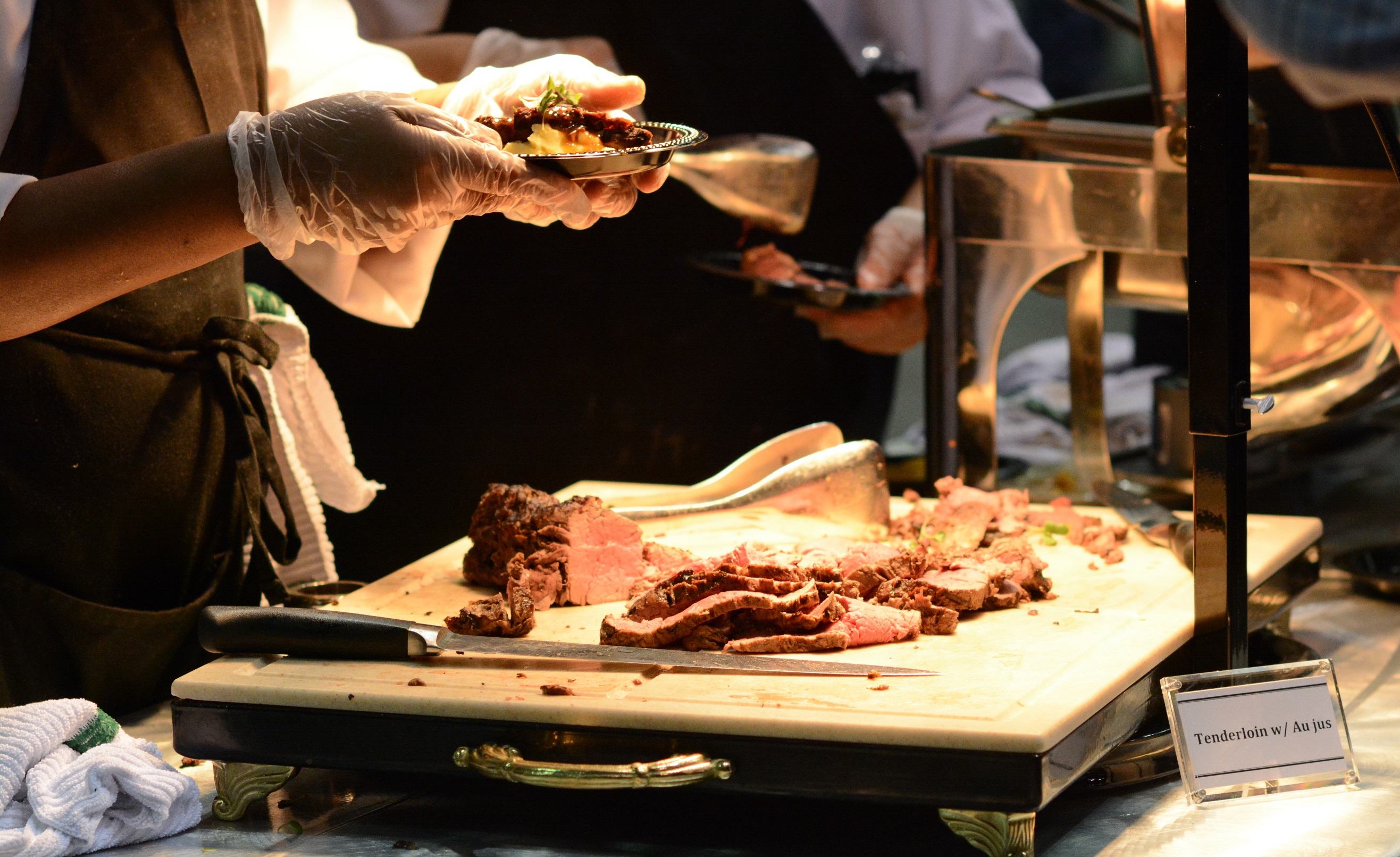
Someone will eat what you produce. Those consumers prefer to eat CAB. Quality matters.

That brings me to another one of Putnam’s zingers: “Some play the game, others change the way the game is played.”

Today’s cattle business isn’t what it was a few decades ago. Have you updated your game plan?

May your bottom line be filled with black ink,

Miranda

PS–In the coming weeks, we’ll share more highlights. In the meantime, check out Team Angus coverage at www.angus.media.

You may also like

Rookies, quick studies and jumping in

Rookies, quick studies and jumping in

Farm and ranch kids are pretty cool. This edition of Black Ink touches on what we can learn from the way they learn whether it’s mini Bud Box setup or hopping on the back of a four-wheeler – it’s about jumping straight in.

Behind those scenes

Behind those scenes

There’s a lot of good in the hard work that nobody sees. But as Miranda’s career takes her into the living rooms and ranches of cattlemen and women across the country, she sees it.
The taste of change

The taste of change

Which traditions are worth holding on to and which ones need a second look? In 2020, change and disruption have been around every corner. Things look different in our newsfeeds, but the cattle in the pasture feel the same, undisturbed by the stressors swirling around us.
Beef yield grade opportunities detailed

System accounts for no more than 40% of red meat yield variation


by Steve Suther

When anyone thinks about beef grading, USDA quality grades such as Prime, Choice and Select likely come to mind. Quality grades have been in effect for nearly a century, but yield grades have been required in the United States for more than 50 years.

While research continues to prove how well quality grades work, the same cannot be said for yield grades. To be fair, quality grading has been updated regularly, while today’s yield grade system is exactly the same as what went into effect in 1965.

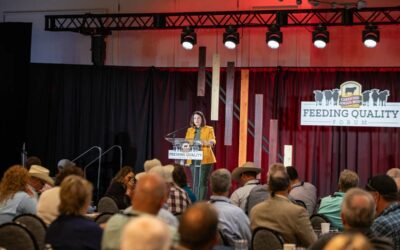
West Texas A&M University animal scientist Ty Lawrence explained the issues at this summer’s Feeding Quality Forum (FQF) in Grand Island, Neb., and Amarillo, Texas. He authored a research paper on the topic this fall entitled, “Beef Yield Grading: History, Issues and Opportunities,” available online at https://cabcattle.com/research.

Lawrence told the 200 FQF attendees that numerous studies have cast doubts on the reliability of the YG system, finding weak to only moderate correlations between yield grade and all of the carcass measurements it was intended to predict, so that those measurements could predict red meat yield.

“We’re trying to predict a predictor of a predictor,” he said, noting it all started with the 1960-published data on 17 independent variables on 162 “representative” cattle processed in the 1950s.

“When the government’s General Accounting Office looked at grading in the late 1970s, they learned that if you sold half of a large pen of cattle to Packer A and the other half to Packer B, you would get two different results,” he said. “Grading was a human, subjective determination.”

The nation that had long since put a man on the moon wanted better. In fact, Lawrence said NASA was asked for help, but the Agriculture Research Service soon turned to Kansas State University’s more focused expertise “in 1980, to estimate red meat yield using a camera.”

Published data proves the “very rudimentary camera” worked. Regardless, for the next decade, the industry “took a left turn toward nuclear magnetic resonance, near-infrared imaging,” the animal scientist said.

More promising technology allowed for a return to video image analysis in the 1990s, as grid marketing emerged amid inconsistent grading by humans. Empathy led them to resist imposing discounts while more readily granting premiums.

“Now you take a picture of a ribeye, convert that to red and white pixels, and you’re counting pixels,” Lawrence said. “This technology gained approval [in 2009] for measuring ribeye area, yield grade, marbling score and back fat thickness.” It cannot measure the kidney, pelvic and heart fat (part of the yield grade equation), so the system accounts for that with a constant or algorithm.

“Now you can take a pen of 500 cattle, sell half to Packer A and half to Packer B, and if they’re both using the camera, you’re going to get the same answer,” he said.

Still, trying “to predict a predictor of a predictor” without accounting for thin meats, brisket or trimmings, using data on 162 carcasses from the mostly Hereford cattle of 60 years ago that ranged from 350 to 900 pounds presents inescapable challenges. It accounts for just 40% of the variation in red meat yield for today’s average fed cattle, and 0% for Holsteins.

The non-linear stair steps for premiums and discounts represent another major flaw in the system, Lawrence said. When the camera calls one carcass a 3.99 and the next a 4.00 yield grade, the grid may suddenly impose a $15 per hundredweight discount.

This system based on a few cattle “of a biological type that no longer exists” predicts red meat yield of cuts from carcasses “increasingly more variable in genetic type and management.”

“We apply that estimate to carcasses that weigh beyond the inference of which [the system] was designed, and we have ignored the opportunity to develop new yield estimates afforded by camera grading,” Lawrence summarized. “Leadership within the beef community must decide if the status quo is acceptable, or if improvement is warranted.”

The Feeding Quality Forums were co-sponsored by Micronutrients, Feedlot magazine, Zoetis, Roto-mix and Certified Angus Beef LLC (CAB). To view presentations and summary information, visit www.feedingqualityforum.com.

You may also like

How to Face Evolving Demands

How to Face Evolving Demands

In the rapid changing space of sustainability, finding clarity on what to do is challenging. At the 2021 Feeding Quality Forum, Dr. Kim Stackhouse-Lawson offered insights on what can be expected of producers moving forward.

From insights to solutions

From insights to solutions

After the last 18 months, what we would pay for a crystal ball that could help us predict the future! They don’t have any magic prediction powers, but leading minds shared their outlook on key beef production areas at this year’s Feeding Quality Forum.

Smith receives Industry Achievement Award at Feeding Quality Forum

Smith receives Industry Achievement Award at Feeding Quality Forum

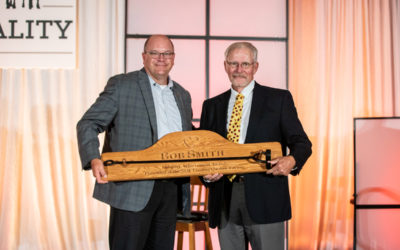
The hands of a veterinarian hold the life cycle of an animal in their care. The mind, however, directs the hands. Anyone who’s met Dr. Bob Smith knows the way he thinks is something else. It’s come from more than 30 years in the industry caring for its people and cattle. It’s why he earned the 2021 Industry Achievement Award.

Meeting of the Minds

It’s been a busy month for the brand. In the last 30 days we’ve marked the end of one fiscal year and the start of another, surpassed a pretty big milestone (more on that later) and hosted that little thing (note the sarcasm) we call Annual Conference (AC).

More often than not, my travels take me to the places where the cattle roam, rather that the spots where the steaks are served. So I usually miss the annual meeting of the minds. But it’s there where distributors, retailers and CAB staffers gather together to talk about the year and the brand’s impact on their businesses.

Since that’s the case I checked in with the folks who indeed focus on the production side of the brand but made the trip to this year’s AC. Feedyard owners and 2015 CAB Feedlot Commitment to Excellence Award winners Shawn and Shane Tiffany said they spent more time with attendees answering questions than they did on stage for their intended session.

ac1
Mark led a discussion with Shawn and Shane Tiffany, Tiffany Cattle Company, Herington, Kan. Feedyards are often one of the most misunderstood parts of the beef community.

“From the time we got off the stage, the rest of the weekend, we were constantly talking to somebody,” Shawn says. “Oftentimes about our business and how we produce cattle but also about what their business was like, whether they were hamburger grinders in San Diego or the largest steak cutter in Canada.”

“As a producer, it can be easy to get so caught up in your own segment of the industry that you don’t think about what happens from that point forward,” Shane says. “For us, you load the cattle on a semi, send them to the packer and you’re focused on the next load coming in.”

ac2
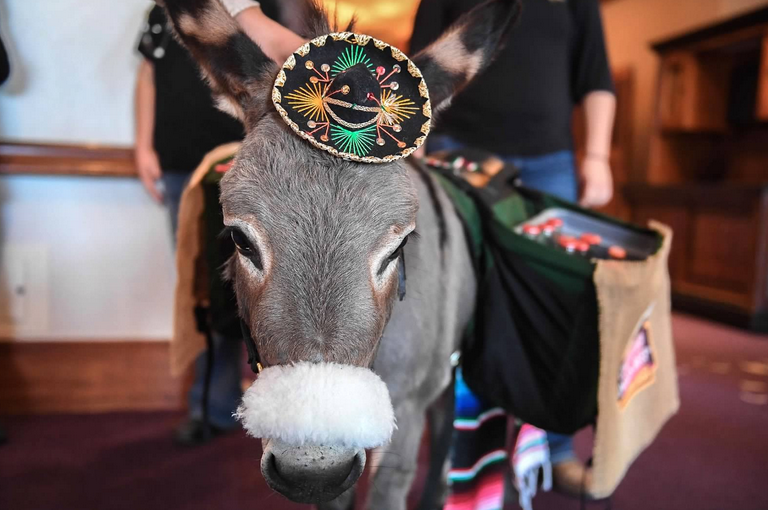
Maybe not the most common species the Tiffanys or Nelsons encounter back home, but he fit this year’s theme, “Hollywood in the Desert,” to a tee.

It’s the perspective he gained, the impact of those who carry on the Tiffany crew’s hard work, he says, that’s stayed with him.

“It’s so important to get a bigger perspective of the industry but it’s also very encouraging to see that these people are great at their jobs. I mean a billion pounds (still more on that later), that’s just a mind-blowing number and that doesn’t happen without them being passionate,” Shane says.

ac3
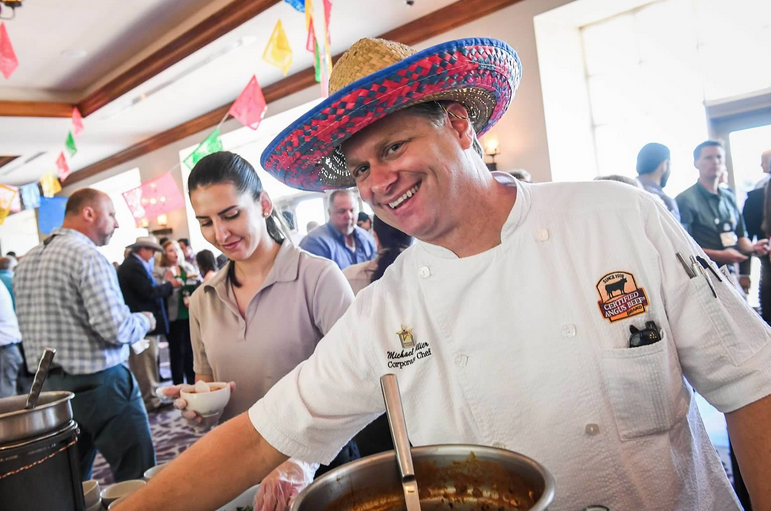
The decor was followed up with beef dishes fit for a fiesta! Chef Michael and others work so hard preparing for AC but also enjoy a little fun every now and then.

Abbie Nelson, Five Star Land & Livestock, Wilton, Ca., and this year’s 2016 CAB Ambassador Award winner said the food and friendships were just icing on the cake to what already lit a fire for her to come home and increase CAB acceptance in the herd.

“We just made a lot of friends,” Abbie says. “Gary and Sally [Myers], of Sizzler’s, we just talked non-stop back and forth about what we do and what they do. I think we established a friendship that will go on forever.”

To learn more about our award winners this year, check out these individual stories:

Thanks for allowing me to tell your story,

Laura

You may also like

Kansas Ranchers Recognized for Sustainability Efforts

Kansas Ranchers Recognized for Sustainability Efforts

Kansas’ Wharton 3C Ranch thrives despite droughts, winning the CAB 2023 Sustainability award. The data-driven, quality-focused approach of first-generation ranchers, Shannon and Rusty Wharton, yields 100% CAB cattle. Their commitment to sustainability and industry collaboration sets a bright future for the cattle business.

Saskatchewan Angus Ranch Earns Certified Angus Beef Award

Saskatchewan Angus Ranch Earns Certified Angus Beef Award

JPM Farms in Canada quietly gained recognition for its dedication to environmental sustainability and quality cattle. The Monvoisin family earned the 2023 CAB Canadian Commitment to Excellence award for their outstanding results and partnership with Duck Unlimited, showcasing their commitment to improving the land, cattle and family daily.

Everything They Have

Everything They Have

Progress is a necessity on the Guide Rock, Nebraska, ranch where Troy Anderson manages a commercial Angus herd, small grower yard, his 10-year-old son, and a testing environment. Troy’s approach includes respect for his livestock, people and land. For that, Anderson Cattle was honored with the CAB 2023 Commercial Commitment to Excellence Award.

Cattle feeding chat builds bridges

Kansas brothers address beef marketers


by Miranda Reiman

When it’s just not possible to bring 600 people from across the globe to the feedyard, the next best thing is to bring a little of that Herington, Kan., family operation to them.

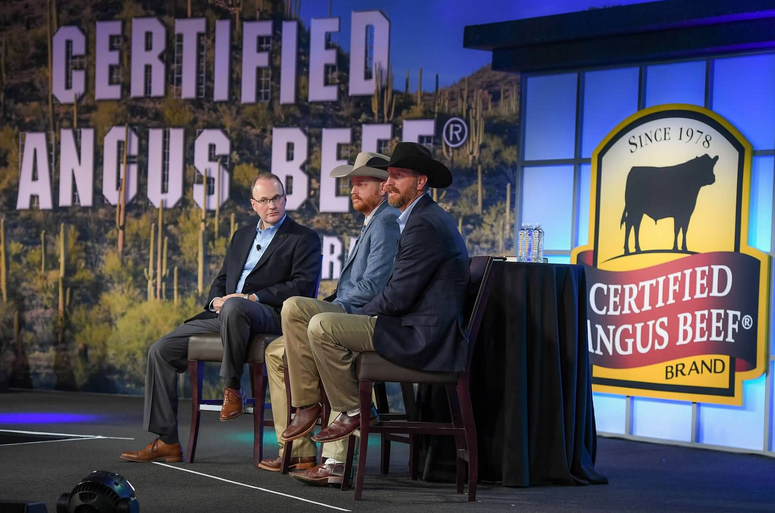
Cattle feeders Shane and Shawn Tiffany took the stage during educational sessions at last month’s Certified Angus Beef ® (CAB®) brand annual conference in Tucson, Ariz. The brothers gave foodservice and retail professionals a glimpse of life in a feedyard, often one of the most misunderstood parts of the beef community.

“It gives us an opportunity in our supply chain to bring those calves together from different genetics, different environments, different weights, shapes and size, born at different times – and create uniformity,” said Mark McCully, CAB vice president for supply during their introduction. “It allows us, as a beef supply chain, to have a 52-week supply of marketable finished cattle for your business.”

The Tiffanys have an open-door business model. They’re happy to talk about any part of the feedyard, they said, so they started at the beginning.

“Shawn and I literally grew up there,” said Shane. Their dad managed the feedyard for 14 years, and as boys they started out washing waterers and cleaning “boot [grain-receiving] pits” in the mill. “There was no such thing as a snow day. When school was cancelled, you went to work.”

Then they both went to college and on to other careers before forming a partnership to buy what is now the 14,000-head Tiffany Cattle Company.

“We took the chance and we jumped in,” Shane said. “The last nine years have been a whirlwind and it’s been a fun ride, but really we’ve just been incredibly blessed as we’ve grown the business.”

They gave a backdrop for the 45-minute conversation by explaining the typical schedule and chores at the yard.

“We’re in our office chairs by six in the morning. We expect the feed trucks to be rolling and dropping feed in the bunks before 7 a.m.,” Shawn said. “Cowboys are out saddling their horses in the dark and getting ready to go inspect every single animal in the yard, every day, for any health issues that may arise.”

They talked about their customers and the quality animals they receive into the yard.

“We’re 99% customer-owned cattle, so we provide a service for our customers that own the cattle. So think of a bed and breakfast,” Shawn said. “We sell food and rent a room.”

The chefs, beef marketers and others had a chance to text in questions for the cattlemen to answer live. Inquiries ranged from the transition to grain from forage and defining “feed conversions” to the kind of legacy they wanted to leave and future challenges.

“Your focus is pretty narrow when you’re young and broke and you’re trying to get a business off the ground,” Shawn said. “The goal is to stay in business until tomorrow.”

Now, there are eight kids that make up the next generation. They said that forces them to look longer-term, and makes them more determined than ever to share their story.

“The ruminant animal has the wonderful ability to take low-quality proteins, such as grass or corn silage and produce some extremely high-quality protein products that we can consume,” Shawn said, noting that most people just want to learn more about that process.

“If somebody will give you the time to explain your story and why you do what you do and how you do it, every single time people go away with a better feeling and better understanding of our industry,” he said.

The men and their wives spent the three-day conference interacting with people from very different geographies and diverse backgrounds.

“The moment we got off the stage, the rest of the weekend, we were constantly talking to somebody,” Shawn said. They chatted about cattle and everything in between, from grinding hamburger in San Diego to cutting steaks in Toronto. “There were just some great conversations with people who are from a considerably different segment of our industry, but are every bit as passionate about it as we are.”

To see more from the CAB annual conference, watch this special edition of “The Angus Report”: http://cab.info/2qx.

You may also like

You, Your Cows and Their Feed

You, Your Cows and Their Feed

Expert guidance from Dusty Abney at Cargill Animal Nutrition shares essential strategies for optimizing cattle nutrition during droughts, leading to healthier herds and increased profitability in challenging conditions.

Marketing Feeder Cattle: Begin with the End in Mind

Marketing Feeder Cattle: Begin with the End in Mind

Understanding what constitutes value takes an understanding of beef quality and yield thresholds that result in premiums and/or discounts. Generally, packers look for cattle that will garner a high quality grade and have excellent red meat yield, but realistically very few do both exceptionally well.

Magnum Feedyard Earns Certified Angus Beef Award

Magnum Feedyard Earns Certified Angus Beef Award

While Magnum hasn’t always had pens filled with Angus-influenced cattle, they’ve invested in infrastructure, improved quality-based marketing and sought better genetics. Their dedication to detail and employee appreciation drive their success to high-quality beef production.

Meat is about trust, says author


by Katie Alexander

Imagine living when there was no supermarket or grocery store where you could buy food, having to grow just about everything your family needs. That could be any rural area in the country a couple hundred years ago.

Livestock were keys to that economy, says author Maureen Ogle, who spoke at the Certified Angus Beef ® (CAB®) brand’s annual conference in Tucson, Ariz., last month. Her book, “In Meat We Trust: An Unexpected History of Carnivore America,” derived from the realization that she ought to know more about this vital food chain.

“Here I am living in Ames, Iowa, which is basically ground zero for all things agriculture,” Ogle said. “My house is built on what used to be, 25 years ago, a cornfield – and I realized I didn’t know anything at all.”

Immersing herself in research for the book, she soon discovered “how wrong” the consensus was.

“My brain started paying attention to the so-called food debate,” Ogle said. “I think it’s more of a shouting match than a debate. As I got deeper into the research, I let my brain start paying more attention to what was going on in the real world rather than what happened 200 years ago.”

Seven years of immersion in the meat industry led her to ask, “If antibiotics are so controversial and confinement is so evil, why and how did it happen? Why do people do these things?” The first part of her book sought those answers.

When the first settlers came to America, cattle became a major form of currency; owning livestock determined your wealth status.

“To be in the new world,” Ogle said, “to be what eventually was called an American, was to be someone who could eat meat whenever they wanted.”

As the Civil War broke out, more people were moving into cities and less meat was being produced locally. That caused problems, but opportunities for people who could supply those protein needs.

People like Phil Armour, who founded Armour & Company in Chicago, and Gus Swift, who revolutionized the meatpacking industry by using refrigerated railroad cars, found solutions.

“As entrepreneurs, they figured out a way to unravel this logistical puzzle and build really efficient systems for getting livestock from the person who starts with the calf or the newborn pig, and moving that animal through a system where the animal gets fed to maturity, slaughtered and then ends up, eventually and usually at least a thousand miles away, on someone’s plate,” Ogle said.

To support urban growth, Armour and Swift built systems that continue to multiply around the world.

Today, the term “factory farming” is a very negative term, but Ogle said it was a statement of patriotism in the early 1900s.

“Farmers understood that if you’re going to feed this big population, you need to have some kind of business-like, efficient system,” she said. “Just in terms of supply and demand, farmers could not keep up with the demand in this country. They had to adapt new technologies and new ways of thinking about production to try to keep up with this extraordinary demand.”

The second half of the book picks up the story during World War II when a lot of things began to change and the structure of relatively modern livestock production and meat processing began to take shape.

“Farmers were soon trying to come up with more efficient ways to feed their livestock,” Ogle noted. “The common view now is that big corporations took over, but the story that I found is that thousands and thousands of farmers were developing jury-rigged equipment so that their cattle and hogs could feed themselves, so that the farmer could get on to doing other jobs.”

That ingenuity went unheralded, but she said producers may need to call upon their traditional ability to innovate to keep consumers happy today.

“Americans spend roughly 11% of our disposable income on food,” Ogle said, noting how relatively low that is in a global sense. “Yet agriculture has somehow lost the culture war. The media latched onto the [food writer Michael] Pollan version, and ran with it.”

Maybe it’s not too late to rebuild the image, though.

“Just keep doing your job as well as you can,” Ogle told Angus producers, “and try to tell your story, if you can, as honestly as you can.”

You may also like

Own what you do

Own what you do

His push to get better and desire to win are as much a part of how he was raised—and people who mentored him along the way—as they are a personal philosophy. Probably why he earned the CAB 2019 Progressive Partner Award.

Tame your selection criteria

Tame your selection criteria

Is docility economically important? We’d say so. Cattle graded Choice or higher was 63.5% for calm temperaments, compared to 55.5% for their excitable pen mates. The calm advantage was $56 per head.

Fetus to feedyard

Fetus to feedyard

This isn’t a research topic you’d find at the middle-school science fair. It’s so new, research is just beginning to explore this 16-letter term for immune cells sharing nutrients with major organs: immunometabolism. So far, there are still more questions than answers.

The matching game

Technology, economics, consumers dictate cattle feeding


by Miranda Reiman

Cattle have changed. If your management hasn’t, animal scientist Robbi Pritchard suggests you take a look to be sure it’s still relevant.

The South Dakota State University emeritus professor addressed cattle feeders and allied industry at the Feeding Quality Forum in August.

“Genetics are better and our growth enhancement tools are better and we know a lot more about them,” Pritchard said, noting the term “precision ag” is typically reserved for row-crop discussions. It doesn’t have to be. “We could go that way in the cattle business and we could make big strides.”

That means matching cattle type to technology and ration.

“If they’re coming out of 1,600-pound (lb.) cows, they probably don’t need any implants,” the ruminant nutritionist said. “The DNA was there. The implants just fill in for a lack of DNA.”

Using those growth promotants in an animal with high growth potential will give you a “nitro-burning car that flames out. It’s not a good thing.”

But another class of cattle would benefit from the technology, as a single implant can add 75 lb. of carcass weight.

“All we need to do is match up stage of growth, potency of the implant and caloric intake,” he said. “We’re getting much better at using our implants like scalpels instead of axes.”

The critical window is from weaning to 65% of their harvest weight.

“That’s where you change the percent Choice, that’s where you change what they weigh when they hit a Yield Grade (YG) 4,” Pritchard said. “These cattle have higher growth potential than they used to have, so we have to feed to that higher growth potential.”

He suggested only grazing commodity cattle on wheat and low-quality forage.

“Five to eight months of age: that’s the window where I can manipulate where I’ll be on quality grade, relative to yield grade in the end,” Pritchard said. “If I rough them too much during backgrounding—either with corn stalks or dormant prairie, I’m going to give up marbling.”

In a normal year, early weaning makes sense only for larger-framed cattle.

“Early weaning is going to make them fatter,” he said. “It will make them grade really well, but you’re going to hang up 100 lb. less carcass weight; it won’t pay.”

Weighing cost versus later return, he said, “Creep feeding fits best just within the nutritional gaps.”

Ranch level changes have created more uniformity in supplies to the feedyard. For example, calving groups are tighter.

“We no longer need time for things to average out as we did when management wasn’t nearly as good. Time solved a lot of problems,” he said.

Genetics play a big role in knowing when cattle are done, and those have changed.

 When Pritchard’s great-grandfather trailed cattle to the railroad, they were usually driving 4-year-olds. “It took a really good steer to go to town when it was three,” he said.

But what rules marketing decisions today? Some sell when they’re “fat enough” and some farmer-feeders when the corn is gone. As calf replacement costs have escalated, some consider them finished one week before the packer won’t take them any longer or when the implant is wearing out.

“None of these are really sound, long-term plans,” Pritchard said.

But don’t listen to yesterday’s wisdom.

“We all learned in school: when cattle get fat, they get less efficient,” he said. “I believed in it a lot once upon a time.”

At the beginning of his career, feed-to-gain ratios on heavy cattle were 8.5 lb. to a pound of gain. Today’s data? “Feed conversion barely got over 6 lb. on pens of cattle that got a pile of [Yield Grade 4s],” he said (see figure attached).

“What is my definition of done supposed to be? When I make the most money or when I make the right product?” he said, alluding to outside factors.

Much larger carcasses cause challenges at the packer level, where their infrastructure isn’t set up for the sheer size of some of today’s animals.

“They’re going to slow down our rate of change,” Pritchard said. “They’re a governor, but so far they’re not going to stop it.”

From 1980 to 2015, the hot carcass weights have increased an average of 5.18 lb./year, and Pritchard expects that to continue.

What does that mean for those who ultimately buy beef products?

“Consumers have our attention,” said Pritchard, noting that the cattle community has responded to quality assurance, food safety and animal welfare issues. “Are we doing anything about size?”

Yet economic signals say, keep making them bigger.

“We keep worrying more about this,” he said. Feeders want to do what’s best for everyone, “but right now we don’t have a price structure system that’ll encourage us to do that.”

The forums, held in Grand Island, Neb., and Amarillo, Texas, were co-sponsored by Micronutrients, Feedlot magazine, Zoetis, Roto-mix and Certified Angus Beef LLC (CAB). To view presentations and summary information, visit www.feedingqualityforum.com.

You may also like

Get BQA’d, Meet Coach Tang at Hy-Plains Feedyard

Get BQA’d, Meet Coach Tang at Hy-Plains Feedyard

Get BQA’d, or renew an expired certification, on Wednesday afternoon, August 21, 2024, at Hy-Plains Feedyard in Montezuma, Kan. Hear from Jerome Tang, K-State’s men’s basketball coach, about how it takes every player on a team to win. The workshop is free to attend and will offer simultaneous Spanish interpretation.

Feeding Quality Forum Registration Now Open for 2024

Feeding Quality Forum Registration Now Open for 2024

As we approach a herd rebuild, you need confidence to navigate today’s cattle market dynamics. This year’s Feeding Quality Forum theme is just that, so attendees can leave ready to make more informed decisions at the ranch and feedyard to get more value for their cattle.

Drought Impact and Cattle Industry Dynamics

Drought Impact and Cattle Industry Dynamics

As drought conditions persist across much of cattle country, farmers and ranchers are at a pivotal juncture in the cattle industry’s landscape. What impact does this prolonged dry spell have on the nation’s herd numbers? When will heifer retention begin? How will industry dynamics influence the spring bull sale season?

Face the pace of change

From beef markets to production systems

By Katie Alexander

We are used to slow change in the cattle business.

After decades at that pace, however, the North American cattle and beef industries are undergoing a rapid transition.

“Farming and food production in total are no longer local industries,” said Pete Anderson, Midwest PMS research director. “They no longer serve local markets. Now, they are part of the global marketplace, paired with scaled opportunities, scaled risk and increased volatility. The upside is bigger, the downside is bigger, and the risk is greater than it’s ever been.”

Anderson presented a state-of-the-industry overview at last month’s Feeding Quality Forum in Grand Island, Neb., and Amarillo, Texas.

“As individual cattle producers, most of us are subject to external influences to a greater degree than ever before,” he said. “Our collective responses will shape the industry and determine its future. In other words, there’s stuff you can’t control that’s influencing how this works.”

There are fewer cattle, different and more valuable compared to previous decades. They’re bigger, better and fatter.

“Outside financial influences are having a bigger effect on our business than ever before,” Anderson said. “That’s one of those things that we can’t really control.”

While head counts are down, there is more beef and “two and a half times as much milk” being produced with forty million fewer cattle.

Genetics have continued to play a role. 

“EPDS [expected progeny differences] were the first selection tool that actually worked, the first genetic and evaluation tool that actually let us make progress,” Anderson said. “We selected for growth, we got more birth weight because those are complementary traits. Because we had EPDs, we could sort through the population and predictably find those that could give us more growth without giving us more birth weight.”

Culling is a natural part of selection, but environmental conditions often drive it.

“We had a big drought a few years ago,” he said. “We’ve reduced the cattle herd by about 2 million head, sort of selectively. In the drought-stricken areas, the better ones moved somewhere, and the worst cattle got killed. We improved the average of the whole herd by using some criteria to determine which ones were worth keeping.”

Low cattle numbers imply feedyard operators must rely on “innovation and excellence to keep the yards full over the next 10 years.”

In the bigger picture, the beef industry needs freedom to operate, technology and knowledge.

“There are two groups that can take it, that can lessen our freedom to operate,” Anderson said. “One is government, and the other is consumers.”

 The government has put more regulations into effect in the last eight years than in any 50-year period.

“Non-therapeutic antibiotic use will end this year,” he said. “A reasonable question we have to ask ourselves and prepare for is what will be the next thing.”

Consumers pay premiums for what they want. They get behind social media platforms and rally for causes that they believe in.

“Consumers will have a greater influence on what we do and how to do it. The customer is always right. Also remember, the customer is not always informed,” Anderson noted. “They’re not always scientifically literate. They’re not always interested in the truth. They’re not always concerned about our well-being.”

Technology can be both risk and benefit for producers and consumers.

“If we used it, consumers might not accept it. They might tell us they’re not going to consume a product, or they’re going to pay less for it if we make it a certain way,” he said. “That’s a risk. The other risk is if you don’t use it, you might not be cost competitive.”

With the ever-growing population, beef producers must look at the increase in meat consumption in not only the United States but other countries as well.

“We must get in, stay in and dominate the world’s high-quality beef market. Exports are a key,” Anderson said. “No other country can do that as well as we can. It’s the best use of our resources. It’s most profitable to export.”

The forums held in Grand Island, Neb., and Amarillo, Texas, drew more than 200. They were co-sponsored by Roto-mix, Feedlot magazine, Micronutrients, Zoetis and Certified Angus Beef LLC (CAB). To view presentations and summary information, visit www.feedingqualityforum.com.

You may also like

2022 Was as Predicted

2022 Was as Predicted

If there was a lesson in 2022, it was that the beef market is very sensitive to declines in quality grade, as evidenced through price signals. It’s the first time in recent history where we’ve gone backwards — albeit ever so slightly — and customers are telling us they have unfulfilled demand. That’s reflected in the premiums paid, and that’s saying something after two years of extremely high premiums.

Taste Drives Demand and Profit

Taste Drives Demand and Profit

Quality starts long before feedyard rations reach the bunk, and it weighs heavily on the bottom line. Brian Bertelsen, vice president of field operations for U.S. Premium Beef, discussed marbling’s impact on grid marketing at CAB’s annual Feeding Quality Forum.

Four Decades Devoted to Cattlemen

Four Decades Devoted to Cattlemen

Always focused on the data and how it can deliver solutions, the decades of work earned Blach a second-nature understanding of the market and all that affects it. That kind of servant leadership earned Blach the 2022 Certified Angus Beef Industry Achievement Award.

Ag Outlook: Not so good, not all bad

Basse predicts price plateaus for most commodities


by Miranda Reiman

“Who is going to flinch first?”

Dan Basse, president of AgResource Co., said that’s the main question he and his team ponder when looking at this “plateau” phase in the ag markets.

“Is it your neighbor that’s going to cut back? Is it you?” the analyst asked, as he addressed cattle feeders and allied industry representatives at the Feeding Quality Forum last month.

The world has added 179 million crop acres during the last decade, and livestock production is currently in a “dynamic expansionary phase,” Basse said. Ethanol demand has matured and a strong U.S. dollar hurts global competition.

“If you want to get bullish in American agriculture, the thing that you want to see is a drop in the U.S. dollar,” he said. “The problem is, the United States is the reserve currency, almost by default, these days.”

Yet even with more production from predicted record yields and stocks-to-use ratios, “the story for grains is not all that bad,” he said.

South American drought hurt that region’s corn yields before rainfall at 250% to 400% of normal hampered soybean production. That will bode well for U.S. exports.

“I worry that we don’t have enough capacity,” Basse said, noting the U.S. can move about 600 million bushels combined of corn, soybeans and wheat each month through its current infrastructure. “There are going to be months that we don’t have enough capacity to export everything the world wants.”

That creates a strong signal to cattle feeders, he said. “You’ve got to be prepared for basis appreciation because there’s going to be a big sucking sound down at the Gulf. That sucking sound is the export demand sopping up bushels, and you can only hope that farmers will be willing to sell them.”

Basse suggested corn will average around $3.40/bushel, and if it dips below $3.25, feeders “want to be a long-term buyer.” AgResource predicts average soybean prices around $9.43/bushel, with lows around $9.25.

“We’ve lived through $3 corn and $1.10 or $1.20 cattle before. That’s not something that’s new,” he said. “What’s new is that our cost structure is out of whack.”

Input prices are still relatively high and farm incomes have decreased the last four years, down to the lowest levels since 2001.

“Low prices don’t mean the same for everybody,” Basse said. Places like Argentina and Russia have weak currency, which bolsters their position in the marketplace.

“In the ag world, there are two different things that cause us to have anxiety,” Basse said. “No. 1 is weather, which is always changeable and difficult. No. 2 is policy.”

He explained, using Argentina as a case study. When Mauricio Macri was elected in December, his goal was to eliminate export taxes on most agricultural products.

Argentinian farmers were paying taxes in the 27% to 35% range: “The next day, you don’t have to pay a tax at all – how are you going to feel?”

Farmers there are making $400/acre more this year compared to last.

That’s a big contrast to the U.S.

“This is the first year you went to the fields and planted corn and soybeans looking at sizable losses,” Basse said, noting his team estimates a $70/acre deficit. “Policy has to get involved here for the grain farmer to stop farming.”

There is tempered optimism in the beef business, however.

Cow-calf margins are down, but Basse still predicts a profit of $100 per head out into 2017.

“When I look at annual feeding margins, it’s getting better, but, boy, it’s been a tough road,” he said. “The good news is that per-capita meat consumption in the United States is rising again. We’ve seen price starting to stimulate more consumption of beef.”

Basse said the futures in August were undervalued by about $10.

“We are not advocating strong hedging, unless you have the margin in the cattle market as we sit,” he said. He predicted a first quarter cash-cattle price in the “mid-120s,” noting, “It’s not a big rally, but it’s something.”

Looking ahead to global factors and maintaining a competitive edge, Basse said producers need to keep improving their cattle, because the rest of the world is on it.

“If I go give this speech to Rockhampton in Australia, they’re feeding more grain than they’ve ever seen before. Argentinians are putting in feedlots and they’re going to be plowing up their Pampas where their cattle have been grazing,” he said. “We’ll see the shift, more grain being fed and more focus on marbling and quality than before.”

The title “grain-fed” alone will not hold the same distinction in another decade, he said.

The forums held in Grand Island, Neb., and Amarillo, Texas, drew more than 200. They were co-sponsored by Roto-mix, Feedlot magazine, Micronutrients, Zoetis and Certified Angus Beef LLC (CAB). To view presentations and summary information, visit www.feedingqualityforum.com.

You may also like

2022 Was as Predicted

2022 Was as Predicted

If there was a lesson in 2022, it was that the beef market is very sensitive to declines in quality grade, as evidenced through price signals. It’s the first time in recent history where we’ve gone backwards — albeit ever so slightly — and customers are telling us they have unfulfilled demand. That’s reflected in the premiums paid, and that’s saying something after two years of extremely high premiums.

Taste Drives Demand and Profit

Taste Drives Demand and Profit

Quality starts long before feedyard rations reach the bunk, and it weighs heavily on the bottom line. Brian Bertelsen, vice president of field operations for U.S. Premium Beef, discussed marbling’s impact on grid marketing at CAB’s annual Feeding Quality Forum.

Four Decades Devoted to Cattlemen

Four Decades Devoted to Cattlemen

Always focused on the data and how it can deliver solutions, the decades of work earned Blach a second-nature understanding of the market and all that affects it. That kind of servant leadership earned Blach the 2022 Certified Angus Beef Industry Achievement Award.

You can think that, but you’d be wrong

Brace yourself. Prepare. That was the message I took from last year’s Feeding Quality Forum (FQF).

Before that came other themes: Manage your risk, there’s some glimmering good news amidst the bad; and high prices don’t mean high profits.

I’ve been to all but one of the forums, which we’ve held with allied industry partners since 2006, and the overwhelming summary is LOTS of good information.

But I might lean on Zoetis veterinarian Robin Falkner’s statement to wrap-up the 2016 meetings: “Just because we’ve been doing something for 100 years, doesn’t mean it’s right.”

2016_08_23_mr_FQF 2016-59
Cattle feeders and allied industry gathered in Grand Island, Neb., and Amarillo, Texas for the Feeding Quality Forum meetings this week.

He was talking about improving stockmanship as a preventative measure, rather than relying solely on veterinarian medicine, but I thought it applied to all topics covered. Especially if we adjust that statement to its positive inverse: “We’re learning new things, and ways of doing things, all the time.”

Here are some myths of yesteryear that our speakers told us are simply not true in today’s year.

  • Record yields mean limit down pricing. Not so fast, says Dan Basse, president of Ag Resource. “We not only have big crops, we also have big demand,” the market analyst told us. He predicts record yields of 547 million metric tons of corn, soybeans and wheat. It’s the third year of record grain storage, but still: “I’m really not that bearish on grain price.”

That’s mainly due to weather challenges abroad. Boiled down: If you see a break in the market, lock in your feed price, he says.
  • Yield grade was perfected a long time ago. While the measurement was first implemented in the 1960s, it is not exactly perfect as it stands. Ty Lawrence, meat scientist from West Texas A&M University noted, “Carcass weights today are comparable to the live weights of the cattle that were used to develop the yield grade equation.”

Among the other reasons he questions its accuracy: small sample size on original study it was based on (162 head), changes in cutting and marketing methods and improved technology to help with estimates.

  • The longer you feed cattle, the more inefficient they get. Maybe once upon a time, but, “Energetic inefficiency is not what it used to be,” Robbi Pritchard, South Dakota State University animal scientist, told the group. Genetics and technology have changed, so feeding cattle longer to improve carcass quality and get more saleable weight per head makes economic sense, regardless of what corn price is doing. Of course, that is at odds with consumer preference, he said.

Also: the idea that calf-feds don’t grade? False, he said. Chalk another one up to genetics.

2016_08_23_mr_FQF 2016-87
Think young cattle can’t grade? Think again, says Dr. Robbi Pritchard.


The day ended with Pete Anderson, Midwest PMS, who told the group that the Choice-Select spread is no longer the distinction of quality, “It’s between Choice and the branded programs.”

Basically all the rules are getting rewritten. “After decades of slow change, the North American cattle and beef industries are undergoing rapid transition,” he said.

Consider that a warning or perhaps more of a motivating statement. You’ve got to learn, keep up, adapt.

May your bottom line be filled with black ink,

Miranda

PS — Thank to our partners – Zoetis, Roto-mix, Feedlot magazine, and Micronutrients – who helped us put together such an informative program.

You may also like

How to Face Evolving Demands

How to Face Evolving Demands

In the rapid changing space of sustainability, finding clarity on what to do is challenging. At the 2021 Feeding Quality Forum, Dr. Kim Stackhouse-Lawson offered insights on what can be expected of producers moving forward.

Beginning again

Beginning again

Life is about phases. Some occur just once and some are on repeat. We tend to spend a lot of time and energy trying to build momentum to summit the final arc of a cycle. When it ends, space is created for something new to start, and off we go again.

From insights to solutions

From insights to solutions

After the last 18 months, what we would pay for a crystal ball that could help us predict the future! They don’t have any magic prediction powers, but leading minds shared their outlook on key beef production areas at this year’s Feeding Quality Forum.

Plan beef herd genetics on consumer desires


by Hannah Johlman

Cattlemen have focused on quality from the beginning. Their success at delivering cattle that perform for the next owner kept them in business through market ups and downs. The approach seems to work, but can it keep working in an era of relatively higher beef prices?

Mark McCully, vice president of production for the Certified Angus Beef ® brand (CAB®), challenged producers at the inaugural Canadian Beef Industry Conference to consider looking at their business in reverse.

“We know genetics are important,” he said. “We know health management is important at the ranch and at the feedyard – but they’re also critically important to consumer satisfaction, which ultimately drives demand for that product.”

And that, he said, brings profitability to the whole system.

“Let’s start with the consumer and work our way backwards,” McCully said in the August 11 presentation in Calgary, Alta. “That’s how we will most effectively hit the consumer target.”

Showing a perfectly grilled and plated steak, he encouraged ranchers and feedyard operators to evaluate how their management decisions affect the end product. He reminded everyone that marbling is the basis of quality grading systems and highly correlated to consumer satisfaction.

“Adding that takes nothing away from cow herd performance but adds much to the value of the end product,” he said.

Improved marbling starts with genetics, as carcass traits are highly heritable. McCully shared data from the USDA Meat Animal Research Center that shows Angus cattle surpass all other breeds in ability to marble, even though there is much variation within all breeds.

That’s why producers use expected progeny differences (EPDs) as comparison tools, he said, noting recommendations in CAB’s “Best Practices Manual” available online. DNA-based tools can also help select heifers with increased marbling potential.

Once calves are born, beef quality is maximized with proper care.

“It boils down to what those things are that impact marbling,” McCully said. “Health and management, nutrition and creep feeding in particular. Know and be aware that the nutritional management of the calf while he’s still on the cow can affect weaning, and that calf’s marbling ability.”

A slide of a steer chasing men over a cliff demonstrated the importance of selecting for docility.

“We all know disposition is important from the family aspect,” McCully said. “They’re also hard to deal with, they’re hard on equipment and they produce a low-quality calf in the end.”

He encouraged producers to establish benchmarks and measure progress, keeping records even after the sale.

The market price shifts have more ranchers looking at retained ownership through the feedyard phase, but if that’s not a possibility, McCully said there’s no reason to waste any of the hard work and planning that went into their cattle.

“A feeder usually gets a set of cattle and knows almost nothing about them,” he said. “There’s no owner’s manual with that set of cattle.”

Such cattle are often capable of better, but can be mismanaged in the feedyard, simply for lack of information. To prevent that disconnect, McCully suggested ranchers and feeders work together. Those who sell should share health and genetic background, and those who buy should give feedback on performance and carcass merit.

“Typically, with no background on the cattle, they are managed like the average,” he said. “What we should be doing in an efficient system is managing those cattle to their genetic ability. Do we take them a little bit farther, to maximize their marbling? Or at what point are we just wasting feed on those cattle that don’t have the ability to hit a high-quality target.”

Missed opportunities only detract from profitability throughout the system. 

Beyond marbling, McCully discussed options to improve beef tenderness

“While historically we’ve dealt with the issue through aging and other post-mortem techniques, identifying and eliminating those problem genetics should be a goal for cattlemen,” he said, noting the ability to measure and select for tenderness will improve with new technology. 

Finally, McCully suggested being mindful of the size of cattle. 

 “We do get a lot of questions about carcass size and ribeye area,” he said. “Cattlemen need to think about ramifications as we look further down the chain.”

Showing steaks cut from different size ribeyes, he said, “The thinner steak from the bigger ribeye is probably harder to prepare to the perfect degree of doneness. Overcooking this steak jeopardizes the consumer’s experience.

Not suggesting a switch to smaller animals, McCully simply said the concern calls for balance.

“We have to have pounds for this to be a sustainable business. That’s ultimately what we’re selling,” he acknowledged. “All these things are important. But we have to make sure we’re not losing sight of the consumer’s eating satisfaction.”

You may also like

Certified Angus Beef Launches Direct-to-Consumer Program

Certified Angus Beef Launches Direct-to-Consumer Program

Could your freezer beef carry the CAB logo? Perhaps. With the launch of a new program. Ranch to Table, a direct partnership program between CAB and cattle operations using Angus genetics, allows ranchers to use the brand’s trusted reputation for increased gain.

Certified Angus Beef Expands Offering with Grass-Fed Beef

Certified Angus Beef Expands Offering with Grass-Fed Beef

Certified Angus Beef ® Grass-Fed by Niman Ranch product will make up less than 1% of it’s total supply. A niche product, it will initially only be available through a few, exclusive restaurants and grocery stores. Consistent with all CAB products, the grass-fed beef must meet all 10 specifications to qualify for the brand.