
MARKET UPDATE
The fed cattle market has been on an exceptionally bullish trend for the past two weeks. As if the wildly aggressive $10/cwt. price increase two weeks ago wasn’t enough, last week’s trade featured yet another $3/cwt. jump to the amazement of most market participants.
CME Live Cattle contract values led last week’s optimism, emboldening cattle feeders to hold a firmer asking price despite the major upswing the week prior. The week’s resulting $248.68/cwt. steer price was highlighted at the top end of the range with $252/cwt. quotes in the northern feeding region.
This week’s market promises to hold further strength as April Live Cattle contracts were valued at $252/cwt. Wednesday morning. Small cash trade volume had already been recorded at $248/cwt. live with additional $390/cwt. dressed on Tuesday.
The strong cattle market has run counter to wholesale boxed beef cutout values, as this week started on a lower-price trend, with Choice boxes down $10/cwt. on Urner Barry’s quote and $5/cwt. on USDA’s report.
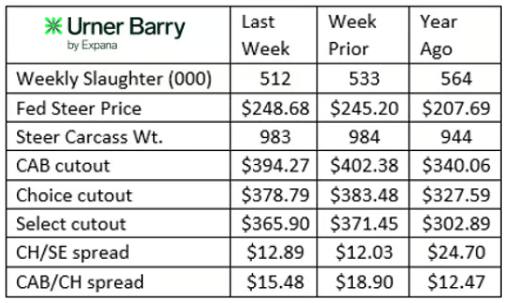
The resumption of processing at the JBS – Greeley, Colo., plant last Tuesday held promise for those looking for a larger national fed cattle harvest for the week. Reality set in by week’s end as packers collectively pulled the federally inspected total head count lower to 512K head, down 4%, with a fed cattle total of 414K head, down 3%. Packer margins have raced backward from decently positive to roughly $200/head negative in the past few weeks.
Spring holidays are lined up in the near future, with increased seasonal volume set to keep the supply chain on edge, as fulfilling large retail volumes requires larger headcounts. Beef demand appears to remain healthy, and a mid-April downturn in cutout values is not uncommon. Last year’s Choice cutout ran up 18% from April 15 through the end of June. Cutout values are 12-15% higher than a year ago.
PRIME CONTINUES TO CLIMB
The nation’s carcass marbling achievement has never been richer, as USDA data reports the latest record-high USDA Prime share at 15.55% of fed cattle. Year to date, the Prime grade has recorded weekly values of 14% or higher. With USDA Choice giving incremental ground to the growing Prime category, the two grades combine to chart a record 88.1% for the first quarter. In contrast, USDA Select carcasses comprised a new record-low 8% of fed carcasses during March.
Historic highs in marbling outcomes logically suggest that the Certified Angus Beefbrand would similarly capture record volumes of Angus-type carcasses, given the brand’s focus on quality and its Modest 00 (Premium Choice) or higher marbling requirement. The importance of marbling among the brand’s 10 carcass specifications can’t be overstated. Several million Angus-type carcasses (often more than 2 million annually) have been evaluated using detailed data since 2012, revealing that 82% to 95% of carcasses failing to meet brand requirements did so due to insufficient marbling. Consequently, the greatest opportunity for improvement or failure in CAB certification rates lies within the marbling specification.
However, in the midst of record-high nationwide marbling outcomes, the brand’s certification rate in March fell to 37% of eligible carcasses – less than impressive in contrast to 41.8% in March 2025. As confusing as this seems, current feedlot economics tell the rest of the story. Cheap corn, increased days on feed and temperate feeding weather combined to push average carcass weights to new heights in March. Twenty-pound leaps in year-over-year weight increases have been a hallmark of the past two years. But the trend since December has held weights to a higher plane than ever. This means that average steer carcasses in the 980+ lb. range yield a record proportion surpassing the brand’s 1,100 lb. upper limit. Our 2025 annual data review indicated that, of the eligible carcasses failing to meet brand standards, 14.5% of the cause was due to carcasses exceeding 1,100 lb., a significant increase from 8.6% in 2024. It’s a safe bet that this carcass weight fallout rate was higher than 14.5% in the first quarter this year, given that steer weights have not dropped below 981 lb., year to date.

Longer feedlot stays have also generated a steady increase in external carcass fat in recent years. This was highlighted by the 2025 uptick to 9.8% of certification failures in the dataset exceeding the maximum allowable 1-inch backfact thickness. Fallout from excess backfat was basically unchanged, in the 7-8% range, from 2022 to 2024, but will likely be reported higher again in 2026 if first-quarter finished weights are any indication.
In March 2025, the brand adjusted the upper limit for ribeye area from 16 to 17 sq. inches. The move aligned with the evolving cattle supply and resulted in cutting the brand’s fallout rate due to oversized ribeyes in half in the 2025 analysis.
Feedlot economics continue to reward heavier weights, urging cattle feeders to add days as they try to offset the high cost of feeder cattle with a favorable cost of gain. This has yielded unprecedented Prime carcass percentages in grid payment summaries, while simultaneously pressuring CAB carcass acceptance in the last two months. Despite these recent challenges, marbling remains the driver in the brand’s ability to add value to a greater proportion of Angus-type cattle.
Read More CAB Insider
Seasonal Carcass Impacts
An overriding theme across the past 18 months in the beef sector has been increased carcass weights. In general, fed steer and heifer carcasses averaging 25-30 lb. heavier year over year has been a net positive for the industry.
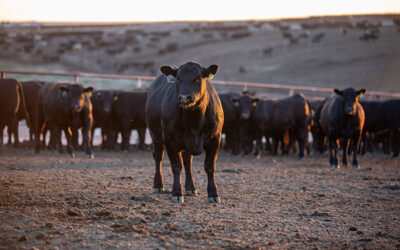
Margins Sqeeze, Markets Cool: What It Means for Fed Cattle
Focused marketing of a premium beef brand demands some attention to tracking price spreads across differing quality specifications. The USDA quality grade scale provides the domestic measuring stick by which the trade differentiates demand across the quality spectrum.
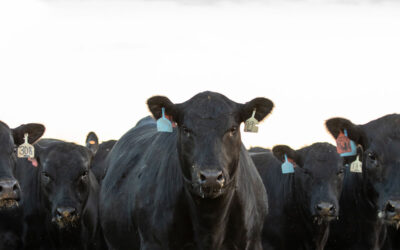
Rapid Decline in Select Carcasses
The steep upward price trajectory in the fed cattle market remains wholly supported on fed cattle remaining in tight supply and the tight grasp of cattle feeders keeping feedlot stays and carcass weights elevated. Weights continue to underpin beef production tonnage, cutting the harvest pace deficit for fed cattle.