
MARKET UPDATE
Fed cattle prices moderated slightly in last week’s trade with a $2/cwt. decline to average $246/cwt., just off the record high observed two weeks ago.
Last week’s 529K harvested total appears robust in a season when an erratic pattern of weekly head counts has bounced between 502K and 529K since mid-March. No doubt, worsening packer margins have been the overriding theme—intertwined with the temporary JBS – Greeley, Colo., plant shutdown— through this timeframe.
In reviewing total federally inspected harvest numbers, it’s important to factor in the normal seasonal decline in cull cow harvest during the spring. This year, the cull dairy cow harvest has declined from 60K head per week to 50K per week (-16%) from mid-February through early April. In the same period, cull beef cows have pulled back from 40K head to about 36K head (-10%) weekly. The confirmed year-to-date total cow harvest is down 4.6% compared to last year, whereas the fed steer and heifer total is down 8.8%.
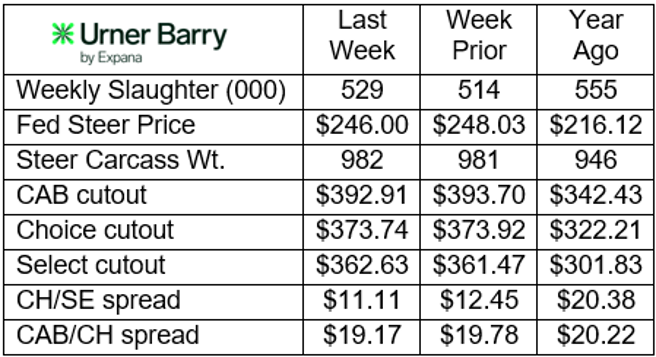
The month of April closes out with a bang as Live Cattle futures set new record-highs. With one day left on the contract, April Live Cattle traded at $256.35/cwt. by noon Wednesday. New highs will be recorded this week in the spot market as well, with Tuesday’s fed cattle business primarily conducted at $255/cwt., a $9/cwt. leap since Friday.
On the boxed beef side of the ledger, the market has recently eased lower in expected seasonal fashion from March through April. As the calendar turns to May, the smaller fed cattle harvest volume has turned a bit higher, driven on increasing end-user volume needs. Even so, market anticipation is that spot beef demand will get a boost from overall tighter supplies and continued consumer demand.
BEEF MONTH ANTICIPATION
May is “Beef Month,” and many in the supply chain are anxious to see what this important season has in store for cattle and beef values. So far in 2026, consumers have shown strong support for the most preferred protein in the market. Yet higher cutout values may test demand as higher gasoline prices and weakening consumer sentiment raise caution.
A look at wholesale prices indicates that demand for middle meat (ie: steak) remains seasonally mixed, with CAB ribeyes recently priced at $11.80/lb., 14% cheaper than a year ago and 7% cheaper than a month ago. A strong weakening in the rib price trend in April is not uncommon, as 3 of the last 5 years saw a similar downtrend, while 2021 and 2025 featured a rapidly increasing rib market. A conservative estimate suggests wholesale ribeyes could rise above $14.00/lb. by June, adding nearly $40 of value per carcass.
Tenderloin demand typically increases modestly ahead of Mother’s Day, with just a 14% increase from February seasonal lows to early May. This year has featured a 4.5% softening of wholesale CAB tenderloin prices for the season since early March.
Strip loins are the classic “in demand” steak cut for spring, with a 26% price increase dating back to January 1 through June over the past 5 years. This year’s price pattern is developing near expectations, with a recent 6% pullback from the March high. There is plenty of room for strip loin prices to increase 15% by late June.
Shifting focus to the lower-priced steak options shows strong recent demand for these cuts. CAB® top sirloin butts had a massive price run in the first quarter, with a 22% increase into mid-March. This uncharacteristic early demand has since corrected lower, but historic sirloin price patterns suggest a potential 15% wholesale increase by mid-June.

The loin complex is currently boosted by chart-topping ball tips, priced at an amazing 50% increase over a year ago and a stout 44% higher than early February. This popular item for Cinco de Mayo typically gets a small seasonal increase ahead of the early May holiday. This year’s unexpectedly high demand suggests broader use of the cheaper cut, even as the current $6.67/lb. wholesale average nears its record high of $6.90/lb. touched briefly during the pandemic shutdowns. Also from the loin primal, CAB® tri-tips are recently 31% pricier than a year ago, steadily higher within seasonal expectations. In keeping with other loin items, tri-tip prices are historically expected to increase by another 23% through June.
Briskets, flanks and plates combine to make up just 15.5% of total carcass weight. Unfortunate, given that these lighter primals are seeing some of the stoutest demand, marked by major price increases, of any beef cuts. The average price increase across the three is 38% over a year ago, while the total CAB® cutout price is just 15% over a year ago.
Carcass cutout values show a promising setup with plenty of room to run higher over the next 60 days. Underpinned by ground beef prices, grilling demand should pull not only ribeye and strip loin prices higher, but also a handful of value steak items, which will likely gain attention as consumers budget their beef buying. Anticipated spot market demand growth will be important to keep processing margins moving in the right direction as fed cattle costs mark new record-highs.
Read More CAB Insider
Seasonal Carcass Impacts
An overriding theme across the past 18 months in the beef sector has been increased carcass weights. In general, fed steer and heifer carcasses averaging 25-30 lb. heavier year over year has been a net positive for the industry.
Margins Sqeeze, Markets Cool: What It Means for Fed Cattle
Focused marketing of a premium beef brand demands some attention to tracking price spreads across differing quality specifications. The USDA quality grade scale provides the domestic measuring stick by which the trade differentiates demand across the quality spectrum.
Rapid Decline in Select Carcasses
The steep upward price trajectory in the fed cattle market remains wholly supported on fed cattle remaining in tight supply and the tight grasp of cattle feeders keeping feedlot stays and carcass weights elevated. Weights continue to underpin beef production tonnage, cutting the harvest pace deficit for fed cattle.