Price discovery in the premium era


by Miranda Reiman

Cattle just aren’t traded the same today as they were decades ago.

Chances are, the beef business isn’t going to reverse its ways, said Iowa cattleman Ed Greiman, during the Feeding Quality Forum in August.

“We know that we are never going back to 70% or 80% of the cattle negotiated on the cash market,” said Greiman. “Why? You are paying extra premiums for calves.”

Feeders trying to fill a yard with repeat suppliers, following special protocols or participating in verification program need a return on the investment. Cow-calf producers need to get extra for their calves if they’ve spent more on improved genetics and management compared to the average.

“We are trying to market the value of our cattle,” the feeder said. They are no longer all commodities.

The partner in Greiman Brothers farm near Garner, Iowa, drew on his work as chair of the National Cattlemen’s Beef Association (NCBA) cattle marketing committee to talk about price discovery with the feeders, allied industry and academia gathered in Omaha, Neb., and Garden City, Kan.

“Retailers or customers want something specific, and in doing that, we form these alliances and partnerships,” he said, “but we also change the dynamics of our market. I’m not saying that’s bad; it’s where the market is going.”

It does cause challenges in establishing base price.

USDA’s Mandatory Price Reporting came about in the late 1990s as a way to introduce more transparency in the market.

“When it first started, its purpose was to report to us what cattle were trading somewhere else. It was to give us an idea of what people were doing with their cattle in different regions,” Greiman said. “No one ever thought that we would end up pricing cattle off of it.”

But that’s where most grids and formulas draw their starting points.

“When you see the average price in Iowa on 1,000 head traded for $1.04, what does that mean? What were those cattle?” he asks. They could be overfat heiferettes or a group with above-average, uniform genetics. “None of us really knows what those cattle are because we can’t see them. We don’t have a picture of them and we weren’t there, so we don’t know what the conditions of those trades are about.

“Another concern I have,” he said, “is what happens when you get to where that last 25% of the cattle are actually below average?” That’s not generally the case yet according to the data, he added.

While Greiman used to enter into packer negotiations by asking about premiums, now he first asks, “What am I based off of?”

When fall 2015 brought an all-time low in the number of cattle traded live, down to 15% one week, this issue came to the forefront.

“I believe that was the week Texas was less than 500 head,” Greiman said. Price volatility was also high at that time, and packer margins have climbed since then. “There was this bright light shined on the cattle business two years ago.” Since then, elected officials, the Commodity Futures Trading Commission (CFTC), producers and industry stakeholders have been working together to come up with solutions, such as the Fed Cattle Exchange.

“We have a tendency to trade cattle once a week…on Fridays. We were doing a lot of Friday, 4-o’clock and 5-o’clock trades,” he said. The futures corrections come on Mondays. “You see a market kind of has a tendency to do what it wants to do during the week, because we weren’t telling it anything.”

Cattlemen need to drive changes, Greiman said, because grid marketing works, rewarding the better cattle with better prices, so it’s likely not going away.


A recent conversation with a retailer cemented his thoughts on that. “He’s saying this is what I want. He’s telling the feedlot what we want, and then the feedlot’s going to tell the cow-calf man. The cow-calf man’s going to go to the seedstock producer, and we’re pulling through.

“Well, if you’re going to build a program like that it’s kind of hard to put them on the open cash market,” Greiman said.

For more information on the meetings, co-sponsored by Roto-Mix, IMI Global, Micronutrients, Zoetix, Feed-Lot Magazine and Certified Angus Beef LLC, visit www.feedingqualityforum.com.

You may also like
Feeding Quality Forum Registration Open

Feeding Quality Forum Registration Open

As cattlemen continue to experience black swan events and rising input costs, so does their need for information on the latest production trends that pay. The 17th annual Feeding Quality Forum brings together people, insights and solutions to generate greater revenue for cattle feeders and cow-calf producers.
How to Face Evolving Demands

How to Face Evolving Demands

In the rapid changing space of sustainability, finding clarity on what to do is challenging. At the 2021 Feeding Quality Forum, Dr. Kim Stackhouse-Lawson offered insights on what can be expected of producers moving forward.
From insights to solutions

From insights to solutions

After the last 18 months, what we would pay for a crystal ball that could help us predict the future! They don’t have any magic prediction powers, but leading minds shared their outlook on key beef production areas at this year’s Feeding Quality Forum.
Ag prospects looking up

Slow but sure improvement in rural economy


by Miranda Reiman

It might not feel like a quick ascent, but agriculture will climb out of the slump affecting nearly all sectors in recent years.

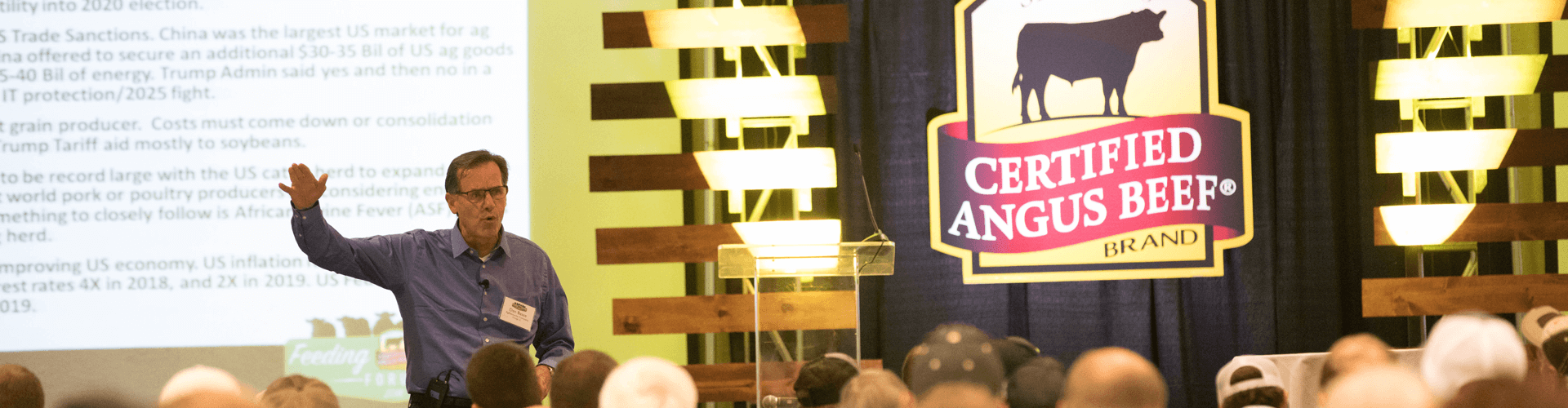
That ray of hope comes from AgResource Company. President Dan Basse spoke as part of the Feeding Quality Forum in Omaha, Neb., last month, while colleague Ben Buckner addressed the crowd in Garden City, Kan.

“Dairy is the only industry this year that will make more gross than the year before,” Basse said, noting it’s up $40 billion, compared to the beef sector, which will drop $7 or $8 billion.

“Our revenues have fallen in half—name me another industry where net revenues have declined by 50% in a period of five years. That’s our story,” he said.

Cyclical trends and export prospects provide a glimmer.

“The world economies are improving at a pace faster than the U.S., but it is improving,” Buckner said. A surprising boon? “The best that’s happened in the last six months or so is the political chaos in Washington, D.C.”

Cyclical trends and export prospects provide a glimmer.

“The world economies are improving at a pace faster than the U.S., but it is improving,” Buckner said. A surprising boon? “The best that’s happened in the last six months or so is the political chaos in Washington, D.C.”

Government instability has caused a decrease in the value of the U.S. dollar, a positive to agriculture since it relies heavily on exports, he said.

“That is putting pressure on producers overseas,” Basse said.

All commodities have a bit of good news in store.

“The United States will be a net exporter of crude oil by 2019,” Basse said. “This is a really big deal, the first time we’ve had a net export of energy going back to the 1940s.”

The ethanol industry is starting to ramp up production, adding about a billion gallons of capacity to meet export demand.

“It’s part of the reason I think you all in the cattle business need to be looking in the next few weeks of taking some feed-need coverage over the next nine months,” he said.

Both analysts said it’s unlikely corn markets will go more bearish coming into harvest. They suggested USDA’s corn yield estimate of 169.5 bushels per acre (bu./acre) is high, because the equation overestimates corn ear weight, given the dry conditions in much of the upper Midwest.

“We don’t think there’ll be a disaster; we just don’t think ear weight’s going to be this high,” Buckner said, noting a change from 169.5 bu/acre to 167 or 165 can cut 2.4 to 8 billion bushels off the total harvest.     

“It doesn’t get you exceedingly bullish on corn, but it does tell me that if corn makes it down to $3.45 to $3.35, I would definitely want to be a buyer down in that area,” Basse said.   

Longer-term, they expect a price increase. World stocks will decline over the next few years, but the U.S. will face increasing global competition as other countries make bigger improvements in yields.

“The U.S. farmer is the very best. It’s hard to really add yield nationwide when you’re yielding 168, 175 [bu/acre],” Buckner said. Countries like Ukraine could increase 30% and Brazil by 50%, while the U.S. might reach a 4% improvement.

Competition is still a factor in the beef sector, but it relies less heavily on global markets, they said.

“Quarterly domestic use is really good, and this is the demand pull that I see in the beef market,” Basse said. “The quarterly per-capita disappearance is now the largest it’s been since 2008.”

If trade with China really ramps up, Basse said, “I could get really bullish on the demand side of cattle sometime during the first quarter of next year.”

He doesn’t expect China to lift any requirements on U.S. beef.

“They like to have a lever on trade,” he said, but it probably also represents an over-arching trend in food production. “I think that’s the way agriculture is going, in terms of producing what the market is demanding. I don’t think that’s all bad because it gives consumers choice.”

But before that trade can bolster the market, the larger beef harvest numbers in recent months and earlier-than-usual placements due to drought will continue to pressure prices in the fourth quarter.

AgResource predicts a bottom of $100 to $104 per hundredweight (cwt.) for fed cattle prices.

“I do believe we’ll see good exports again going forward,” Basse said. “The price structure of cattle has done its job in terms of building the demand down the road.”

Other hurdles remain. Ag lending is down, and competing proteins continue to expand. Pork production will increase by 2% to 3% in 2018, Basse said:       “Look over your shoulder, because there’s going to be plenty of pork on the doorstep of the United States.”

Things are looking up, but it may take a few years to feel across-the-board recovery.

“The markets are an ocean freighter, slow to move,” Buckner said. “We’re starting to steer them in the right direction and perhaps we are through the trough of this bear.”

The meetings, co-sponsored by Zoetis, Roto-Mix, IMI Global, Micronutrients, Feed-Lot Magazine and Certified Angus Beef LLC, drew cattle feeders and allied industry from Nebraska, Kansas and several surrounding states.


You may also like

Feeding Quality Forum Registration Open

Feeding Quality Forum Registration Open

As cattlemen continue to experience black swan events and rising input costs, so does their need for information on the latest production trends that pay. The 17th annual Feeding Quality Forum brings together people, insights and solutions to generate greater revenue for cattle feeders and cow-calf producers.

How to Face Evolving Demands

How to Face Evolving Demands

In the rapid changing space of sustainability, finding clarity on what to do is challenging. At the 2021 Feeding Quality Forum, Dr. Kim Stackhouse-Lawson offered insights on what can be expected of producers moving forward.

From insights to solutions

From insights to solutions

After the last 18 months, what we would pay for a crystal ball that could help us predict the future! They don’t have any magic prediction powers, but leading minds shared their outlook on key beef production areas at this year’s Feeding Quality Forum.

Finding Profit


by Miranda Reiman

Opportunity. It’s there, but you may have to look a little harder for it.

That’s what this year’s Feeding Quality Forum attendees learned during the daylong meetings on Aug. 29 in Omaha, Neb., and repeated in Garden City, Kan., Aug. 31.

AgResource Company kicked off the forum with market predictions.

Its president, Dan Basse, told Omaha attendees, “Ag is not at its bottom yet, but I think the worst is over.”

In the next few months, the analyst predicted fed cattle prices will hit bottom at $100 to $104 per hundredweight (cwt.), but improve into the first quarter of 2018.

USDA’s corn yield prediction at 169.5 bushels per acre (bu./acre) is more optimistic than Basse’s estimate of 165 bu./acre. Feeders might want to lock in feed costs now before there’s an incentive for a price increase, he said, noting $3.45 to $3.35 as an opportunity.

“The strategy is to find grain now, extend coverage. Perhaps don’t sell your cattle just yet if we’re looking forward into 2018,” said Ben Buckner, the AgResource analyst who carried the company message to Garden City.

Being proactive was a theme, as Doug Stanton, vice president of Where Food Comes From, talked about value-added opportunities.

U.S. beef going into Chinese markets is a hot topic that the third-party verification provider—IMI Global is a subsidiary—has been fielding questions on lately.

Traceable source of origin is the first step, Stanton said, along with no implants or beta agonists. Ranchers and cattle feeders wanting to target that market were advised to compare notes with potential buyers in advance.

“If you want to get involved in China, you better be talking with your packer you’ll be marketing to and see what their requirements will be,” he said.

Sharing information usually works for the good of all.

That was the intention behind USDA’s Mandatory Price Reporting, first introduced in the late 1990s, said Iowa cattleman Ed Greiman. The feeder was drawing on his experience as chairman of the cattle marketing committee for the National Cattlemen’s Beef Association (NCBA).

istering those shots.

Today the 20% to 30% of cattle traded live and represented in the report sets the base price for the remaining 70% to 80% sold on grids and formulas. It’s not always an accurate reflection of all fed cattle offered for sale in a week’s time, Greiman said.

“When you see that information, you don’t know what was being bought or how that trade was made,” he noted. 

Yet, increasing the number of cash trades isn’t feasible when feeders have invested in premium calves and need to market them as such.

“CAB (the Certified Angus Beef ® brand) has done all this work to make sure the consumer wants the product, so we’ve got to produce more of them,” he said, suggesting cattlemen get involved in determining a new way to set base prices.

But long before marketing, feeders have decisions to make that will affect profitability.

It all starts with sourcing the right ones, said Justin Sexten, CAB’s director of supply development.

“There are cattle you want to own, and probably some you want to buy at a discount,” he said, noting all the variation in feeder calf supplies.

“There’s a lot of emphasis on flesh, precondition, where cattle come from—you name it—those each may account for $2 to $4 per hundredweight of the variation in cattle price,” he said.

But genetics make up a bigger difference in final profit.

“From a genetic perspective, there’s a $4 to $14 [/cwt.] difference out there from average genetics to exceptional,” he said, using an Angus example.

Once those cattle are in the feedyard, performance becomes a big driver of profitability.

Richard Zinn, University of California-Davis ruminant nutritionist, talked about how to increase that, predictably.

“The single most important factor affecting animal performance is energy intake,” he said. “And the link between intake and growth is perhaps the most reliable concept in cattle feeding.”

That allows for predicting accurate daily gains given gender, frame, weight and diet, Zinn said, adding these concepts are “nested in what we expect and how much results can vary before triggering alarm.”

During lunch, Lee Borck accepted the FQF Industry Achievement Award. With the help of Tyson and Performance Food Group, the meal featured Certified Angus Beef ® brand strip loin roast from cattle fed at one of Borck’s Beef Marketing Group partner yards.

More than 200 people attended the meetings, which were co-sponsored by Zoetis, Roto-Mix, IMI Global, Micronutrients, Feed-Lot Magazine and CAB

You may also like

Feeding Quality Forum Registration Open

Feeding Quality Forum Registration Open

As cattlemen continue to experience black swan events and rising input costs, so does their need for information on the latest production trends that pay. The 17th annual Feeding Quality Forum brings together people, insights and solutions to generate greater revenue for cattle feeders and cow-calf producers.

How to Face Evolving Demands

How to Face Evolving Demands

In the rapid changing space of sustainability, finding clarity on what to do is challenging. At the 2021 Feeding Quality Forum, Dr. Kim Stackhouse-Lawson offered insights on what can be expected of producers moving forward.

From insights to solutions

From insights to solutions

After the last 18 months, what we would pay for a crystal ball that could help us predict the future! They don’t have any magic prediction powers, but leading minds shared their outlook on key beef production areas at this year’s Feeding Quality Forum.
Borck honored for beef industry success


by Steve Suther

Lee Borck, Manhattan, Kan., has known hard times and boom, seen the impact on others as well as his own enterprises. That could describe a lot of cattle feeders, but Borck stands out for his record of leadership and overcoming adversity through cooperative efforts.

That’s why the Feeding Quality Forum honored this master of ag finance and “business by the numbers” with its 2017 Industry Achievement Award.

Borck gives credit to mentors and partners over the years, and willingness to fail sometimes to stay ahead of the curve and win most of the time.

Growing up on the family’s homestead near Blue Rapids, Kan., he was mentored by a father who farmed through the Great Depression.

“He was very conservative, but the best businessman I was ever around in my life. I learned a lot more from my dad than I did going to college, as much as I love K-State,” Borck says. He earned his degree in ag economics in 1970 and recently served on the boards for Kansas State University Foundation and Kansas Bioscience Authority. He’s also chairman and founding shareholder of American State Bank in Great Bend, Kan.

Cattle feeders know Borck as current chairman of both Innovative Livestock Services and The Beef Marketing Group Cooperative, but he’s also served as president of the Kansas Livestock Association and of CattleFax.

The road to indelible marks on the industry began with his first job, eight years as a loan officer with the Farm Credit System’s Production Credit Association (PCA) in Larned, Kan., before he started down the path of being a cattle feeder in that community.

“They were the folks that weren’t afraid to try new things,” he says. “They were taking more risk. They got more bumps, but they got more rewards at the same time.”

One thing he learned from looking over loans at PCA, however: “the mistakes people made in the way they looked at their business plan and not thinking far enough out in front.”

Borck bought into Ward Feedlot at Larned in 1978. Interest would soon climb to 18% as the young feeder built on lots of small deals and fought a 50-cent regional discount vs western Kansas. By 1988, he’d had more than enough of that and called several area feedlots with plans that became The Beef Marketing Group (BMG)Cooperative.

“We had a lot more packers then, but it was a game of numbers,” he says. “If you had the numbers, you could attract packers and get a better price.” Western feedlots were warning ranchers away from their eastern competition based on that discount.

“Well, you could either have capital or you could have cooperation,” Borck says. “We didn’t have any capital, but we decided to try to pool our cattle together. And it was the Capper-Volstead Act at its finest, negotiating price together without having restriction of trade from competitors.”

Excel, the Cargill forerunner, opened by paying “the cartel,” as detractors called it, 50 cents a hundred more than the western Kansas price on 50,000 Holsteins in 1988. The competition took notice.

“It wasn’t very popular,” Borck says. “That wasn’t the way that you were supposed to do business. I didn’t know that. You’re supposed to sell your own cattle. You aren’t supposed to sell someone else’s cattle. And it worked well for us.”

The cooperative organizer was fast becoming an industry leader, for which he credits the Kansas Livestock Association and the rise of information sharing.

BMG members used faxes to share packer bids in 1993, and also began a marketing relationship with IBP, now Tyson, that’s still in effect, getting past the controversies of captive supply and using others cash bids for a base.

“We traded cattle every day of the week or you would sit there and argue all week long over 25 cents a hundred,” Borck recalls. “And it just appeared that there was so much more benefit out of spending time figuring how to be a better cattle feeder and do what we did in a more efficient way.”

Part of the deal with IBP was the right to harvest data on all cattle. BMG’s first 500,000 carcass and closeout records formed the foundation of Vet Life’s Benchmark program, but BMG members keep learning from data today.

“Most everybody in the business at that time knew that if a steer gained 3 pounds a day and it converted 6.2, you were doing a pretty good job,” Borck says. “But nobody knew the difference between feeding an animal for 40 cents and 45 cents.”

Performance targets may update to nearly 4 pounds daily gain at 5.6 conversion, but Borck says feeders still wonder why pens vary from 75- to 80-cent cost of gain.

“Information has been a huge part of my career,” he notes. “I wasn’t really a feedyard manager but I knew how to massage numbers a little bit and figure out what they said”—with the help of partners and consultants.

“Anybody that tells you I did it my way and it didn’t take anybody else, they’re not being very truthful with you. My partners are, behind my family, the dearest thing I’ve got. And they deserve every bit as much credit as what I do for any successes.”

Borck will be recognized and comment at the 11th annual Feeding Quality Forums in La Vista-Omaha on August 29 and in Garden City, Kan., on August 31.

FQF sponsors are Zoetis, Roto-Mix, Micronutrients, IMI Global, Feedlot magazine and the Certified Angus Beef brand. For more information or to register, visit www.feedingqualityforum.com,  or contact Marilyn Conley by phone at 800-225-2333, or by email at mconley@certifiedangusbeef.com.


You may also like

Feeding Quality Forum Registration Open

Feeding Quality Forum Registration Open

As cattlemen continue to experience black swan events and rising input costs, so does their need for information on the latest production trends that pay. The 17th annual Feeding Quality Forum brings together people, insights and solutions to generate greater revenue for cattle feeders and cow-calf producers.

How to Face Evolving Demands

How to Face Evolving Demands

In the rapid changing space of sustainability, finding clarity on what to do is challenging. At the 2021 Feeding Quality Forum, Dr. Kim Stackhouse-Lawson offered insights on what can be expected of producers moving forward.

From insights to solutions

From insights to solutions

After the last 18 months, what we would pay for a crystal ball that could help us predict the future! They don’t have any magic prediction powers, but leading minds shared their outlook on key beef production areas at this year’s Feeding Quality Forum.

Finding flavor, incentivizing more

Scientists weigh in on “the next frontier” for beef quality research


Story and photos by Miranda Reiman

Life is not always heads or tails, black and white or pass-fail.

When it comes to beef, certain traits, like tenderness, are easier to quantify than others.

“Beef flavor is very complex. It’s not one attribute, but many, many flavor notes,” said Bridget Wasser, executive director of meat science for the National Cattlemen’s Beef Association (NCBA). “There are a lot of things that can go right and there are a lot of things that can potentially go wrong.”

Each consumer views it differently.

“We have to make sure we find a way to give it to everyone, all the time, and so consistency of the product comes into play,” Wasser said, during her Cattlemen’s College presentation earlier this month.

She told 2017 Cattle Industry Convention and NCBA Trade Show attendees the beef community has made marked improvements in tenderness over the past few decades, “so the good news is that it allows us to focus on some of these other eating attributes.”

Phil Bass, meat scientist for the Certified Angus Beef® (CAB ®) brand, was in the audience and agreed. Projects are starting to encompass some of these harder-to-measure traits.

“We’ve researched tenderness quite extensively and beef flavor is the next frontier, the next area that we really need to focus on,” he said later.

Lipids, carbohydrates and proteins that make up beef have the greatest influence on flavor. Lipids, or fats, are species-specific, differing in both amount and fatty acid composition. That’s why beef doesn’t taste like pork or poultry.

“We’ve always known that fat contains the specific flavor compounds; more of it will express more of those flavors,” Bass said. “The grain-finished, beef-fat flavor is highly desirable to the palate.”

Recent work validates the USDA quality grading system’s ability to predict eating satisfaction, along with the CAB brand’s 10 carcass specifications, Bass said.

“Marbling is something we hang our hat on as a beef industry,” Wasser said, because it gives the protein its “buttery, beef-fat” notes. “That’s a very positive flavor. It’s something consumers respond very positively to and that’s why it has a lot of credence in our quality grading system and the valuation of our beef carcasses.”

A Beef Checkoff project recently added more precision to sensory science, by developing a beef lexicon, or a dictionary of sorts for 38 attributes.

“How can you pick them out if you don’t know what an individual flavor note is?” Wasser asked.

Researchers train panels using this common terminology, and use participants as instruments in both discrimination and descriptive research.

Scientists get better results by either increasing the numbers in a sample size or limiting the variance, Bass said.

“When you have a trained sensory panel, you don’t need as many,” he said. “The better you can control the variation, panelist to panelist, the better you’ll be able to find the differences.”

Oftentimes, training for beef-fat flavor involves sampling a Prime strip steak versus a standard or very low Select option.

“It’s very important to have these folks calibrated,” Bass said.

Trained panels will detect flavors and note intensity, but larger consumer panels will determine its acceptability level.

“It’s not until you put it into the mouth of the consumer that you see, is this economically viable? Is this applicable to the end-user?” Bass said. “Time and time again, consumer research looking at beef marbling shows more marbling is better. It gives better flavor. It contributes to tenderness. It maintains juiciness.”

That’s why it’s getting the attention of the entire beef community.

“Consumers of your product have very high expectations,” Wasser told the cattlemen. “That gives us a common goal to work towards.”

You may also like

Amarillo or bust: Part two

Though educating center-of-the-plate specialists was the No. 1 goal during the International MBA class, we made sure they were well-fed, too. When I wasn’t snapping plate photos for Black Ink’s Facebook and Instagram accounts, I was taking my own to share. (While it felt a little braggy to send them to my husband who was back home eating leftovers and solo parenting in my absence, I knew he’d appreciate the beefy job perks.)

But we knew we were in for an especially big treat when we walked in to Trail Boss Ranch Cooking on Nov. 15. Danielle Matter, the event’s planner, and I arrived early to make sure everything was ready to go while the class finished up touring the packing plant. The first thing we noticed was a centerpiece created just for us by the trail boss himself: Two Certified Angus Beef brand briskets on ice.

“You can’t make good brisket without the Certified Angus Beef brand,” he said.

img_20161115_112046
After lunch, the trail boss told us, “You look at how moist that was, how flavorful it was — that’s because we use Certified Angus Beef!”

After the class finished their meal (for many, it was their first time to have brisket, a Texas staple), they loaded the bus again for the 100-mile drive to the Bradley 3 Ranch.

Though all of the participants had been excited to set foot on a working ranch (and the excitement only grew as the bus travelled down the final four miles of “caliche road,” the local term for gravel road), few were prepared for what they’d see.

“This place is as big as my country!” one participant exclaimed.

James Henderson, Bradley 3 Ranch, Memphis, Texas, shows his new chute to participants and explains how they work cattle.

After they got over the shock of being told to watch out for rattlesnakes by James Henderson, the class eagerly looked around the sale barn, a new high-tech chute, and a pen of bulls that will be offered in the operation’s February sale. They had many questions, and the majority said it was their favorite stop so far.

As the sun set, the class gathered around James, Mary Lou Bradley-Henderson and Minnie Lou Bradley for a photo op under the ranch gate. They asked about the cattle guard, those funny-looking birds (Sandhill cranes) and cattle rustlers before returning to the barn for a chuck wagon dinner.

Tomorrow they’d be 1,200 miles away in Wooster, Ohio. But, tonight, they had the ranch.

-Katrina

Katrina Huffstutler is a freelance writer based in Electra, Texas. She’s a frequent contributor to the Black Ink team and lover of functional cattle and quality beef.

P.S. Missed part one? Catch up here.


You may also like

All that really matters

All that really matters

He’s not a cattleman, but Kent Black may look familiar to those who are. Maybe you remember the owner of The Original Black’s Barbecue from our recent video “Quality Outside the Middle Meats,” in which he talked about the importance of really good brisket and being an early fan of the Certified Angus Beef® brand.

Trevor Dam, Angus Link and focus

Trevor Dam, Angus Link and focus

“Good cattle sell themselves,” says Nebraska cattleman Trevor Dam. He uses artificial insemination, breeds based on EPD parameters and is trying Angus Link to give him even more information on this year’s calf crop.

Beyond beef buzzwords

Beyond beef buzzwords

You don’t have to tell people who make their living from the land that treating it poorly is just bad business. Ranchers have been leading conservation efforts for generations. Yet, you’d have to have had your head in the sand to not hear something in the news about beef sustainability.

Loud and clear

Beef market demands quality


by Miranda Reiman

The beef market tells you what it wants. You just have to pay attention.

“We know there are signals out there in the marketplace for quality. As you move further away from the end product, we know those signals are…not quite as distinct,” said Mark McCully, Certified Angus Beef LLC (CAB) at the 2016 Angus Convention in Indianapolis in November.

The brand’s vice president of supply made sense of many of those economic indicators.

“We need to make sure we’re watching the long-term trends and don’t get too carried away with some of the short-term ‘noise,’ because the decisions we’re making in our breeding programs are really about the next two, three, five years,” he said.

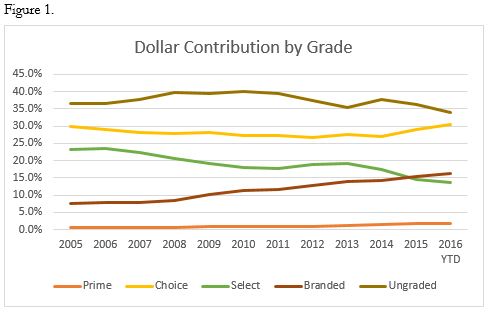
On a carcass-weight basis, there’s 37% more Prime beef today than just two years ago, compared to Select grade, which is down 21.7%.

“This year we actually see a higher percentage of dollar contribution is coming from branded product than Select,” McCully said, noting that branded beef accounts for 16.3% of total industry revenue (see Figure 1).

“Not all beef is created equal and not all beef brings the same price out in the marketplace,” he said.

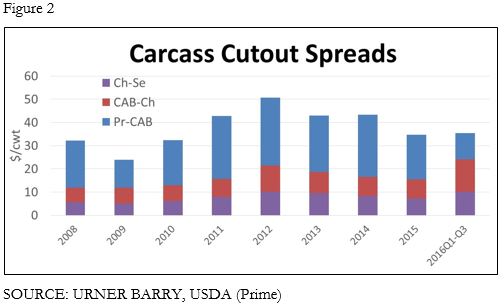
Through the third quarter of 2016, carcass cutout values showed a $35-per-hundredweight advantage for Prime over Select.

That reward potential may help explain why 78% of cattle today sell on alternative marketing agreements like value-based grids, compared to just 52% a decade ago.

The bar on such arrangements keeps moving higher. When 76% of fed cattle are grading Choice, beating plant averages is more difficult than it was in 1997 when barely more than half reached that level. Most grids only pay a Choice premium on that share of a load that exceeds the plant average.

“We get this question a lot: ‘Have we gotten them to grade high enough? We’ve selected for quality long enough – maybe we ought to go select for something else,’” McCully said. “If you want to continue to reap the premiums, or if your customers do, you’ve got to be better than the average. That’s how these systems work.”

Producers sometimes tell him they must give up pounds to get quality, but he showed that the average Certified Angus Beef ® (CAB®) brand qualifying carcass is 7 lb. heavier than the overall industry average.

“I dispel the myth that high-quality cattle aren’t also high-producing, high-performing, heavy cattle because, again, the data suggests you don’t give up weight for quality,” McCully said.

Showing a grid marketing example with cattle ranging from no Primes and 14% CAB to 15% Prime and 55% CAB. He decreased carcass weight 65 lb. from the poor group to the excellent.

“I know you don’t have to do this, but how much weight could you give up and still keep your dollars the same?”

With those high-grading cattle, the quality premiums would make up for dropping 65 lb. in carcass weight.

The Choice-Select spread runs on a seasonal pattern. There are times when those “excellent” cattle would be more advantageous than others, but McCully noted the long-term signal is clear.

“We hear from time to time when the Choice-Select spread gets to zero, or goes negative. The reality is, that doesn’t happen too often,” he said. That is less than 2% of the time, compared to more than 35% of the time that spread is $10 or above (see Figure 2).

Even while producing much less Select in 2016, packers continue to pay up for Choice.

“The discounts for yield grade (Y)4s and Y5s have narrowed over the last several years, which in-and-of-itself has been a quality signal,” he said.

The more cow-calf producers know and communicate about their cattle, the better position they are in to capture additional value.

“Nobody wants to pay more for cattle just because,” McCully said. “We’re starting to see more value around the data: the carcass history, the reputation, where these cattle came from, what the genetics have been, how they’ve been managed.”

He predicts that will continue to be more important with cow inventory numbers on the upswing.

“Feeder cattle supplies have been pretty tight. All of them have been worth a lot of money,” he said. “What’s going on right now? We’ve got more supplies out there; guess who gets to be a little pickier? The feeder.”

Producers who are investing in high-quality genetics need to do a better job marketing them, McCully said.

“If you’re going to take a set of premium calves and you’re going to run them down to the sale barn and not tell anybody anything about them, guess what? They’re going to probably bring the average price,” he said. “You take a premium product, market it as a commodity, you’re probably going to get a commodity price.”

You may also like

Connecting With Consumers at the Meat Case

Connecting With Consumers at the Meat Case

CAB is committed to prioritizing consumers’ evolving expectations for high-quality beef, sustainability and connecting the next generation. Explore our Ranch to Table program and learn how we connect the next generation of ranchers and culinarians for a brighter, more sustainable future for the beef industry.

Michigan Angus Family Earns Ambassador Award

Michigan Angus Family Earns Ambassador Award

Seldom Rest Farms in Michigan, known for show-ring success, receives the CAB 2023 Ambassador Award for sharing their beef production story with Meijer grocery communications team and other CAB partners. The Foster family shares their passion for Angus cattle while fostering connections within the beef supply chain and promoting the Angus breed and CAB’s role in the industry.

North Dakota Partnership Earns CAB Progressive Partner Award

North Dakota Partnership Earns CAB Progressive Partner Award

The Bruner and Wendel families earned the 2023 CAB Progressive Partner award by selling high-quality beef through Dakota Angus, LLC, as part of the CAB Ranch To Table program. They focus on their commitment to quality, data-driven decisions, achieve impressive CAB and Prime percentages and offer high-quality beef directly to consumers in their communities.

Amarillo or bust: Part one

Cattle buyers at the Amarillo Livestock Auction on Nov. 14 were in for a surprise when 25 international guests walked in and crowded along the back wall just after noon. The group was hard to miss — they talked excitedly, snapped sale ring selfies and took notes in leather padfolios.

Geof Bedner, CAB international director
Geof Bednar told attendees, “Restaurant customers progressively demand higher quality food and service than before” and explained the many advantages to the brand.

But as quickly as they entered, they were gone again, back on the bus and off to their next stop.

The group was in the Texas Panhandle for the first half of a unique Certified Angus Beef® (CAB) brand experience.  The International Masters of Brand Advantages program brought together center-of-the-plate specialists (that’s fancy talk for the folks who sell meat to foodservice and restaurants) representing 12 countries, and they began their quest to learn the pasture-to-plate story right there in the salebarn.

“This program is more than just teaching them about selling the Certified Angus Beef brand,” says Geof Bednar, our director of international. “If you look at our international partners, in many of these countries they are not self-sufficient at producing their own food. They’re very curious about where this food comes from, and they want to build trust in American beef production. That’s why we share the entire story of our industry.”

The first morning kicked off with some cattle industry 101 in a classroom setting, where they covered everything from basic genetics and management to marketing and lifecycle timelines. Then the participants boarded the bus to the auction market and followed by the feedyard.

jessica-lopresto-cab-jerrid-vincent-randall-county-mgr_e
Feedyard Manager Jerrid Vincent answered questions that ranged from how different feedstuff affect flavor to how often they ship cattle.

Most had never been to a feedyard, and certainly not one as large as Friona Industries’ Randall County Feedyard, a 90,000-head yard on the outskirts of Amarillo. They heard from Jay Cortese, cattle procurement manager, and Jerrid Vincent, feedyard manager, as the bus drove around the operation.

jorge-marcos-from-heb-mexico-takes-a-selfie
While all of the participants took selfies at the feedyard, Jorge Marcos’ was no doubt the most acrobatic. Marcos represents HEB Mexico.

They saw the feed mill (a busy place since the yard goes through 3.9 million pounds of feed every day), and several pens up-close. Many stood in line for a photo op with Jay or Jerrid, while others balanced on the edge of the bunks to get selfies with cattle in the background.

Though it was a lot to take in, there was one concept that immediately resonated with the class: The importance of occupancy. While cattle in the pens equals money for feeders, the same goes for guests at the table for the restaurateurs they sell to.

Join us again Friday to hear about the class’ trip to the Bradley 3 Ranch near Memphis, Texas.

-Katrina

Katrina Huffstutler is a freelance writer based in Electra, Texas. She’s a frequent contributor to the Black Ink team and lover of functional cattle and quality beef.

You may also like

All that really matters

All that really matters

He’s not a cattleman, but Kent Black may look familiar to those who are. Maybe you remember the owner of The Original Black’s Barbecue from our recent video “Quality Outside the Middle Meats,” in which he talked about the importance of really good brisket and being an early fan of the Certified Angus Beef® brand.

Trevor Dam, Angus Link and focus

Trevor Dam, Angus Link and focus

“Good cattle sell themselves,” says Nebraska cattleman Trevor Dam. He uses artificial insemination, breeds based on EPD parameters and is trying Angus Link to give him even more information on this year’s calf crop.

Beyond beef buzzwords

Beyond beef buzzwords

You don’t have to tell people who make their living from the land that treating it poorly is just bad business. Ranchers have been leading conservation efforts for generations. Yet, you’d have to have had your head in the sand to not hear something in the news about beef sustainability.

In the shoes of customers, buyers

Seedstock panel addresses ways to capture value of good genetics


by Miranda Reiman

Angus bull buyers paid record-high prices in 2015. The calves from those sires are going to market now, and breeders should be helping their customers get the most out of the investment

That was the message from three panelists at the 2016 Angus Convention in Indianapolis, Ind., Nov. 4-7.

“When I left college in ’77, I swore that some day we would get paid for our genetics,” said Mike Kasten, a commercial cattleman from Millersville, Mo. “I didn’t know it would be the mid-’90s before that actually happened.

Twelve years into his 42-year career, the producer started retaining ownership of his calves through the finishing phase, but the rewards weren’t immediate. As value-based marketing developed, the incentive for breeding and managing cattle for high-quality endpoints became more apparent.

“We still see $500 to $600 difference from the most profitable calf to the least profitable,” said Kasten, who currently runs the Quality Beef by the Numbers program. His goal is to keep learning about the top performers and the bottom end, and replicate the former. “We can create a lot more value and a lot more dollars on the same resources. It won’t cost us a penny more to do that.”

About the time Kasten was looking for a grid, Angus breeder Tim Schiefelbein was developing one as cattle buyer for Monfort Inc. (later Swift, and now JBS).

“They wanted a way to pay more for the good cattle and less for the worse cattle,” he said.

Growing up on his family’s Minnesota Angus operation, Schiefelbein recalled asking his dad why they were collecting carcass data: “Because,” he said, “one day we’re going to get paid for it.”

That original formula was introduced in 1996, just two years after he and brother Don Schiefelbein helped the family establish a customer buy-back program.

“There was no way back to the family farm unless you sold more bulls,” he said. The answer was expanding sales westward. “Try selling bulls out in western South Dakota from Minnesota, and that’s a challenge at 22 years of age,” he said.

Schiefelbein said his older brother had the idea: “What we need to do is help these customers at the thing they hate most.”

Marketing.

That “you buy, we bid” customer service program is still going strong in Kimball, Minn., where the family helps place about 25,000 cattle on feed each year, owning 20% of them.

“We give the data back to the producers,” Schiefelbein said. “We can make improvements, make changes, do all that good stuff and get paid more.”

Bridgewater, Iowa, breeder Dave Nichols has a model that looks a bit different. It goes back to his bank board experience during the 1980s Farm Crisis.

“Families that never missed a loan payment had to file for bankruptcy because they were under water. It was one of the really grim things I did in my lifetime and it left some really deep scars,” he said.

Nichols sold bulls primarily to customers with small herds, and it became apparent he had to do something to help them stay in business.

“I didn’t mind competition with anyone selling bulls, but I couldn’t sell bulls if people didn’t have cows,” Nichols said. “We decided that to keep our customers in business, we had to add value to their feeder calves.”

In 1991, the family held their first genetic source auction where weaned, vaccinated, Nichols-sired calves sold in a special sale.

Although a competing auction market advertised in an effort to shake would-be buyers’ confidence, the Nichols crew visited customers to be sure calves met the protocols and Nichols himself called on the top 50 feedyards in the United States.

“Those cattle brought $10.80 (per hundredweight) more than the market price at the time,” he said.

Having outgrown the one-sale model, Nichols now helps customers by promoting their calves at local auction markets of their choice.

Still, Nichols doesn’t agree with “experts” who advise his customers.

“If you don’t feed out your own calves, then don’t pay any attention to marbling. Don’t pay any attention to carcass, because you’re selling your calves at weaning and you’re not getting paid anything for it,” he’s heard often enough.

“That’s not true,” he countered. “I say to our bull buyers, ‘Everybody feeds them out, and somebody ends up eating them. By golly, everything is worth weight times the money, and so we breed our cattle as if we were going to retain ownership on them and end up eating them.’

“If any of you think you can make this work, and you aren’t selling bulls that will gain and grade and produce Certified Angus Beef, you’re going to be in for a big disappointment,” Nichols said.

The three cattlemen agreed on many points. Gain, grade and health are the three most important traits for a cattle feeder, they said, and the only way to learn more about the next segment is to live it, at least once.

“If you’re a purebred person and you have never feed cattle, you need to feed cattle,” Kasten said.

It’s important to gain a new perspective and to get more information, Nichols said.

“We’re in a position now that the people buying our calves know more about our cattle than we do,” he said. “The thing to do is to breed these cattle right and have them as healthy as you can.”

You may also like

Look Back and Learnings from the 2021 Cattle Market

Look Back and Learnings from the 2021 Cattle Market

Starting in March 2020, disarray set in motion a chain of events leading to the fed cattle backlog from plant closures slowing the supply chain throughout 2021. While the market likes to avoid the unkown, the last two years put the beef business in uncharted territory.

A Look Ahead at Early 2022 Dynamics

A Look Ahead at Early 2022 Dynamics

December has started off on a high note in the fed cattle sector and all of us on the cattle side of the supply chain should be made well aware of what’s ahead in 2022.

The idea that worked

The idea that worked

“So, if we make sure the humans can be prosperous and survive, that’s what sustainability is,” Mark Gardiner says. “That is the opportunity that USPB gave our family and thousands more all across the United States.” It’s why USPB earned the 2021 CAB Progressive Partner award.

Bending Curves, Breaking Stereotypes


by Miranda Reiman

Angus cattle need to do more than ever before. Carcass quality, functional females, feedlot performance—they all matter. 

That theme was evident at the Innovation Workshops during the National Angus Convention, Nov. 4 to 7, in Indianapolis, Ind. 

John Stika, president for the Certified Angus Beef ® (CAB®) brand, talked of reaching the billion-pound sales milestone in the recent fiscal year. 

“You won’t find a bigger fan of marbling than me, but the success of CAB is more than just marbling,” he said. 

It starts with a live, healthy calf and all the ranch-level money-makers, Stika said.  

He recalled a producer once telling him about a high-quality carcass: “It’s the most valuable thing we produce, but it’s the last thing we get paid for.” 

That’s why it’s important to be sure cattle are “doing it all,” Stika said, while challenging the crowd to further  

the breed’s current momentum.  
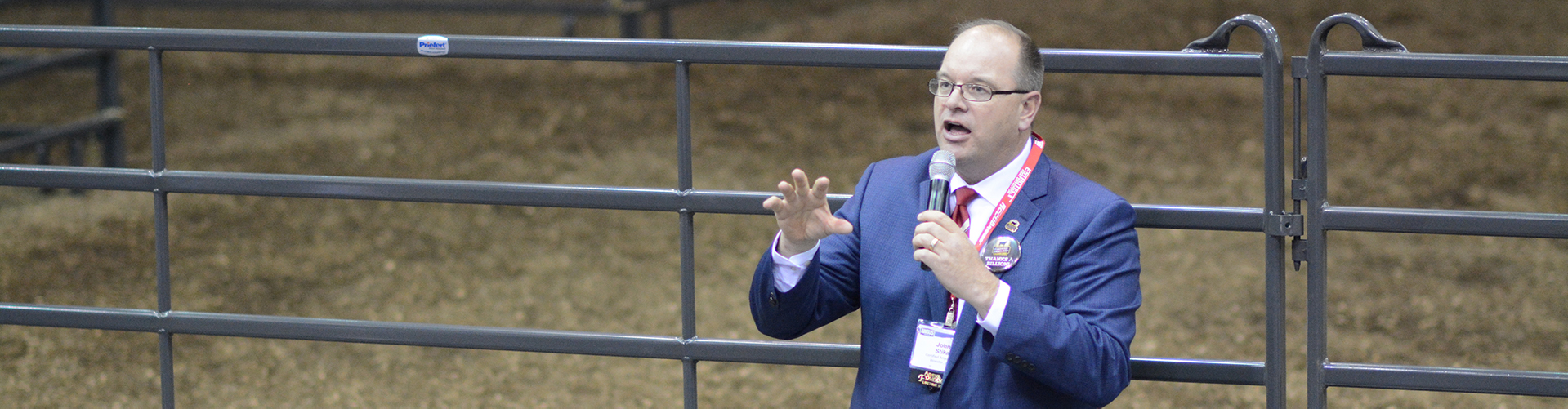
“We will not sell two billion pounds of Certified Angus Beef doing the exact same thing we did for the last 38 years,” he said. 

Employing all available technology is the logical path. 

“The genomics will just become part of what we do. It won’t be special anymore,” Stephen Miller, director of genetic research for the American Angus Association, predicted. 

In 2015, a quarter of all registered Angus cattle included DNA information. 

That data helps make expected progeny differences (EPDs) more accurate. 

Miller told the audiences how to use those measures to make progress while avoiding narrow selection. 

“The more traits we throw at the thing, the less progress you’re going to make in any one of them,” he said, noting that’s why indexes were created. 

The scientist suggested using economically weighted values, such as weaned calf value ($W) or beef value ($B), to rank animals. 

“Then we can look at different traits and structure and things like that,” he said. 

Trends show cattlemen are making progress, as the breed average for $B, carcass weights and marbling have trended up. At the same time, weaning weight has improved, while birthweight has decreased. 

“Curve benders” have become more common, said Dan Shike, University of Illinois animal scientist. 

“It used to be if you selected a calving-ease bull, you just had to accept that you were giving up other traits,” he said. 

Curve benders are typically considered those with “relatively low birthweight as compared to weaning weight,” Kent Andersen, director of genetic technical services for Zoetis, explained.   

He and Shike evaluated live animals and then revealed their genomic data, talking through how it might change breeding recommendations. 

“By testing, we front-load them with information so we can do a better job with mating,” Andersen said. It especially bolsters confidence on young sires. “We can jumpstart accuracy.” 

Adding the genomic data uncovered a “triple curve bender,” as Andersen called it, among the live animals on display.  

As O A Big Sky 305 came into the ring, the pair described his moderate birthweight. He was in the top 10% for weaning weight EPDs, yet had the genetics to produce moderate daughters.  

“We want rapid, efficient growth until a year of age, and then stop,” Shike said. “This breed has proven we can do that.” 

The bull’s carcass traits made him a “triple,” with well-above-average carcass weight and marbling. He was in the top 20% for $B.  

Attendees were able to use text-polling to interact with the presenters. When Andersen asked them to select their favorite bull on both visual appraisal and the numbers, 305 was the clear choice, with 88% picking him. 

Finding bulls to fit specific breeding goals can be as simple as using the “Sire Summary Search” on the Association’s website (www.Angus.org), Andersen said. Producers can enter minimums and maximums for all reported traits and narrow the report of prospective sires.  

“It’s a powerful tool,” he said. 

You may also like

They run deep

They run deep

The pastures at Dalebanks Angus near Eureka, Kan., hide the plants’ challenge well. Native big and little bluestem adapted over the ages to thrive in the shallow soil, only a few inches deep in places, that blankets the underlying limestone. Shards of flint mingle with the roots.

Never gone dry

Never gone dry

Two fishing cabins stood on the edge of the San Marcos river in 1919. Sixty years later Bodey Langford connected the two, as brick-by-brick, he built a home where he and Kathy would raise daughters Anna and Callie. There on his late father’s ranch near Lockhart, Texas, he also built his herd with purpose.

Flavor’s secret ingredient

Flavor’s secret ingredient

As a moderately to highly heritable trait, marbling is something that cattlemen have a lot of ability to manage. It also happens to be one of the major contributors to beef flavor. Texas Tech University meat scientist Jerrad Legako spoke about the topic at the 2020 American Society of Animal Science meetings.