Consumer trends, more than fads

By Hannah Johlman

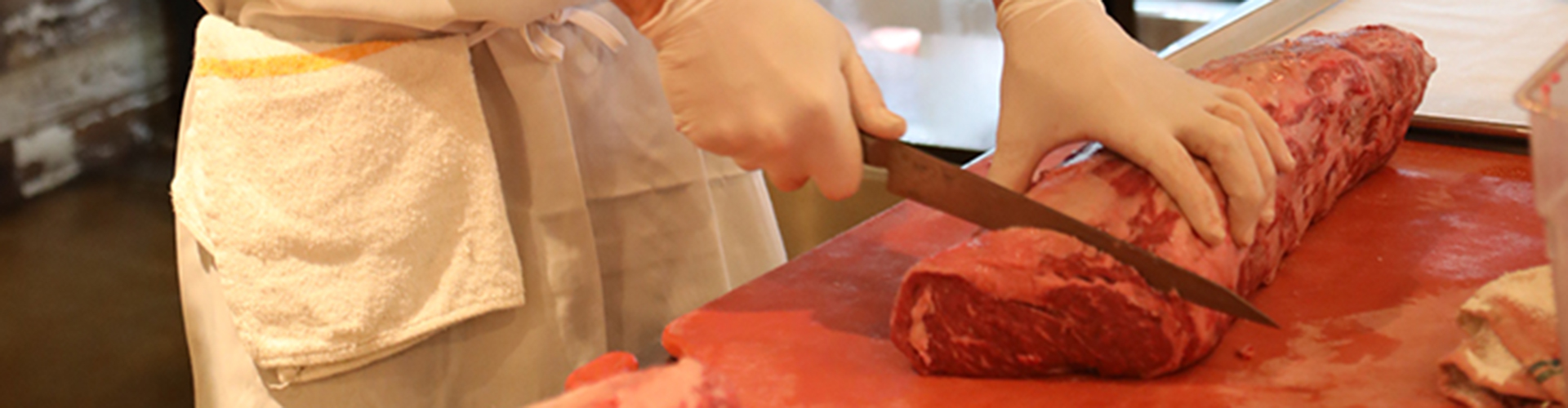
Trends in the food business affect people far beyond restaurant diners and retail shoppers. They reach back to the farm and ranch to shape the way food is produced, keeping consumer demand for high-quality, sustainable beef top of mind in the country.

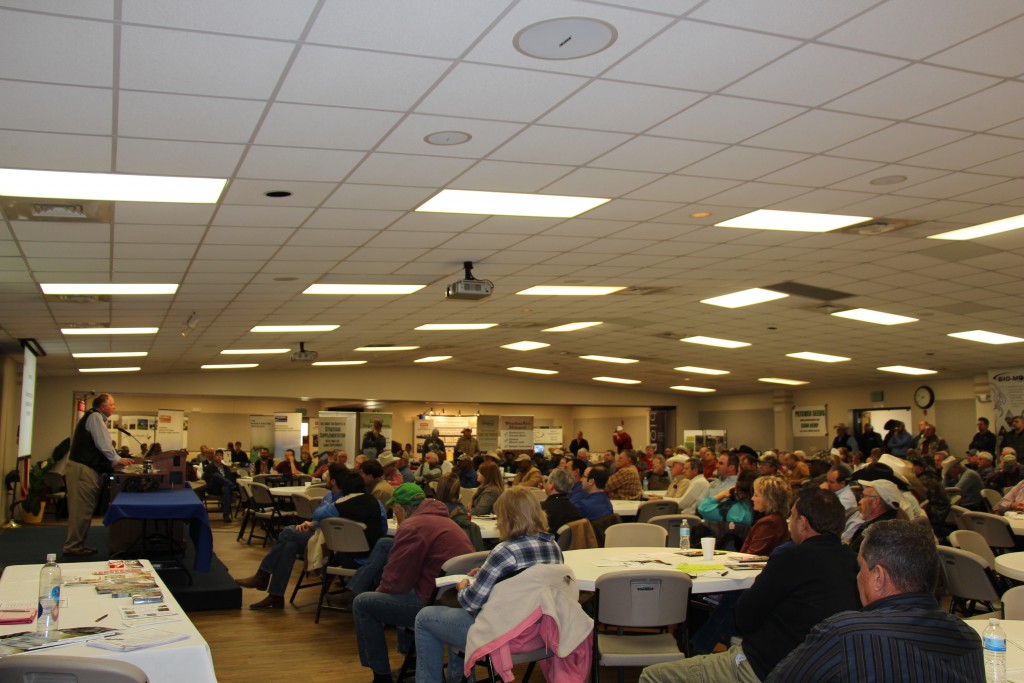
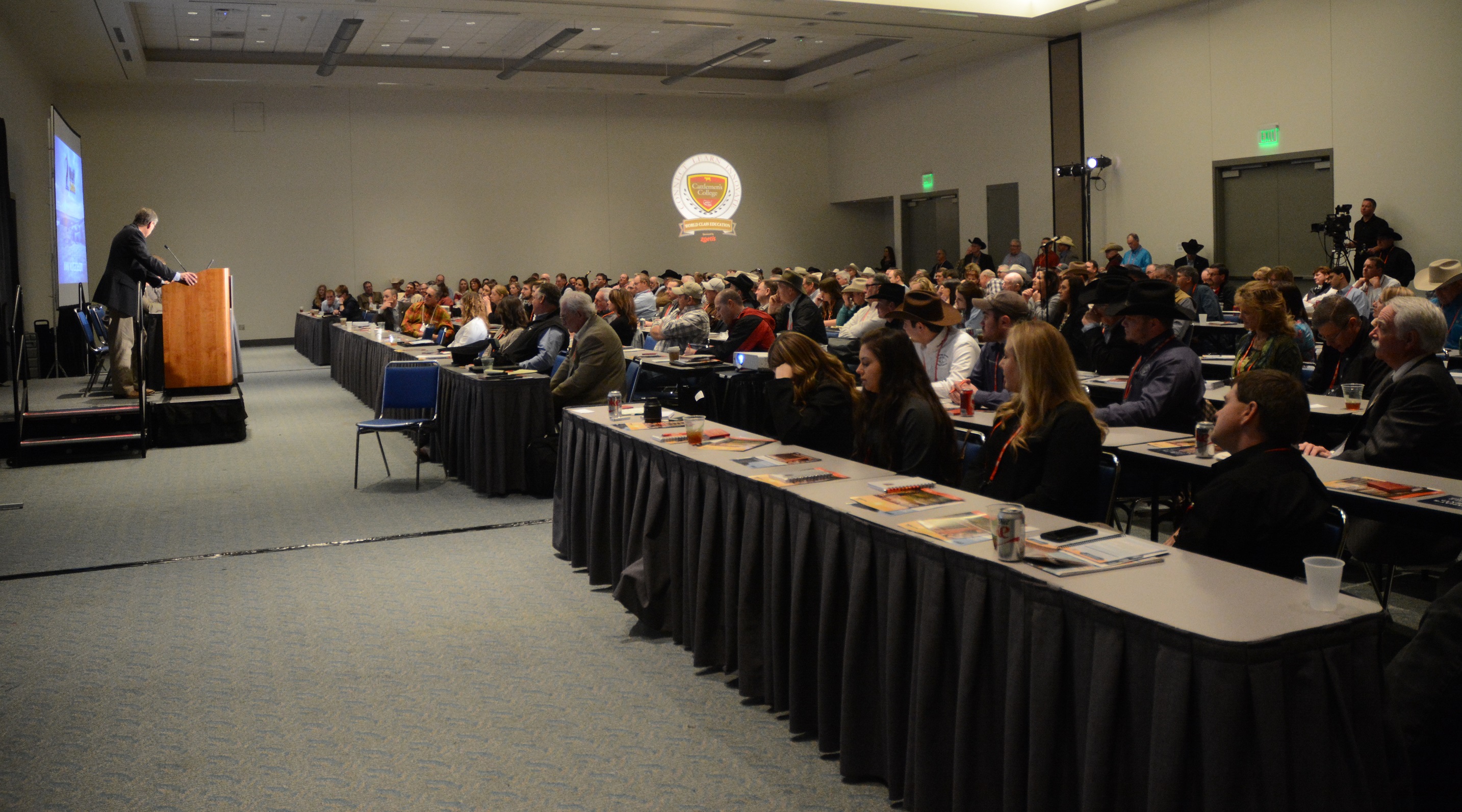
At the National Restaurant Association (NRA) trade show in Chicago this spring, exhibition halls were filled with chefs, culinary and other professionals, ranging from food to beverage, packaging to cookware.

Midan Marketing, which encompasses the food chain from gate to plate from offices in North Carolina and Chicago, shared five beef demand trends noted at the show:

  1. Trust and transparency are tops
  2. Local is trendy, but fuzzy
  3. The Story matters
  4. Premium is in
  5. Fat is back

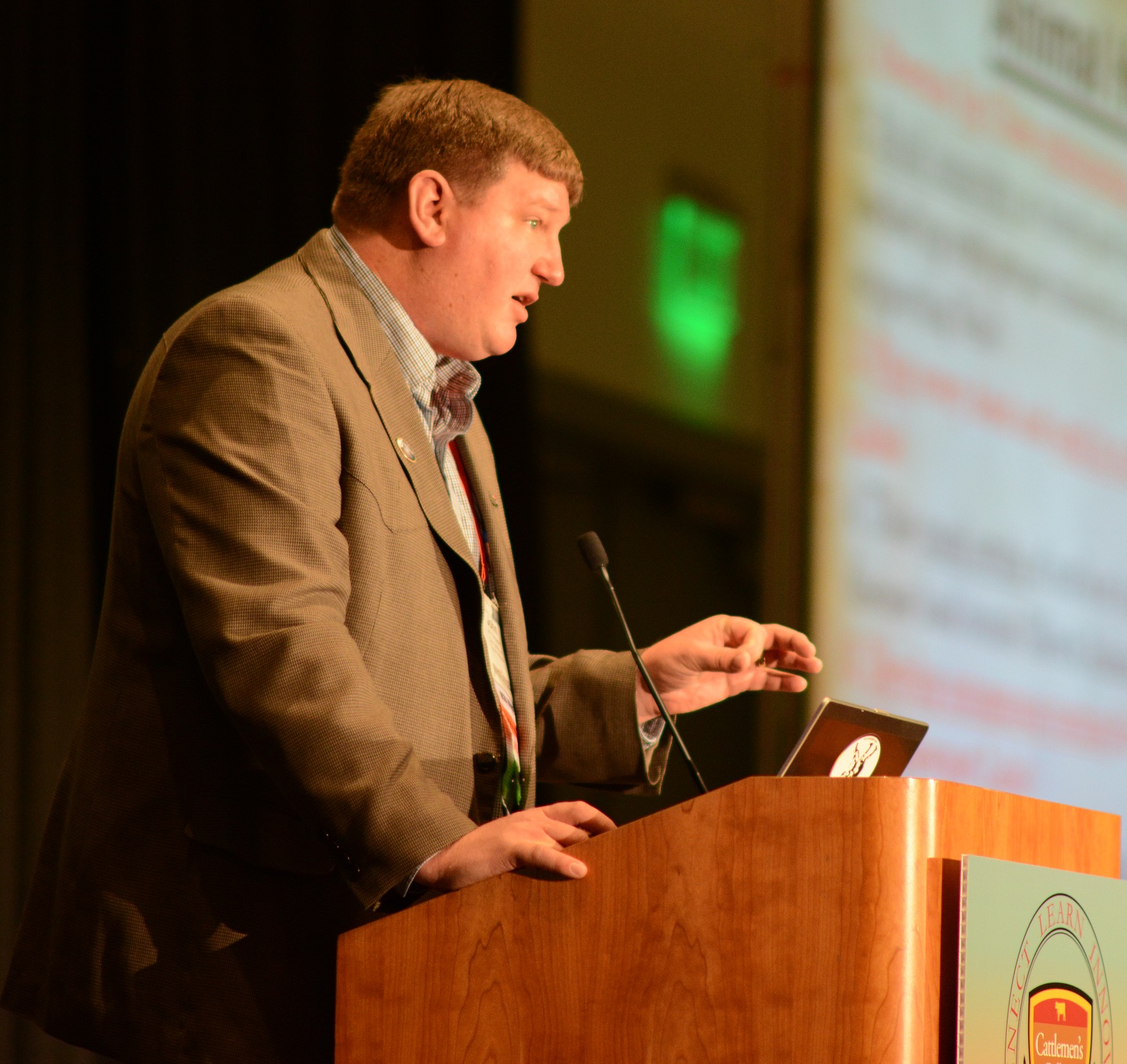
“There was a clear theme that attendees were seeking regional or local products, sustainable products and transparency between producer and consumers,” said Steve Hixon, account management director for Midan. Trends were identified from topics in common among exhibitors and presenters throughout the show, he explained.

Some of the biggest changes Hixon noticed were increased demand for added value – both in terms of processing and high-quality beef – and more desire for transparency from producers.

“Cattleman should really see that as an opportunity to do a better job of adding value to the cattle they’re producing by doing simple things,” said Mark McCully, vice president of production for Certified Angus Beef LLC (CAB). “Sometimes we look at these things as cattleman and maybe get a little overwhelmed at, ‘What does the consumer fully want to understand?’”
The answers are simple though, he said.

“There are some basic things that I think the market will start rewarding as it relates to source verification, some documentation of animal care, antibiotics, stewardship and those sorts of things,” McCully said.

Those components combine to create the producer’s “story.”

Hixon said producers at the show who stood out in telling their story demonstrated being “genuine and transparent. No smoke and mirrors but complete openness to the process and the distribution.”

“Small farmers should focus on their niche,” he said. “Don’t expect to consume the whole pie. Capture your piece and do it well.”

And they should not feel intimidated competing with larger producers, either. Using the power of social media to reach consumers gets your voice heard, Hixon said.

Combining clear channels of communication with a quality product leads to the top, McCully said, noting that has long been the recipe at CAB.

“It’s kind of the cornerstone of how this brand was built,” he says. “It is understanding that at the end of the day, the consumer still wants a consistently great eating experience and quality products.”

Most cattlemen know some basics of what consumers want, but as trends like the top five from the NRA show become more apparent, McCully said it’s time to think about how to fit those into management and marketing today.

You may also like
2022 Was as Predicted

2022 Was as Predicted

If there was a lesson in 2022, it was that the beef market is very sensitive to declines in quality grade, as evidenced through price signals. It’s the first time in recent history where we’ve gone backwards — albeit ever so slightly — and customers are telling us they have unfulfilled demand. That’s reflected in the premiums paid, and that’s saying something after two years of extremely high premiums.
Growing Marketability

Growing Marketability

Advertised as the “Best Angus Beef” and “If it’s not Certified, it’s not the Best,” Certified Angus Beef’s reputation claims elite category status. To remain in that position, the brand must continue to deliver on that promise as customer expectations of quality evolve.
A Drop of Hope, A Heap of Hard Work

A Drop of Hope, A Heap of Hard Work

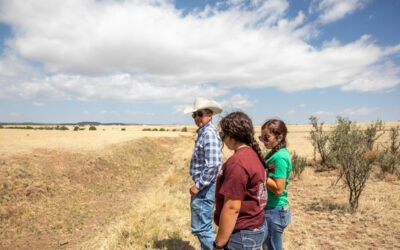
For Manny and Corina Encinias’ family of nine, sustainability runs deep. They are stewards of a legacy, working the land dating back to 1777, when the first generation began herding sheep in the nearby Moriarty community. Today they focus on cows well suited to the harsh New Mexico desert, fostering community strength and creating opportunities for others to follow in their footsteps.
Consumer trends headline beef conference


by Miranda Reiman

“The prosperity of this entire industry lies with the consumer.”

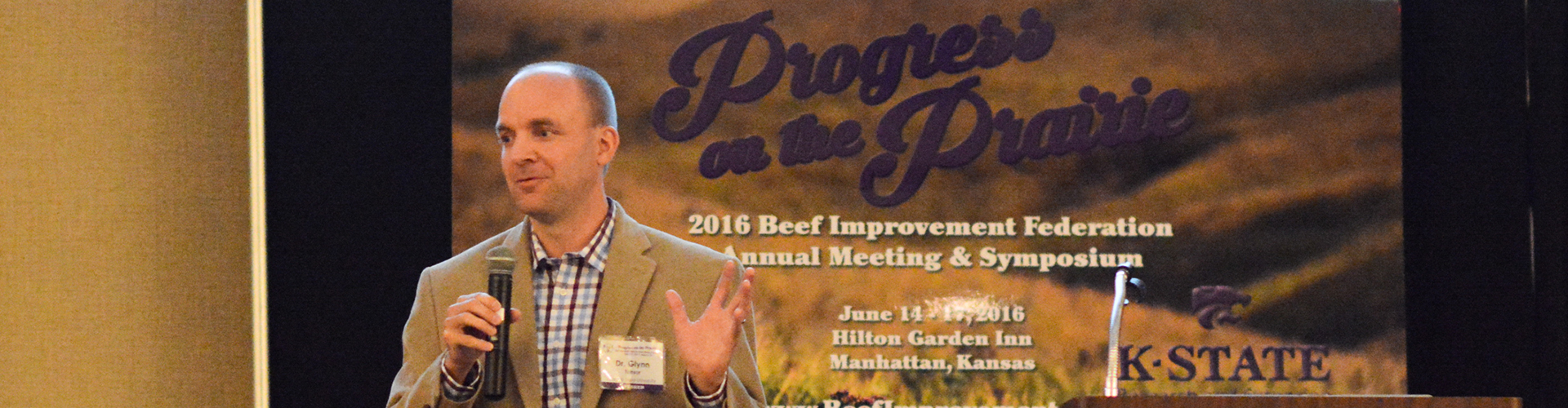
Ag economist Ted Schroeder made that statement during the recent Beef Improvement Federation meetings in Manhattan, Kan., June 15-17, but it summed up the theme of the opening session.

Schroeder and fellow Kansas State University ag economist Glynn Tonsor kicked off the conference, talking about beef demand in the next two decades.

Tonsor pointed out four competitive advantages the U.S. and Canada have over trading partners:

  • Trust that the product is safe and correctly identified
  • A grain-finishing system that supports high-quality production
  • Solid infrastructure, including transportation and research expertise
  • Property rights and business practices that encourage investment

“We are not a low-cost producer,” Tonsor said, and we have fierce competition. Countries like Australia and Brazil are “not standing still waiting for us to get our act together,” he continued, suggesting that market opportunities will “pass us by if we don’t improve on communication, coordination, signaling.”

Not only will the demographics of our domestic consumers change in the next few decades, to include more Hispanics and other backgrounds, but beef’s core customer base will increasingly rely more on exports.

“Global is where our major growth potential rests,” Schroeder said. It’s more important than ever to focus on trade negotiations and overcoming trade barriers.

“The goal is to create value for everyone,” said John Stika, president of Certified Angus Beef LLC, He addressed the crowd on “The Consumer-driven Food Business.”

That’s the only way beef-eaters will buy more at a higher price. Something they’ve proven they will do if the perceived value, in the “price-value relationship,” is solid. Stika shared Certified Angus Beef ® (CAB®) brand demand as a case study. It’s increased 98.1% since 2009, at the same time USDA Choice demand decreased.

The price side of the equation was steep when compared to other proteins, but “taste-driven consumers” still chose beef, he said.

“During the worst economy and a tighter cowherd, premium products continued to grow,” Stika said.

In 2015, beef prices were 57% higher than pork and 207% higher than chicken (see chart).

“If we expect consumers to buy our product, we have to up our game,” he said. That includes continuing to engage consumers, not just with a good story, but by verifying that story.

Brad Morgan, Performance Food Group, said building relationships is key for his company.

“Our customers really and truly want to know, ‘Do you have our back?’” he said.

Among the most powerful groups to have an impact on beef are moms, millennials, and meat lovers.

Moms control $20 trillion in buying power while meat lovers understand beef and are squarely focused on quality, Morgan said.

“They will open their wallets to pay for the best,” his slide noted.

“Millennials, whether you appreciate them or not, they like beef. They just want to know more about it,” Morgan said.

In addition to a story, the product must live up to it, and Keith Belk, Colorado State University meat scientist, talked about traits cattlemen should focus on to be sure it does.

His presentation noted tenderness as the most important measure in eating satisfaction, but “several studies have shown that when tenderness reaches an acceptable level, flavor becomes the most important driver.”

The No. 1 thing producers have done in response to the call for improved quality is “turn the cattle black,” Belk said, asking the beef community to do even more

He suggested looking into the microbiome, or the animal and the bacteria that naturally live on it, to develop future tools.

“We need to learn to take advantage and capitalize on that,” Belk said.

Beef quality has improved, and we are “in the most consumer-centric times we’ve seen,” Stika said. It comes down to this advice he shared: “We need to change our perspective from, ‘I’m in the cow business,’ to ‘I’m in the food business.’”

You may also like

2022 Was as Predicted

2022 Was as Predicted

If there was a lesson in 2022, it was that the beef market is very sensitive to declines in quality grade, as evidenced through price signals. It’s the first time in recent history where we’ve gone backwards — albeit ever so slightly — and customers are telling us they have unfulfilled demand. That’s reflected in the premiums paid, and that’s saying something after two years of extremely high premiums.

Growing Marketability

Growing Marketability

Advertised as the “Best Angus Beef” and “If it’s not Certified, it’s not the Best,” Certified Angus Beef’s reputation claims elite category status. To remain in that position, the brand must continue to deliver on that promise as customer expectations of quality evolve.

A Drop of Hope, A Heap of Hard Work

A Drop of Hope, A Heap of Hard Work

For Manny and Corina Encinias’ family of nine, sustainability runs deep. They are stewards of a legacy, working the land dating back to 1777, when the first generation began herding sheep in the nearby Moriarty community. Today they focus on cows well suited to the harsh New Mexico desert, fostering community strength and creating opportunities for others to follow in their footsteps.

new calf

Less about touring, more about trusting

2016_04_19_mr_Chef Tour-94
When a tour bus full of curious chefs pulls into a Nebraska pasture, you know good things are happening.

“I just wish they’d trust me.”

It seemed ironic. We were enjoying a chuck wagon supper on the Lienemann family farm near Princeton, Neb., when Chef David Kocab told me that. Just prior, we’d taken a pasture tour and talked about everything from EPDs and AI to what the cows eat all winter.

The whole Nebraska-based trip was designed to give the 50 or so chefs in attendance confidence in the beef they serve their customers, to show them the commitment and intentionality at every stop from seedstock supplier through harvest.

We’ve hosted Certified Angus Beef ® (CAB®) brand Chef Tour for six years and taken somewhere around 350 professional foodies on many journeys from Texas and Colorado to Kansas and Nebraska, all in the name of building trust.

More than anything, David wants the customers coming to Trentina, his high-end 35-seat, Italian restaurant in Cleveland, to place a little more confidence in him, too.

I heard, “I just wish they’d trust me,” and I immediately thought of Anne Burkholder and the feedyard video we recently shared. The chef’s statement was almost a carbon copy to one of her heartfelt ending lines: “I would really like people to trust me, and I know that’s hard to do because you don’t know me.”

2016_04_19_mr_Chef Tour-21
Trevor and Torri Lienemann opened up their farm to the group. At the end of the evening, Trevor told the chefs, “I just wish you could stay longer.” You could tell he meant it.

Conversation by conversation, that’s changing. There’s no way you could listen to the Lienemanns and not get lit on fire by their enthusiasm for the beef community.

The chefs sensed that, too.

“I have to go home and think of more things to do with Certified Angus Beef, more ways to use it,” David told me.

2016_04_19_mr_Chef Tour-41
Paul gave basics on beef production, while the Lienemann family shared more about their farm.

And this is coming from a guy who renders the trim fat to make a beef candle that burns on the table, until the waiter lets you in on the secret: you can dip your bread in it! They are creative beef users.

“Utilization is big for us,” he says.

“Italian food is based on making something out of nothing,” David says half-joking about flour and water as the base. But the “waste not, want not” culture is alive and well.

Now he knows cattle fit that, too.

“They are the biggest solar converters, taking grass and making it into quality beef products,” he says.

David saw where you come from. He trusts you.

2016_04_19_mr_Chef Tour-165
Our own Chef Michael cooked steak and all the fixings alongside Chef Kent Rollins, famous for his chuck wagon eats.

“They have spent all this time raising it to the perfect state,” David says. “Now it’s almost on us as stewards to give customers something with the same flavor profile, but an entirely different delivery.”

“The Cleveland dining scene has come a long way, and our diners are much more open-minded today,” David says of Trentina customers. He sincerely hopes he’s earned their good faith, and yours, too.

“Just trust us. Don’t be afraid of the food,” David says.

If you order a tasting menu, taste everything. And please, pretty please, don’t ask for the sauce on the side.2016_04_19_mr_Chef Tour-118

May your bottom line be filled with black ink,

Miranda

You may also like

2022 Was as Predicted

2022 Was as Predicted

If there was a lesson in 2022, it was that the beef market is very sensitive to declines in quality grade, as evidenced through price signals. It’s the first time in recent history where we’ve gone backwards — albeit ever so slightly — and customers are telling us they have unfulfilled demand. That’s reflected in the premiums paid, and that’s saying something after two years of extremely high premiums.

Growing Marketability

Growing Marketability

Advertised as the “Best Angus Beef” and “If it’s not Certified, it’s not the Best,” Certified Angus Beef’s reputation claims elite category status. To remain in that position, the brand must continue to deliver on that promise as customer expectations of quality evolve.

A Drop of Hope, A Heap of Hard Work

A Drop of Hope, A Heap of Hard Work

For Manny and Corina Encinias’ family of nine, sustainability runs deep. They are stewards of a legacy, working the land dating back to 1777, when the first generation began herding sheep in the nearby Moriarty community. Today they focus on cows well suited to the harsh New Mexico desert, fostering community strength and creating opportunities for others to follow in their footsteps.

Beef must differentiate

Keeping up with the times includes marketing


by Miranda Reiman

A lot can change in half a century. A lot can stay the same.

U.S. feeder cattle illustrate that well, said Mark McCully, vice president of supply for the Certified Angus Beef ® (CAB®) brand, at the Indiana Beef Cattlemen’s Association annual meeting last month.

“Think of how we are selecting genetics today—the tools and amount of information we have available—versus 50 years ago,” he said. “In many cases, herd bulls are selected with far more precision, and yet we still tend to lump their offspring together with others. We use ‘the eyeball test’ and sell them as a commodity.”

Programs that detail health history have been around for a while, but those are just part of what’s possible in classifying differences, McCully said. One relatively new opportunity is genetic documentation.

“We’ve probably suppressed some value discovery in the feeder calf market over the last few years just because the cow-calf producer has had the leverage,” he said, “but now that’s changing.”

The comments were part of a talk on “value-added cattle,” which McCully noted everyone in the beef chain defines differently. To some, it means trying to “upgrade” inferior cattle. Others might interpret it as a special feeder-calf program or coordinating genetics and management to aim for a premium target. Consumers tend to rely on brands, he said.

Using a live, text-to-respond tool, he asked the audience, “What’s the most important trait for a value-added feeder calf?”

Nearly half, 47%, said “source verification,” while another 37% said “health documentation, and the remaining 16% selected “genetic verification.” No one chose “humane care” or “age verification.”

As fed cattle are marketed, however, the real value drivers are in performance and carcass merit, McCully said. Marketing has shifted from a 50-50 split on formula versus cash in 2005, to nearly four out of five fed cattle sold on grid or formula pricing today.

During that same time, the number of USDA-certified branded programs grew from 53 to 197.

“The mix has really changed over the last 10 years,” he said.

Reviewing the USDA-reported average load counts by grade, the number of branded boxes versus Select boxes flip-flopped.

“This was the first time the beef industry sold, on average every week, more boxes of branded beef than Select—almost three times more than Select,” McCully said, noting that in 2005 that ratio was 3:1 Select to branded.

That indicates the market signals are working, he said.

February wholesale cutout prices for a 900-pound (lb.) carcass showed nearly $200 difference between a Select carcass and one that had qualified for CAB, for example.

McCully asked, “What is the No. 1 reason consumers purchase beef?”

Almost three-quarters of the respondents replied, “unique and desirable flavor.” Their answer lined up with decades of end-user studies, many of which show that eating experience improves linearly with quality grade.

The group collectively looked into the future to predict which trait would increase the most in value.

Marbling/quality-grade premiums came in first at 40%, followed by naturally-raised/organic (23%), genetic documentation (20%) and humane handling documentation at 17%.

“There is no ‘right’ answer,” McCully said, but the informal poll should make producers think about what creates value now, and what will in the feature.

A lot can change. A lot can stay the same.

You may also like

Beef must differentiate

Beef must differentiate

A lot can change in half a century. A lot can stay the same. U.S. feeder cattle illustrate that well, said Mark McCully, vice president of supply for the Certified Angus Beef ® (CAB®) brand, at the Indiana Beef Cattlemen’s Association annual meeting last month.

Precondition for performance, quality, cash

Precondition for performance, quality, cash

It’s been talked about for 60 years. It’s better for animals, preferred by most cattle feeders and could provide a 169% return on investment. “2014 was the biggest ‘no brainer’ year in history to precondition your calves,” says Purdue University veterinarian W. Mark Hilton. “2015 could be even better.” Crunching the numbers, Hilton first turns to an 11-year analysis of Indiana beef herds that showed weight alone added $50.84 average profit on preconditioned calves.

olson barn

To return, or not to return – that is the question

Ok, it’s likely not as dramatic as the Shakespearean language makes it sound, but as a young person trying to get their footing, the road back to the cattle business is anything but a straight one.

I went to college with a mix. There were those who were without a doubt returning home to the position waiting for them, those who wanted to but no room was available, and finally, those whose family wished their son or daughter would return but their child had other ideas.

Oh, and then there were those who set out with a plan and realized plans can change. A lot.

If only I had an acre for every time I was asked, “So, Laura, what are you going to do? You going to go back or what?” Never one to take the normal route, I found a way to do a little of both; but that’s another story for another time.

IMG_2740To return, or not to return… Farming and ranching aside, it’s a question any person who comes from any sort of family business must face, and popular enough to be the focal point of a session at this year’s Cattle Industry Convention in San Diego. Thankfully there’s a saving grace in the fact that others have gone before us and are willing to share their dos and don’ts.

Dan McCarty, a fourth-generation Colorado cattleman and NCBA’s director of industry and affiliate outreach, was on hand to talk about his decision-making process and what eventually led he and his wife to venture out on their own.

Dan McCarty_1_LC“It sure makes family dinners a lot more fun,” he joked, sharing that “it” steered conversations away from business.

Dan’s story is unique, as is mine and I’m betting yours as well.  But that doesn’t mean there aren’t common threads that tie us all together in this adventure.

Here’s what Dan had to say:

  • Set goals: “Keep a picture in your head of what you would do in a perfect world, and then dial it back a little to be realistic.”
  • Take risks: “Take risks, but only those you can survive. Take calculated risks, because if you do fall down, you better get up right away.”
  • Find your niche: “I wanted to have 1,000 cows by now, and we aren’t there. But we’ve found our niche and can build on that for our future.”
  • Get involved: “Relationships are important. Find the right people to surround yourself with and bounce ideas off of when making decisions.”
  • Know business: In or out of school, study because “marketing, business and finance will never go out of style and are essential to any line of work.”
  • Challenge yourself: “Don’t just find opportunities; find the opportunities that challenge you and make you ask, ‘why?’ That’s when personal growth happens.”

Thanks for allowing me to tell your story,

Laura

To read more on this session, or many others form convention, visit the newsroom at www.4Cattlemen.com.

You may also like

BIG, BAM boost beef demand

BIG, BAM boost beef demand

A dry, flavorless and thinly cut steak can be enough to sour anyone’s taste for beef. “There is no doubt that cattle are getting bigger, and that will continue,” says Terry Houser, Kansas State University meat scientist. “I don’t think we are going to produce smaller rib-eyed cattle anytime soon or start selecting cattle for that trait.” Still, demand for beef looks bright, thanks to new cutting methods developed to tackle the issue of increasing carcass size and its effect on the eating experience.

A supply chain approach to beef quality

A supply chain approach to beef quality

Managing for beef quality isn’t an arbitrary end-product objective, panelists pointed out at a Cattlemen’s College® session. According to moderator Larry Corah, vice president of Certified Angus Beef LLC (CAB), it also means managing for more profit. “Managing for Quality: A supply chain approach” was presented at the National Cattle Industry Convention and Trade Show’s annual educational event Feb. 2 in Denver, Colo.

Today’s beef consumer

Today’s beef consumer

An industry that aims to be consumer driven must first identify its drivers. That’s why “Defining Consumers – Emerging Expectations” was part of the Pfizer-sponsored Cattlemen’s College at the winter National Cattlemen’s Beef Association (NCBA) meeting in Phoenix, Ariz.

john grimes

Listen and learn

I’ve often wondered if listening is more a trained rather than innate skill. The reason being, I dare say it’s difficult to find good listeners these days.

From the hectic schedules we keep and the smartphones we carry, to actually digest the information, to look someone square in the eyes, at times it can feel a bit archaic.

But as the youngest of my team’s members, I make it a point to listen. It’s a given that outside there are lessons to learn, but within CAB’s walls there’s a great deal of wisdom and history, all housed within its people.

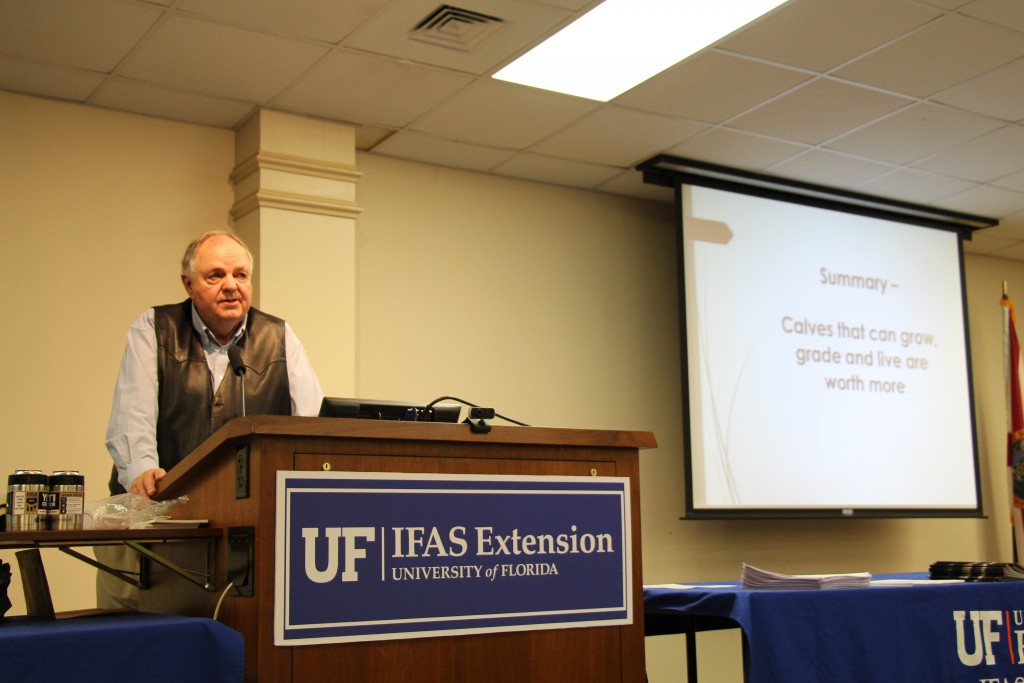
So when Larry told me he’d be coming to Florida to speak at the Northwest Florida Beef Conference, I wanted to be there. The six-hour drive up my state’s center was a given, because when I think of wisdom and insight into the industry that I love, I think of Larry Corah.IMG_5655

“I’ll have to admit, my first surprise when I got to Marianna (Fla.) was that I’d be scraping ice off my windshield,” Larry joked. “We have that in Kansas, but I wasn’t prepared for it here.”

Always keeping people guessing, the state welcomed him as he shared his thoughts on the industry we all rely on.

Sure he talked about the volatility of the market and the increased costs required to run just a single cow on a piece of land, but leave it to Larry to see the silver lining and offer steps to success.

For calves headed to pasture or finishing on feed, health, weight and consumer demand are driving profits, he told us.

Health has taken on a new relevance as the overall cost of an animal increased. Encountering sickness coming into the feedyard or death during the stay is felt more than in years past.

“We’re still a pounds game,” he said of the next factor. “In this industry we sell pounds and cattle have got to have the ability to grow. That’s a key driver, so don’t lose sight of that.”IMG_5659

Even more important is the consumer. In a shift greater than even he could have predicted, Larry said approximately 70% of all cattle fed today are sold on a grid-based system that identifies individual animals and offers premiums or discounts for value markers like quality.

“The consumer is the one determining the value of your cull cows and the price you get for your calves. We have to produce a product that the consuming public desires and wants, but the great news is they’ll pay you for it.”

There were data points shared and graphs on display and people leaning in on their chairs to listen.

“Basically, calves that can grow, grade, and live are worth more, and I think there’s some real economic opportunities available,” he said in closing.

“The consumer is telling us what they want and they’re creating price opportunities that will funnel back to the feedyards, to the stocker operators, to you as the cow-calf men.”

Thanks for allowing me to [first listen and then] tell your story,

Laura

You may also like

Charting the course

Charting the course

This story is part of a special three-part series celebrating the 40th anniversary of the Certified Angus Beef ® brand.

Everybody has to start somewhere.

Nestled off of old Route 66 in the Missouri Ozarks, my ancestors set out to write their own success story. From sheep and hogs to the newly-acquired Angus cattle in 1933, they knew nothing more than how to look forward.

What’s in a name?

What’s in a name?

What’s in a name? by Nicole Lane Erceg What’s in a name? More than you might imagine. The Duke and Duchess of Sussex publicized weeks ago they’re expecting and with the announcement came a flood of ideas for baby names. Meghan Markle shared with the press she...

Time tested

Time tested

Time tested We’ve dubbed it the “smiling house.” On my family’s regular route through the Sandhills, there’s a lonely old place, rain and time have left the wood devoid of color. Yet, with its classic, square farmhouse design—and a little imagination—its two upstairs...

Ulrich branded barn

Beef battle

“Bring it!”

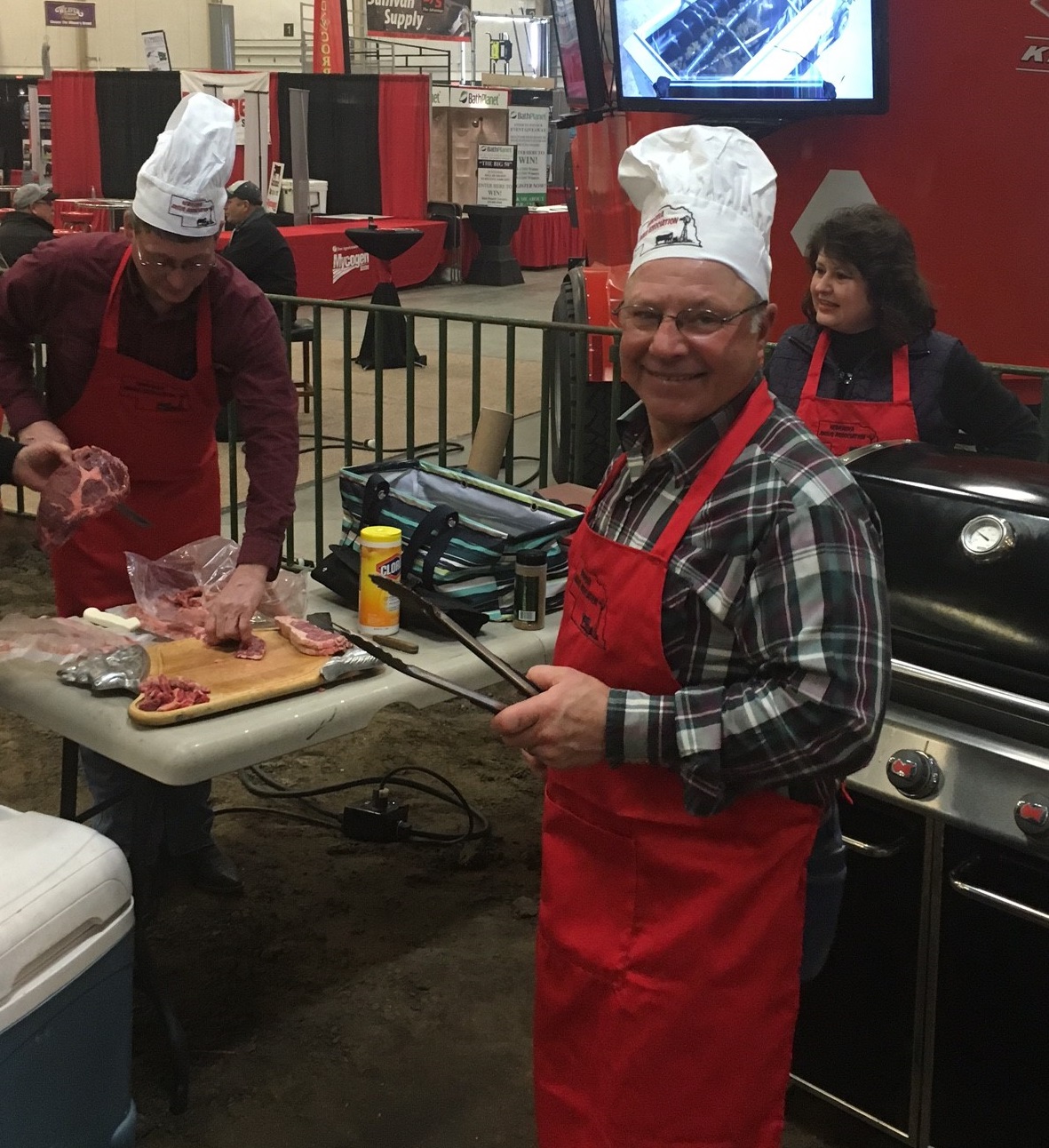
Maybe those weren’t his exact words, but that was Dick Hollman’s attitude when he heard about the plan for a breed cook-off of sorts set to take place at the following year’s Nebraska Cattlemen’s Classic.

BattleBreeds_HollmanBLOG
Dick Hollman, Hollman Angus

The Hallam, Neb., producer confidently said something like, “Bring your best, but don’t feel bad if you get second place!”

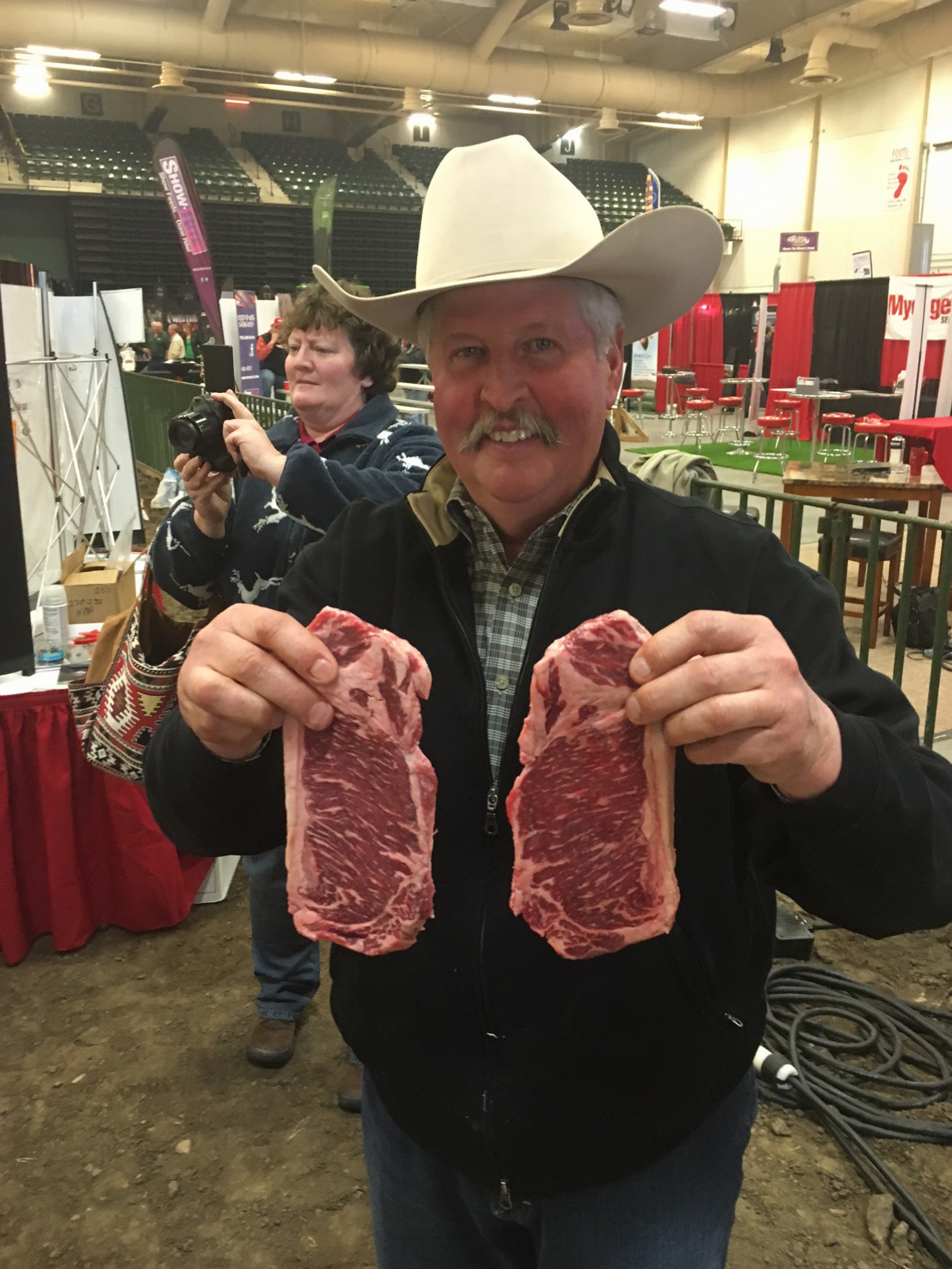
With a taunt like that, Dick and the state’s other Angus Association members wanted to be sure the beef lived up to all expectations. A few conversations with our team at the National Western Stock Show and a connection with a CAB-licensed distributor and they secured 30-day dry-aged Certified Angus Beef ® (CAB®) Prime New York strips.

Eating good beef and hanging out with producers are two of my favorite things to do, but my schedule didn’t allow me to make the short trip. Instead, I asked Paul to take a few moments away from cutting beef to step up as a temporary reporter. He said the lines were long, the hungry crowd satisfied, and he’d figured the results before the official tally was in.

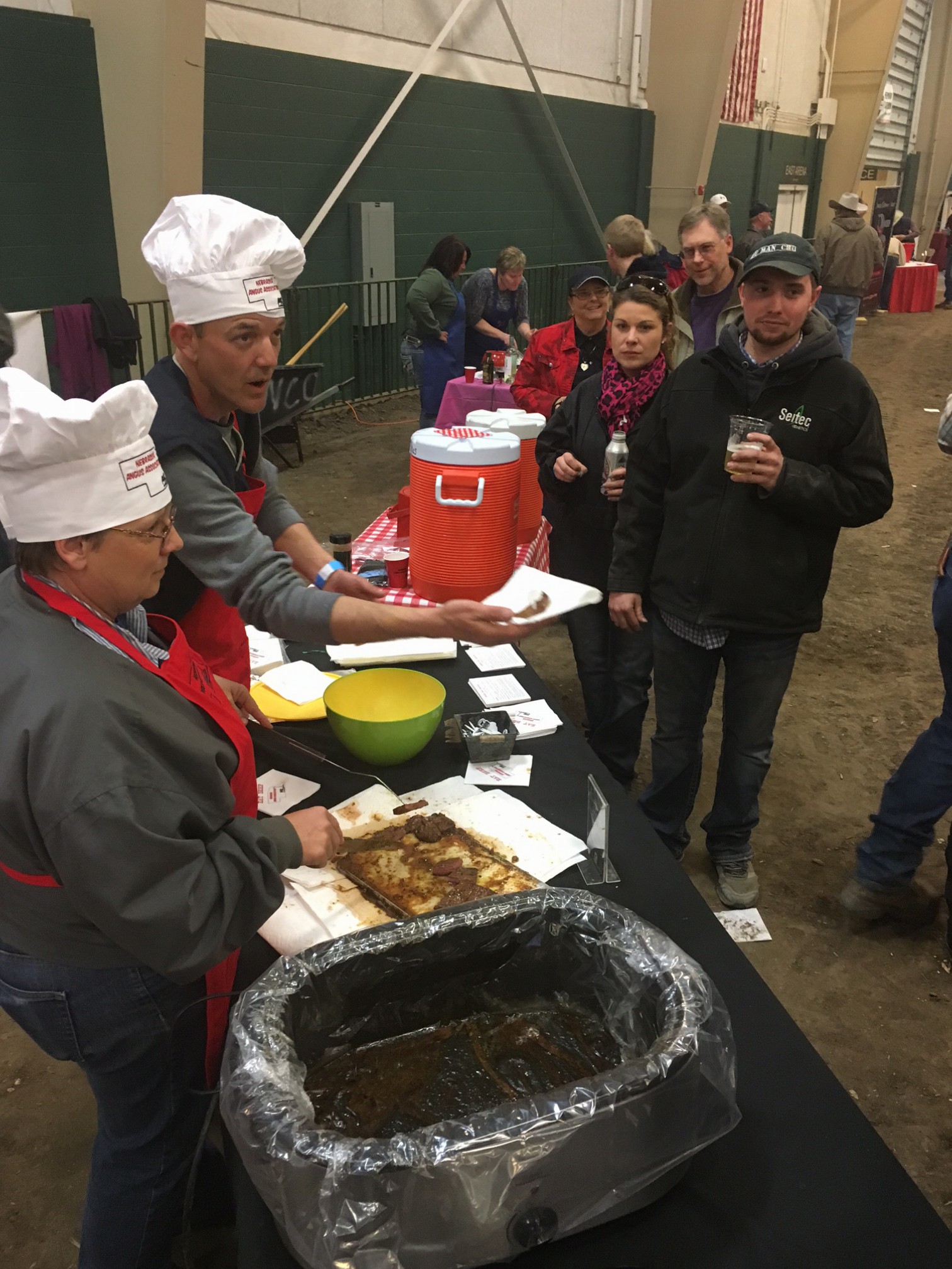
BattleBreeds_serving2Community members and show-goers chose among the five breeds represented for three categories: Best Meat, Best Display and Best Hospitality.

Angus won both Best Meat and Best Display, earning two complimentary ads in next year’s event program.

Dick gives a lot of credit to the product. “When you start out with meat like that, all you have to do is heat it up.”

The recipe was practically that simple: Start with the CAB brand. Add Jim Baldrige’s Secret Seasoning. Cook to desired doneness.

BattleBreeds_Tiedeman
Bob Tiedeman, Nebraska Angus producer

They almost doubled the expected turnout, dishing up more than 250 servings.

“It was an opportunity to educate about CAB, not only to producers but also the public that was there,” Paul says.

In addition to the popular vote, there was a formal “Classic Steak Cook-off” where nine teams all started with the same beef and a panel of judges selected the winner based on appearance, doneness and taste.

Hollman and Bob Tiedeman were sponsored by the Nebraska Angus Association and also took home top prize in that jackpot-style contest.

“We had a good night,” Hollman says. “It couldn’t have been more successful.”

He already has his eye on taking the Triple Crown next year. And if there’s dry-aged CAB involved, I am already marking it on my calendar!

May your bottom line be filled with black ink,

Miranda

You may also like

2022 Was as Predicted

2022 Was as Predicted

If there was a lesson in 2022, it was that the beef market is very sensitive to declines in quality grade, as evidenced through price signals. It’s the first time in recent history where we’ve gone backwards — albeit ever so slightly — and customers are telling us they have unfulfilled demand. That’s reflected in the premiums paid, and that’s saying something after two years of extremely high premiums.

Growing Marketability

Growing Marketability

Advertised as the “Best Angus Beef” and “If it’s not Certified, it’s not the Best,” Certified Angus Beef’s reputation claims elite category status. To remain in that position, the brand must continue to deliver on that promise as customer expectations of quality evolve.

A Drop of Hope, A Heap of Hard Work

A Drop of Hope, A Heap of Hard Work

For Manny and Corina Encinias’ family of nine, sustainability runs deep. They are stewards of a legacy, working the land dating back to 1777, when the first generation began herding sheep in the nearby Moriarty community. Today they focus on cows well suited to the harsh New Mexico desert, fostering community strength and creating opportunities for others to follow in their footsteps.
cows walking

ROI felt more than measured

12524024_10100648620272736_6712838727182633517_n“You da best mom in da whoooooole wurrrld!”

My two-year old utters that phrase and her bubbly grin and a stubby ponytail remind me that she’s getting older every day. It makes me want to make that statement true.

I want to be a better mama each day, but only have a finite amount of time to make it happen. And there’s no way to really know if I’m accomplishing that goal.

We can look at clues: that my kids are (mostly) happy and well-adjusted. That they treat others with respect. That they know a thing or two about the way the world works. Still, there is no easy way to quantify it.

[I know, this is not a parenting blog. Hang with me a moment longer and I’ll make my point for the cattle community.]

I whole-heartedly know the effort is worth my physical and emotional investment, though I might never see a balance sheet that quantifies a return on investment (ROI).

And so it is with sustainability in the beef business.

Stika at CCI sat in on a session during the Cattlemen’s College at last month’s Cattle Industry Convention in San Diego on that very topic. Our own president John Stika was one of the panelists.

“Premiums and revenue and return on investment show themselves in different forms. I think that’s the key. I cannot sit here today and tell you we’re going to see an economic signal paid for sustainably that’s as vivid and real as the one that we see today for getting paid by weight,” he said. “It’s really about demand protection and growth.”

The Global Roundtable for Sustainable Beef (GRSB), describes sustainability as, “environmentally sound, socially responsible and economically viable.” Of course, it all boils down to the first basic truth I know about cattlemen and women: they want to do the right thing.

But if you want to talk in economic terms, it’s just as easy to explain why we all have a stake in this: sustainability is a means of maintaining and growing beef demand. It’s about keeping consumer confidence high.

DSC_8908In a defensive tone, a question came from the crowd that was something like, “Aren’t we already sustainable?”

Yes.

Could we do better?

Yes.

“It’s really a low-risk, high-opportunity chance to bring people together and have communication and dialog. We’re all focused on the same end point,” John said. “This is not a threat. It’s an opportunity.”

Parenting and sustainability have one more thing in common, because as John pointed out, “You never really arrive.”

May your bottom line be filled with black ink,

Miranda

To read more on this session, or many others form convention, visit the newsroom at www.4Cattlemen.com.


You may also like

North Dakota Partnership Earns CAB Progressive Partner Award

North Dakota Partnership Earns CAB Progressive Partner Award

The Bruner and Wendel families earned the 2023 CAB Progressive Partner award by selling high-quality beef through Dakota Angus, LLC, as part of the CAB Ranch To Table program. They focus on their commitment to quality, data-driven decisions, achieve impressive CAB and Prime percentages and offer high-quality beef directly to consumers in their communities.

Kansas Ranchers Recognized for Sustainability Efforts

Kansas Ranchers Recognized for Sustainability Efforts

Kansas’ Wharton 3C Ranch thrives despite droughts, winning the CAB 2023 Sustainability award. The data-driven, quality-focused approach of first-generation ranchers, Shannon and Rusty Wharton, yields 100% CAB cattle. Their commitment to sustainability and industry collaboration sets a bright future for the cattle business.

Saskatchewan Angus Ranch Earns Certified Angus Beef Award

Saskatchewan Angus Ranch Earns Certified Angus Beef Award

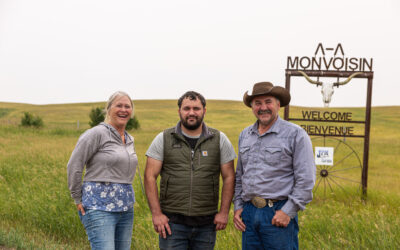
JPM Farms in Canada quietly gained recognition for its dedication to environmental sustainability and quality cattle. The Monvoisin family earned the 2023 CAB Canadian Commitment to Excellence award for their outstanding results and partnership with Duck Unlimited, showcasing their commitment to improving the land, cattle and family daily.

Goodbye ocean, hello involvement

If there’s ever a chance to skip class and travel to a beach state…count me in. Now don’t get me wrong, I’m a good student and value my education, but a free trip to California was something I simply could not pass up.

My classmates and I (I'm in the middle there!)So, a couple of weeks ago I packed up my boots, left the snow and ice and Set Sail to San Diego for the Cattle Industry Convention and National Cattlemen’s Beef Association Trade Show.

Coming from a production background, I really wanted to keep up with policy and the various issues in the beef industry. This trip meant I finally made it to the last semester of my certificate program at the University of Nebraska-Lincoln, but it was also an incredible opportunity to network with some of the industry’s latest and greatest.

During my time at convention I engaged in the grassroots policy process, sat in meetings to hear from industry experts and browsed the massive trade show. It was great to see producers from around the country coming together to discuss issues and make decisions. I’ve realized more than ever how much we need our beef leaders in Washington, D.C., voicing our opinion to elected officials. With help from them doing their job, my family can continue to do theirs.

Looking at the big picture, producers are only a piece of the pie regarding the food industry. When we are raising our cattle, we have to keep the consumer in mind and work toward what they want. Consumers now, more than ever, want to know where and how their food is being produced. Implementing sustainability practices will help to produce the very best beef for our consumers.

Trade Show_2_LCComing home, I was provoked to start getting more involved in our cattlemen’s association at a local level. Participating in policy committees and meetings can help me protect my family’s legacy. Great things can happen when we all come together to make a difference. Hopefully one day I can step up and take a leadership role in the industry.

While I was only away  for a short period, not all of my time in San Diego was centered on breakout sessions and meetings. This landlocked girl got to see the ocean for the FIRST time! I saw a surfer, soaked the bottom of my skinny jeans and left a trail of sand in the hotel room.

Until next time, West Coast.

~Jenny

????????????????????????????????????Jenny Keyes grew up as the fifth generation on her family’s Springfield, Neb., farm. Her early experiences—which included showing Angus cattle—inspired her to keep on learning about all things agriculture. Our current industry information intern, Jenny is a senior ag communications major at the University of Nebraska-Lincoln.

You may also like

Not one for small talk

Not one for small talk

Uncomfortable silence.
If you don’t like it, you know the kind. Perhaps you’re just getting to know somebody, and you reach a point in the conversation where that silence hangs heavy and it makes you uneasy.

Coming home

Coming home

“His name is Panic Switch,” says Colton Hamilton with a grin. His father Gavin helps hold the stuffed bull’s head nearly their height.
But I didn’t hear the word “panic” clearly. I don’t know what I heard, even after asking a couple more times. Maybe the Canadian accent was fooling me.

From one over-achiever to another

From one over-achiever to another

Ryan Noble is smart. And goal oriented. For example, he set a goal to grow the herd from 120 to 300 cows, which quickly escalated to 750 cows and a large number of developing heifers. The definition of an overachiever.

Buzz words still tell the stories

Adding value. Consumer confidence. Growing demand.

Those are popular (and thus often overused) phrases, but they are central to what we do here at CAB.

Cattlemens College
Some of the nearly 7,000 convention attendees taking in one of the educational sessions on Wednesday.

But it’s not just us. During the Cattle Industry Convention and Trade Show last week, we heard those same themes in many sessions and individual conversations. It turns out that adding value, increasing consumer confidence and growing demand is central to the greater industry, too.

Especially as we navigate what Randy Blach and the rest of the CattleFax crew told us have been the most dramatic markets many of us have ever seen. (In fact, the exact quote was, “This is the second most volatile market in history.”)

We’ll be sharing more in the coming weeks, but as for a quick recap, here some of our favorite zingers from our time in San Diego:

  • “You have to produce cattle with the consumer in mind. If you don’t, nothing else matters,” said Don Schiefelbein, Minnesota Angus breeder. I can’t think of a better way to set the stage for the week. Tom Brink echoed his comments with, “You have to think of who is next on the supply chain and give them what they want.”
  • “This isn’t about us. This is about our kids and grandkids,” said Rob Fraley, Monsanto executive, talking on the importance of using technology to produce more with less. We’ve got to encourage STEM education and we have to start telling our story. It’s that important.
  • “People want to buy products they can trust,” said Paige Hartley, with Darden. “I don’t think you can put a dollar value on that.” Fellow presenters, including our own John Stika, noted it’s not likely we’ll see an economic signal for sustainability like we do for quality or weight, but it still brings dollars back. It’s just harder to measure. But there is a long-term connection and we must be cognizant of that.


  • Schroeder for blog
    John Schroeder, Darr Feedlot

    “You have to begin with the end in mind, and you have to have a plan,” said John Schroeder, Darr Feedlot, talking about communication and cooperation from ranch to the feedlot. It certainly takes a plan to get his ideal animal: “a safe, humanely handled, upper 2/3 Choice, yield grade (YG) 2.” (For the record, we think he’s got a pretty comprehensive definition. Just add “Angus” and you’re set.)


We were happy when CattleFax said the “supply shock,” and thus the price shock, happened last year and although it’s a completely different market, overall they’re still positive going into 2016.

I wouldn’t call the tone the same “riding high” type of attitude of a year ago, but I still felt much enthusiasm. I mean, it’s not like a group of cattlemen to see an upcoming challenge and approach it half-heartedly.

I think we’ll have a whole team of people, that will be working on these three things: Adding value. Consumer confidence. Growing demand. (And much more, of course!)

May your bottom line be filled with black ink,

Miranda

PS–Check out our Facebook, Instagram, and Twitter feeds for a variety of coverage of the event.

You may also like

In Tough Times: Minimize Waste, Maximize Genetics through Management

In Tough Times: Minimize Waste, Maximize Genetics through Management

With drought and high input costs in the balance, it takes sharp management decisions to keep black ink on the bottom line. Knowing what to cut back or keep doing was the focus for Dusty Abney, beef cattle nutritionist for Cargill Animal Nutrition, during his Cattlemen’s College session at the 2023 Cattle Industry Convention.

More Than Steak and Potatoes

More Than Steak and Potatoes

Yesterday’s steak and baked potato is today’s beef brisket from the restaurant downtown. The food scene is changing, driven by a new age of consumers who want more. They seek new flavors and attributes on the packaging, but still expect beef to taste great.

2022 Was as Predicted

2022 Was as Predicted

If there was a lesson in 2022, it was that the beef market is very sensitive to declines in quality grade, as evidenced through price signals. It’s the first time in recent history where we’ve gone backwards — albeit ever so slightly — and customers are telling us they have unfulfilled demand. That’s reflected in the premiums paid, and that’s saying something after two years of extremely high premiums.