It takes a team

We lived in a two bedroom apartment in the middle of the city when my husband made the first livestock purchase of our marriage. Bidding in an online pig sale, he made us the owners of a beautiful crossbred gilt with nowhere for it to live. No barn, no plan, no pig feed, no truck or trailer, absolutely nothing we needed to start a livestock business. We couldn’t even fill out the shipping information for where this gilt would go.

The planner in me panicked. What in the world had he we just done?!

He calmly turned to me and said, “The world is run on partnerships.”

Though not necessarily comforting at the time, he wasn’t wrong. There was no way we were going to be able to start a livestock business alone. Whether you’re raising pigs or cattle, it takes a good team to get the job done.
IMG_3630

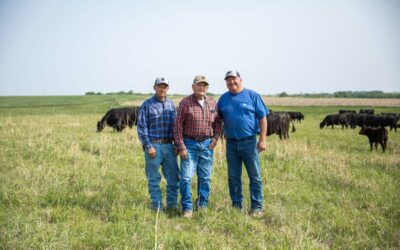
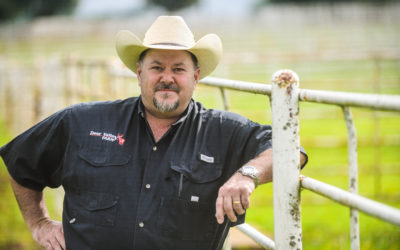
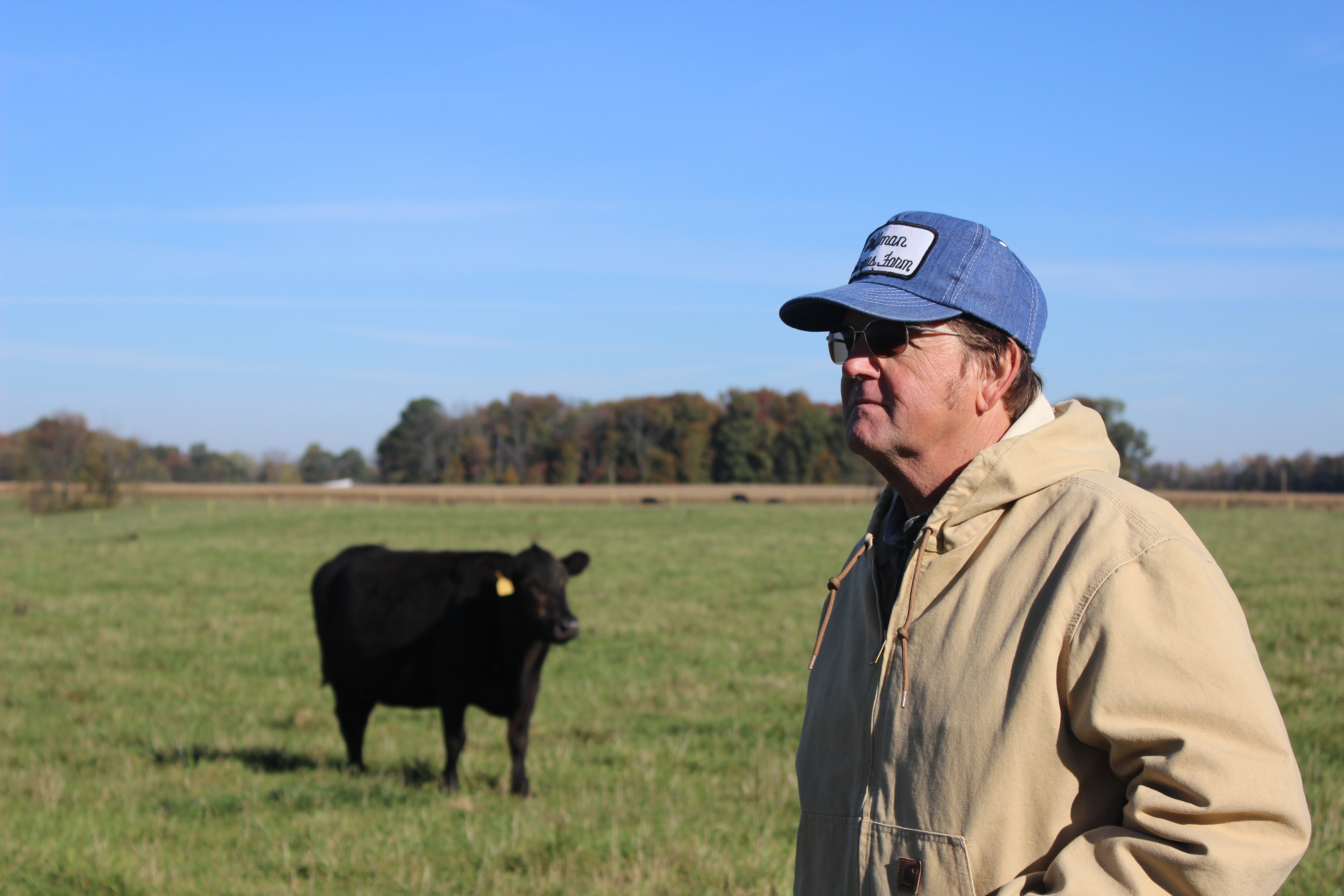
For Jamie Hoffman of Hoffman Angus in Otwell, Ind., winner of the inaugural Certified Angus Beef Angus Value Discovery Contest, his herd’s success stems from his original partnership with his dad. The late Albert E. Hoffman, instilled a disciplined focus on quality genetics and animal care in his son — values Jamie has continued to integrate into their herd.

The hard work has paid off, in premiums and recognition. His grand champion pen of 40 graded 100% Choice or better, with 75% qualifying for the Certified Angus Beef® (CAB®) brand, including 32.5% Prime.

But the success wasn’t his alone.

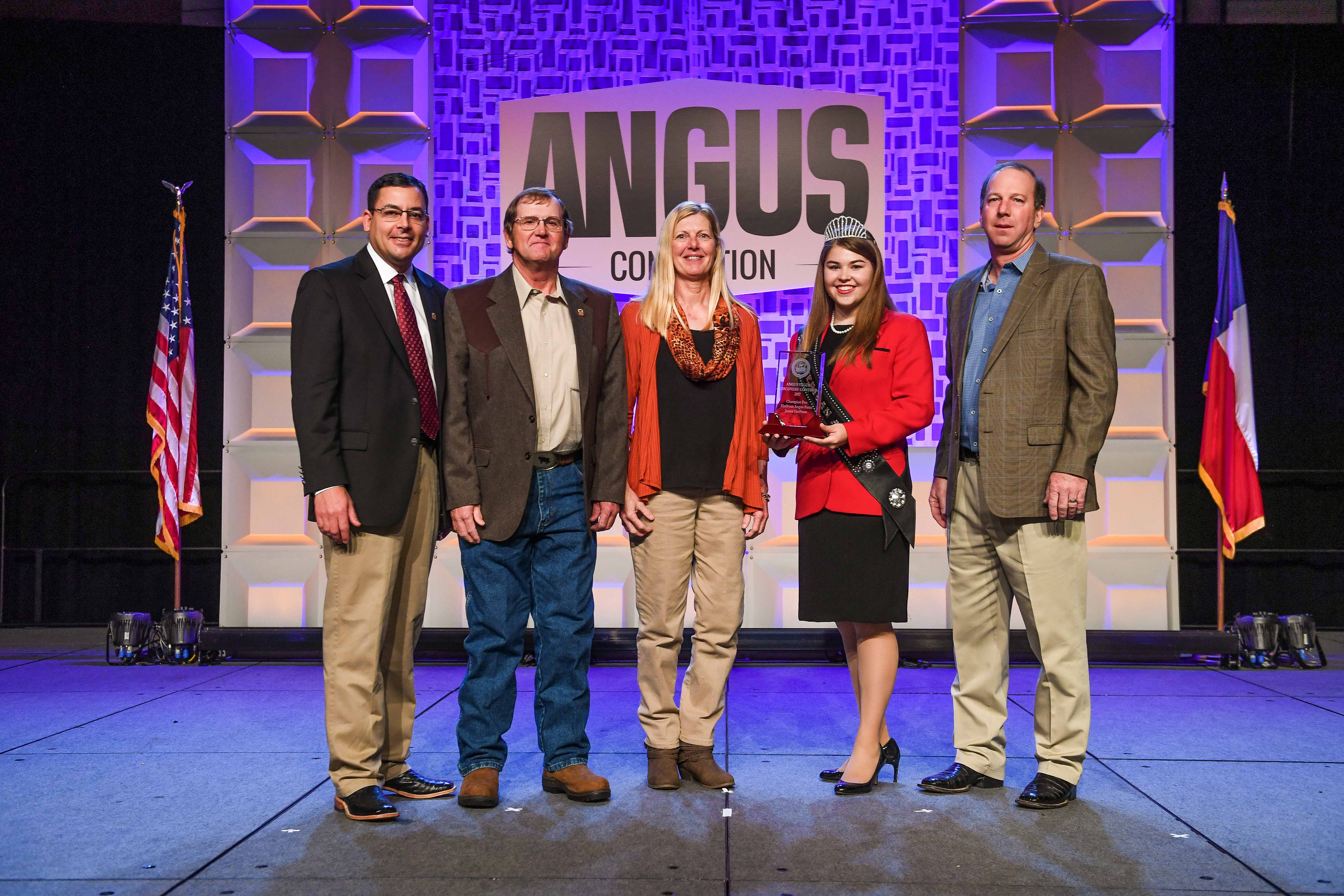
When Jamie couldn’t find the balanced carcass and performance genetics he needed, his search for a new bull supplier led to James Coffey of Branch View Angus, in Hustonville, Kentucky. Jamie’s cattle buyer introduced the two and understood their shared vision for producing cattle that perform on the rail.

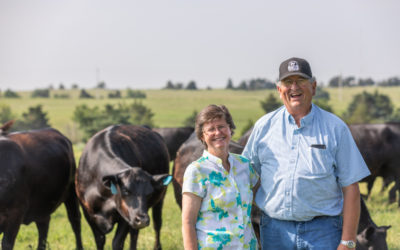
“From my first conversation with Jamie, I knew he and his wife were dedicated to raising and feeding high-quality Angus cattle,” Coffey said. “This winning group that won didn’t happen by chance. They’ve concentrated on raising the right kind for years.”
EPM_5312

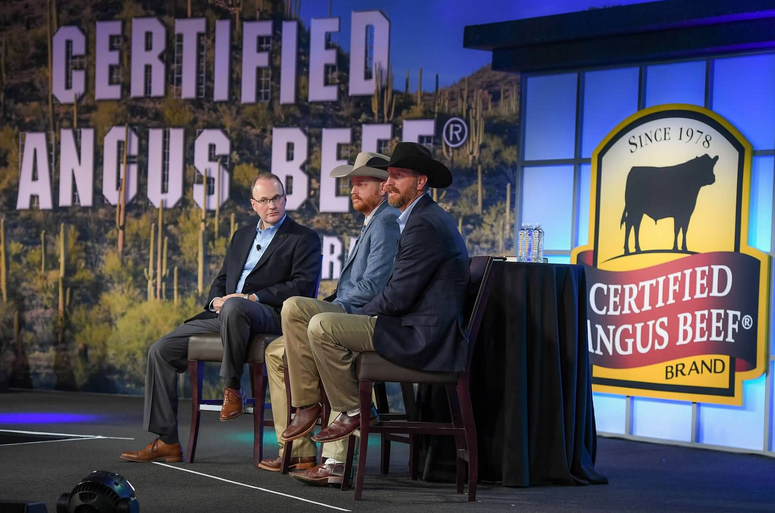
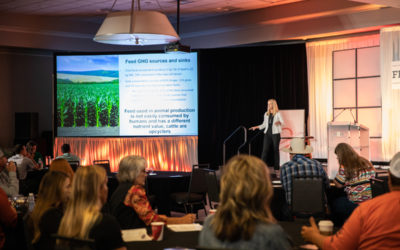
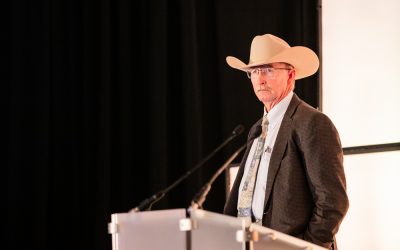
In November at the 2017 Angus Convention in Fort Worth, Texas, the two stood next to each other on stage as Jamie accepted the Grand Champion Award.

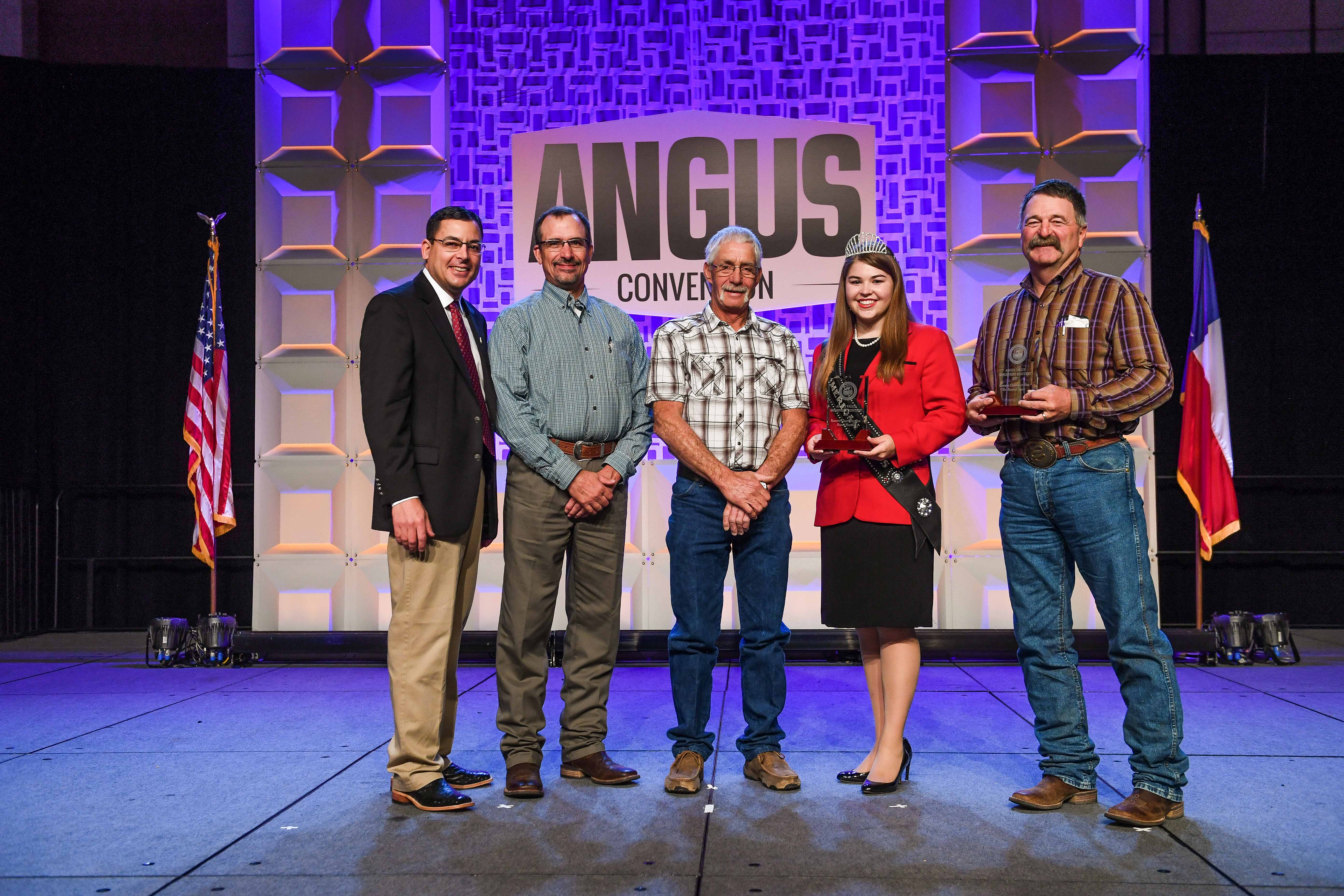
The reserve winners of the Angus Value Discovery Contest went to a partnership that spans the beef industry. Mark Gardiner of Gardiner Angus Ranch, Ashland, Kan., nominated long-time customer Randy Bayne of nearby Protection, Kan., along with his feeding partner and veterinarian, Randall Spare of Ashland.

A customer of Gardiner’s for more than 20 years, Bayne said he has leaned on his suppliers’ expertise when selecting carcass genetics and Spare for creating the optimal health program. Both Gardiner and Spare credit the commercial cattleman’s management skills and business sense as a key success factor in producing high performing profitable cattle.
EPM_5314

“Randy is very disciplined in selecting cattle that provide end product merit,” said Gardiner. “He’s worked toward selecting cattle that are in the upper percentiles without compromising reproduction and maternal function.”

I snapped photos as the winning cattlemen received their awards and headed back to my seat reflecting on the people that have contributed to the success of my family’s own livestock business. The night we made a snap decision to buy a pig could have been a bit of a disaster, but with the help of great friends and business partners, a spontaneous decision has grown into a profitable business.

Although hanging show pig banners is a bit different than creating high-dollar, high-quality carcasses, neither version of success happens alone. It’s about more than hard work and great genetics — having the right people in business with you can make all the difference.

Producing high quality beef requires an excellent genetic supplier, a superior health program, a great feeder, a careful rancher making sure those calves never have a bad day and of course patient mentors who pass along their wisdom.

When it comes down to it, genetics and management are vital, but the right people by your side help drive the decisions that produce profitable, high quality beef.

Until next time,

Nicole

P.S. Want to enter the 2018 Angus Value Discovery Contest? We’ll start accepting entries in January and more information will be available at cabpartners.com. Look for more on this year’s winners in upcoming issues of the Angus Journal!

You may also like
Going Above and Beyond

Going Above and Beyond

It’s a normal day near Hudson, Colorado for the Walter family, yet the view is uniquely awe-inspiring for visitors who have never stepped foot on a ranch. As cows come in closer visitors take in the far-reaching pastures and breath-taking mountain views. For the Walter Family, there’s no better backdrop to introduce people to the place where beef begins.
Progress, Not Perfection

Progress, Not Perfection

It’s a labor of love, obvious in the way she lights up explaining their family’s 33-year effort to proactively adapt Angus cows to their land. A lifetime of telling stories from the pasture or kitchen has resonated with nonfarm consumers as much as fellow ranchers. “Everything we do is about cattle, but it’s also about family and connecting our kids to the land and to the cattle,” Debbie Lyons-Blythe says.
Like Father, Like Daughter

Like Father, Like Daughter

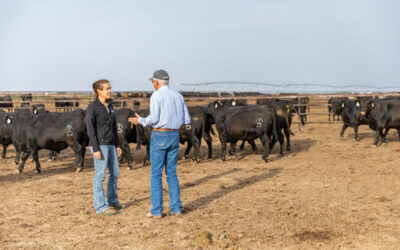
For Hands, there’s no short answer to anything. Problems are approached with thoughtful consideration to every possible outcome. Solutions are executed with care. It’s more than a suggestion on how to treat everything from people to cattle to equipment, it’s simply the Triangle H way. They work to be the best in everything they do – a mindset that he’s passing on to his daughter.
Borck honored for beef industry success


by Steve Suther

Lee Borck, Manhattan, Kan., has known hard times and boom, seen the impact on others as well as his own enterprises. That could describe a lot of cattle feeders, but Borck stands out for his record of leadership and overcoming adversity through cooperative efforts.

That’s why the Feeding Quality Forum honored this master of ag finance and “business by the numbers” with its 2017 Industry Achievement Award.

Borck gives credit to mentors and partners over the years, and willingness to fail sometimes to stay ahead of the curve and win most of the time.

Growing up on the family’s homestead near Blue Rapids, Kan., he was mentored by a father who farmed through the Great Depression.

“He was very conservative, but the best businessman I was ever around in my life. I learned a lot more from my dad than I did going to college, as much as I love K-State,” Borck says. He earned his degree in ag economics in 1970 and recently served on the boards for Kansas State University Foundation and Kansas Bioscience Authority. He’s also chairman and founding shareholder of American State Bank in Great Bend, Kan.

Cattle feeders know Borck as current chairman of both Innovative Livestock Services and The Beef Marketing Group Cooperative, but he’s also served as president of the Kansas Livestock Association and of CattleFax.

The road to indelible marks on the industry began with his first job, eight years as a loan officer with the Farm Credit System’s Production Credit Association (PCA) in Larned, Kan., before he started down the path of being a cattle feeder in that community.

“They were the folks that weren’t afraid to try new things,” he says. “They were taking more risk. They got more bumps, but they got more rewards at the same time.”

One thing he learned from looking over loans at PCA, however: “the mistakes people made in the way they looked at their business plan and not thinking far enough out in front.”

Borck bought into Ward Feedlot at Larned in 1978. Interest would soon climb to 18% as the young feeder built on lots of small deals and fought a 50-cent regional discount vs western Kansas. By 1988, he’d had more than enough of that and called several area feedlots with plans that became The Beef Marketing Group (BMG)Cooperative.

“We had a lot more packers then, but it was a game of numbers,” he says. “If you had the numbers, you could attract packers and get a better price.” Western feedlots were warning ranchers away from their eastern competition based on that discount.

“Well, you could either have capital or you could have cooperation,” Borck says. “We didn’t have any capital, but we decided to try to pool our cattle together. And it was the Capper-Volstead Act at its finest, negotiating price together without having restriction of trade from competitors.”

Excel, the Cargill forerunner, opened by paying “the cartel,” as detractors called it, 50 cents a hundred more than the western Kansas price on 50,000 Holsteins in 1988. The competition took notice.

“It wasn’t very popular,” Borck says. “That wasn’t the way that you were supposed to do business. I didn’t know that. You’re supposed to sell your own cattle. You aren’t supposed to sell someone else’s cattle. And it worked well for us.”

The cooperative organizer was fast becoming an industry leader, for which he credits the Kansas Livestock Association and the rise of information sharing.

BMG members used faxes to share packer bids in 1993, and also began a marketing relationship with IBP, now Tyson, that’s still in effect, getting past the controversies of captive supply and using others cash bids for a base.

“We traded cattle every day of the week or you would sit there and argue all week long over 25 cents a hundred,” Borck recalls. “And it just appeared that there was so much more benefit out of spending time figuring how to be a better cattle feeder and do what we did in a more efficient way.”

Part of the deal with IBP was the right to harvest data on all cattle. BMG’s first 500,000 carcass and closeout records formed the foundation of Vet Life’s Benchmark program, but BMG members keep learning from data today.

“Most everybody in the business at that time knew that if a steer gained 3 pounds a day and it converted 6.2, you were doing a pretty good job,” Borck says. “But nobody knew the difference between feeding an animal for 40 cents and 45 cents.”

Performance targets may update to nearly 4 pounds daily gain at 5.6 conversion, but Borck says feeders still wonder why pens vary from 75- to 80-cent cost of gain.

“Information has been a huge part of my career,” he notes. “I wasn’t really a feedyard manager but I knew how to massage numbers a little bit and figure out what they said”—with the help of partners and consultants.

“Anybody that tells you I did it my way and it didn’t take anybody else, they’re not being very truthful with you. My partners are, behind my family, the dearest thing I’ve got. And they deserve every bit as much credit as what I do for any successes.”

Borck will be recognized and comment at the 11th annual Feeding Quality Forums in La Vista-Omaha on August 29 and in Garden City, Kan., on August 31.

FQF sponsors are Zoetis, Roto-Mix, Micronutrients, IMI Global, Feedlot magazine and the Certified Angus Beef brand. For more information or to register, visit www.feedingqualityforum.com,  or contact Marilyn Conley by phone at 800-225-2333, or by email at mconley@certifiedangusbeef.com.


You may also like

A rare opportunity

A rare opportunity

It’s been 16 years since the “cow that stole Christmas” shut down exports from North America and cost the industry $9 billion. All these years later and still no national traceability program? Joe Leathers shared his exasperation.

Passing the torch

Passing the torch

We speak with pride about what our forebears did to build up the land and business. But there’s more to each generation than that. At the 2019 Feeding Quality Forum, Rodd Welker said all you have to do is find common ground.

Beef grading from yesterday to today

Beef grading from yesterday to today

With more quality in the cow herd than ever before, producers are talking about premium brands and grades over Choice. New technology is making its way in to packing plants and shows promising signs of accuracy.

Yon Angus cow

Commitment you recognize

Just when does the lifelong road to excellence start?

For some, it seems it’s inherited as easily as blue eyes or a deep voice. For others, there’s a turning point, some life-changing event that causes a seismic shift in the way they do business or live their lives.

I’m always looking for the clues as I chat with cattlemen and women who earn CAB honors. My summer story trips have included these “Commitment to Excellence” award winners for more than a decade, and even though they all share some traits—work ethics, smarts, tenacity—it seems the path to quality is different every time.

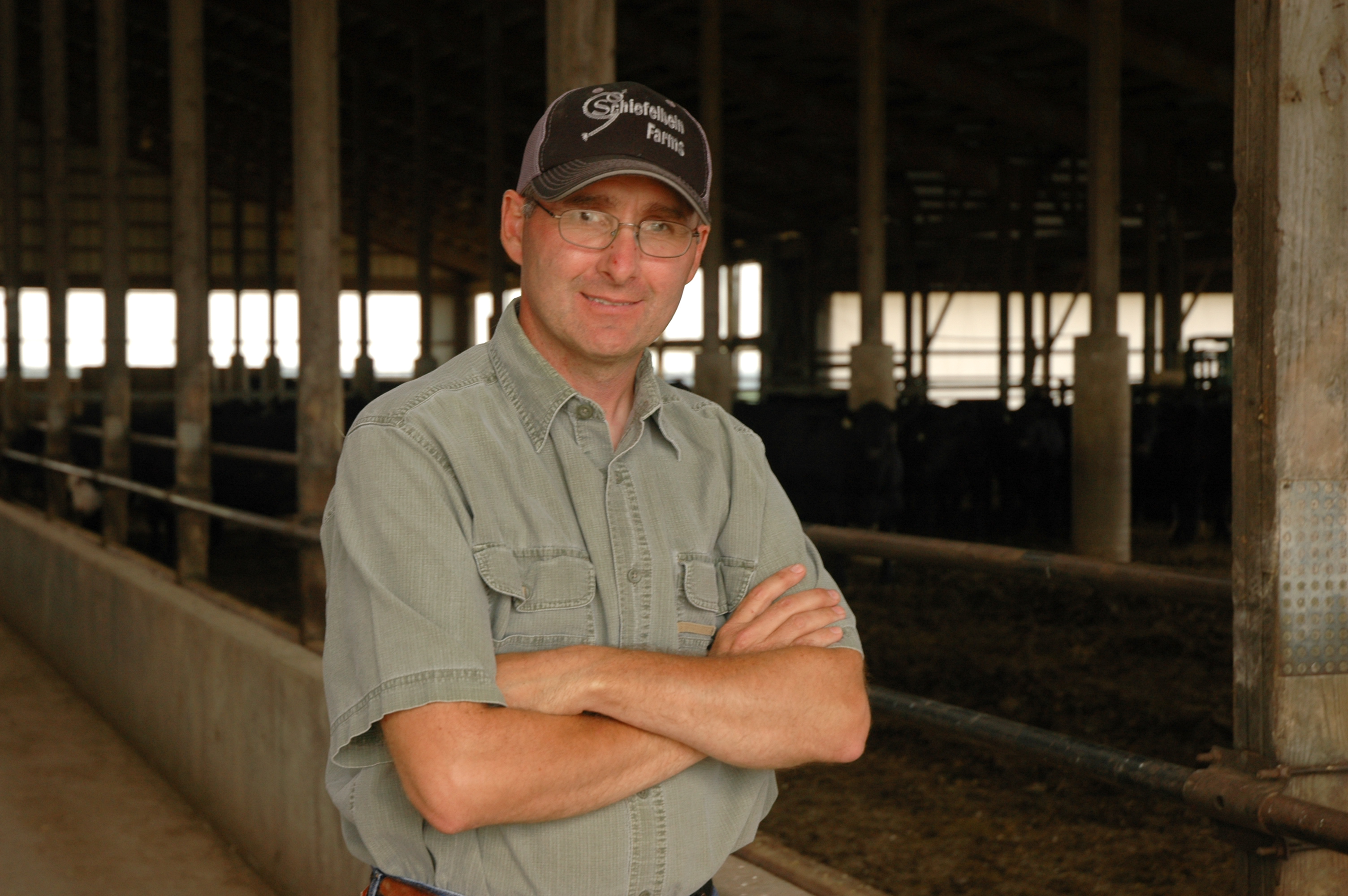
2012_07_12_mr_Schiefelbein Farms-118-22
When the Schiefelbeins won the 2012 Seedstock Commitment to Excellence Award I started my day at their family meeting, seeing their teamwork in action. “Quality.” I heard it many times from each of the brothers, including Don who is pictured here.

When I visited the Schiefelbein family in 2012, they said it was a given.

“Dad always said,If we’re in the beef business, we better raise good beef,’” says Angus breeder Don Schiefelbein. “He’s just been laser-focused on how do we produce efficient, great-tasting beef?”

So the eight brothers continued the tradition, using more technology and implementing marketing that would reward commercial customers for doing the same.


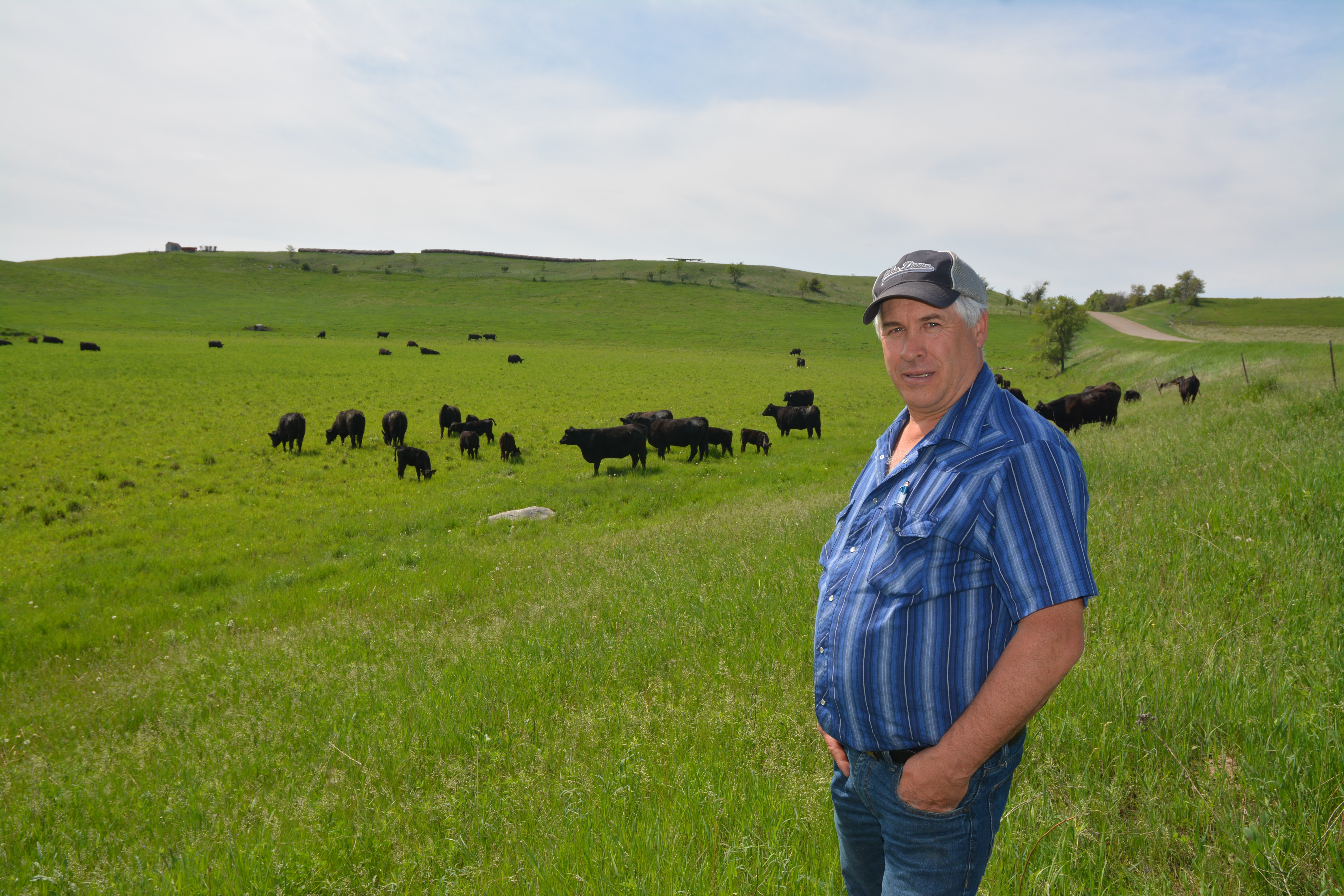
Cattleman John Moes, of Florence, S.D., is "always looking to try something new."
John Moes volunteered to be a real-life laboratory of sorts for the nearest land-grand university. They test breeding protocols and application of DNA technology on the commercial Angus producer’s herd.

In 2014, commercial cattleman John Moes said his dairy farm upbringing taught him the value of “sweat equity,” but it was a partnership with South Dakota State University that gave him the tools to make sweeping herd improvements in a shorter amount of time.

“You can’t just work hard to make a living anymore,” the cattlemen says, noting his widespread use of timed artificial insemination (AI) and DNA testing. “You also have to work smart.”

2010_6_18_mr_Triangle H-354
Sam Hands and his brothers operate Triangle H, a diversified farming and feeding operation near Garden City, Kan.. He won the 2009 Feedlot Partner of the Year honors. (Today that is called the Feedyard Commitment to Excellence award.)

In 2009, Kansas cattle feeder Sam Hands talked about the way his father brought he and his brothers in as equal partners from the start.

“We’ve made errors along the way, but we learned from them and kept working to make it better,” he says, noting that the cattle enterprise has always been a way to add value to their farm-raised feedstuffs. That doesn’t mean they’re an afterthought.

“We’ve got a unique product— it can adjust to a lot of different environments, a lot of different feedstuffs, and still put out the most nutritious, most sought-after flavor, but the consumer is boss and we’ve got to keep that in mind,” he says.

Do you know somebody who has taken an interesting path to quality beef production? Perhaps they learned from the “school of hard knocks” or maybe they found quality as the only way to bring back the next generation? Maybe they’re your genetic supplier or your cattle feeder? Or if you’re in the registered business, it could be your customer.

We are currently accepting nominations for our 2017 Commitment to Excellence awards, along with one Progressive Partner award. Read this to find out more about qualifications, but do it fast—nominations close Friday.

I can’t wait to find out who I get to meet next.

May your bottom line be filled with black ink,

Miranda


You may also like

Going Above and Beyond

Going Above and Beyond

It’s a normal day near Hudson, Colorado for the Walter family, yet the view is uniquely awe-inspiring for visitors who have never stepped foot on a ranch. As cows come in closer visitors take in the far-reaching pastures and breath-taking mountain views. For the Walter Family, there’s no better backdrop to introduce people to the place where beef begins.

Progress, Not Perfection

Progress, Not Perfection

It’s a labor of love, obvious in the way she lights up explaining their family’s 33-year effort to proactively adapt Angus cows to their land. A lifetime of telling stories from the pasture or kitchen has resonated with nonfarm consumers as much as fellow ranchers. “Everything we do is about cattle, but it’s also about family and connecting our kids to the land and to the cattle,” Debbie Lyons-Blythe says.

Like Father, Like Daughter

Like Father, Like Daughter

For Hands, there’s no short answer to anything. Problems are approached with thoughtful consideration to every possible outcome. Solutions are executed with care. It’s more than a suggestion on how to treat everything from people to cattle to equipment, it’s simply the Triangle H way. They work to be the best in everything they do – a mindset that he’s passing on to his daughter.
Meeting of the Minds

It’s been a busy month for the brand. In the last 30 days we’ve marked the end of one fiscal year and the start of another, surpassed a pretty big milestone (more on that later) and hosted that little thing (note the sarcasm) we call Annual Conference (AC).

More often than not, my travels take me to the places where the cattle roam, rather that the spots where the steaks are served. So I usually miss the annual meeting of the minds. But it’s there where distributors, retailers and CAB staffers gather together to talk about the year and the brand’s impact on their businesses.

Since that’s the case I checked in with the folks who indeed focus on the production side of the brand but made the trip to this year’s AC. Feedyard owners and 2015 CAB Feedlot Commitment to Excellence Award winners Shawn and Shane Tiffany said they spent more time with attendees answering questions than they did on stage for their intended session.

ac1
Mark led a discussion with Shawn and Shane Tiffany, Tiffany Cattle Company, Herington, Kan. Feedyards are often one of the most misunderstood parts of the beef community.

“From the time we got off the stage, the rest of the weekend, we were constantly talking to somebody,” Shawn says. “Oftentimes about our business and how we produce cattle but also about what their business was like, whether they were hamburger grinders in San Diego or the largest steak cutter in Canada.”

“As a producer, it can be easy to get so caught up in your own segment of the industry that you don’t think about what happens from that point forward,” Shane says. “For us, you load the cattle on a semi, send them to the packer and you’re focused on the next load coming in.”

ac2
Maybe not the most common species the Tiffanys or Nelsons encounter back home, but he fit this year’s theme, “Hollywood in the Desert,” to a tee.

It’s the perspective he gained, the impact of those who carry on the Tiffany crew’s hard work, he says, that’s stayed with him.

“It’s so important to get a bigger perspective of the industry but it’s also very encouraging to see that these people are great at their jobs. I mean a billion pounds (still more on that later), that’s just a mind-blowing number and that doesn’t happen without them being passionate,” Shane says.

ac3
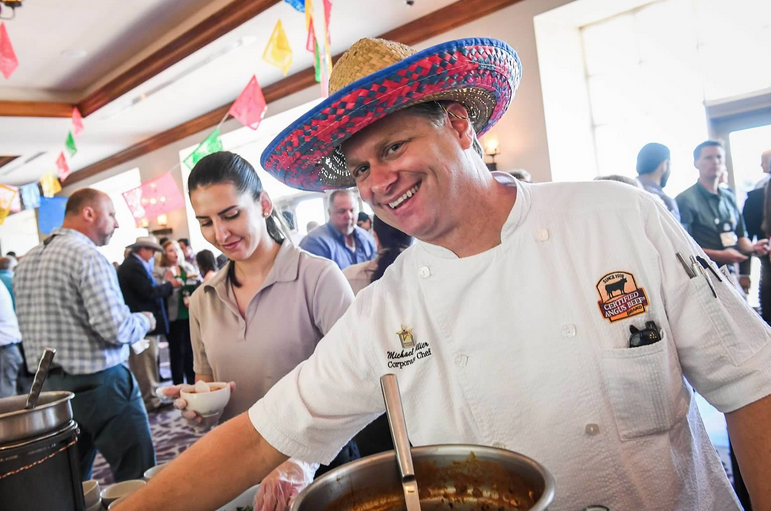
The decor was followed up with beef dishes fit for a fiesta! Chef Michael and others work so hard preparing for AC but also enjoy a little fun every now and then.

Abbie Nelson, Five Star Land & Livestock, Wilton, Ca., and this year’s 2016 CAB Ambassador Award winner said the food and friendships were just icing on the cake to what already lit a fire for her to come home and increase CAB acceptance in the herd.

“We just made a lot of friends,” Abbie says. “Gary and Sally [Myers], of Sizzler’s, we just talked non-stop back and forth about what we do and what they do. I think we established a friendship that will go on forever.”

To learn more about our award winners this year, check out these individual stories:

Thanks for allowing me to tell your story,

Laura

You may also like

Going Above and Beyond

Going Above and Beyond

It’s a normal day near Hudson, Colorado for the Walter family, yet the view is uniquely awe-inspiring for visitors who have never stepped foot on a ranch. As cows come in closer visitors take in the far-reaching pastures and breath-taking mountain views. For the Walter Family, there’s no better backdrop to introduce people to the place where beef begins.

Progress, Not Perfection

Progress, Not Perfection

It’s a labor of love, obvious in the way she lights up explaining their family’s 33-year effort to proactively adapt Angus cows to their land. A lifetime of telling stories from the pasture or kitchen has resonated with nonfarm consumers as much as fellow ranchers. “Everything we do is about cattle, but it’s also about family and connecting our kids to the land and to the cattle,” Debbie Lyons-Blythe says.

Like Father, Like Daughter

Like Father, Like Daughter

For Hands, there’s no short answer to anything. Problems are approached with thoughtful consideration to every possible outcome. Solutions are executed with care. It’s more than a suggestion on how to treat everything from people to cattle to equipment, it’s simply the Triangle H way. They work to be the best in everything they do – a mindset that he’s passing on to his daughter.
Montana Angus ranch: data-driven quality from the start

2016 CAB Commercial Commitment to Excellence Award


by Miranda Reiman

It’s hard to pinpoint when the transformation began, but on the Christensen family’s western ranch, it’s evident that it happened: a commitment to excellence.

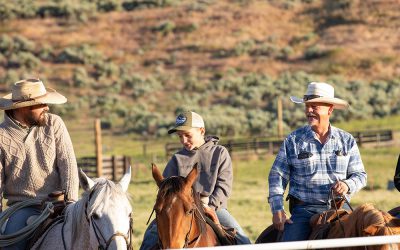
The views of the Rocky Mountains look much the same as they did when Grandpa Karl homesteaded near Hot Springs, Mont., a century ago, but third-generation rancher Shawn Christensen and wife Jen now raise their two daughters there.

Ranch talk might center around the same challenges then and now, from lack of moisture to grasshoppers, but a quick glance at stacks of artificial insemination (AI) records and carcass data provides a clear distinction. The diversified crop and livestock farm that once housed milk cows and chickens is not the same as the commercial Angus ranch the family operates today.

Shawn’s dad brought in Angus bulls and then switched to the breed completely in the 1970s, a decade later Shawn participated in the 4-H carcass contest and later learned to AI.

There might not be one central event, but there’s evidence of the fruits of that commitment.

“They’ve just been good gaining and good converting cattle,” says Ryan Loseke, of Columbus, Neb. He’s bought the family’s cattle for most of the last 20 years. “It’s been neat to see how he has done a good job of maximizing carcass quality but not getting poorer performing cattle.”

Loseke specifically remembers the pen that went 100% Choice and Prime. It also made 65% Certified Angus Beef ® (CAB®) brand, and gained more than 4 pounds (lb.) per day.

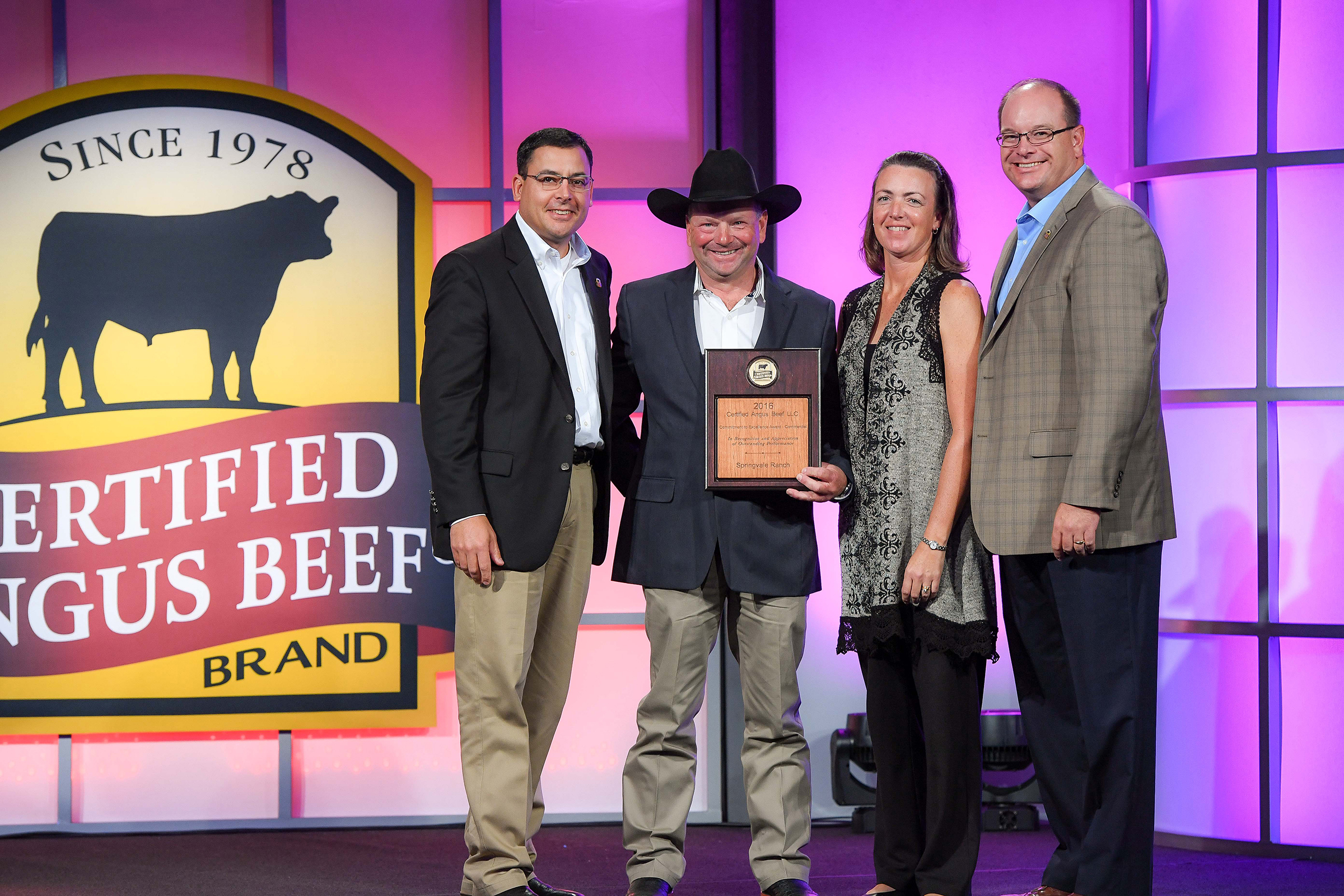
That kind of cattle and the lifelong dedication to produce them earned Shawn and Jen Christensen’s Springvale Ranch the 2016 CAB Commercial Commitment to Excellence Award, which they accepted Sept. 24 at the brand’s annual conference in Tucson, Ariz.

“He’s always thinking and always evaluating and looking for ways to improve his genetics and his management, too,” says Ben Eggers, manager of Sydenstricker Genetics, Mexico, Mo. “Kind of a student of the Angus breed, really.”

For Christensen, the award is gratifying, a validation of the vocation that he’s made his life’s work.

“When I was 3 years old, I wanted to be an airplane pilot,” he says. “It was pretty obvious I was ready to want to be a rancher when I was probably 4 years old. I think ever since I haven’t really changed my mind.”

Christensen got an early start, helping his dad do everything from watch gates to rake hay. As a teenager he started making business decisions, as his dad focused on growing an irrigation business.

“He kind of says, ‘Okay, you’re going to build this program,’” the son recalls.

At first Christensen studied sale books and sent his dad to the sale with a wish list. Then he was making decisions himself, but his dad’s influence remained.

“That’s how we were raised. Whatever you are doing, you want a product that the consumer wants,” Christensen says. “We are raisers of beef, but you still have to raise cattle that can calve out on the range, get bred back during a drought, and go on to the feedlot and have a feedlot want to come back and purchase your cattle.”

When he became an AI tech in 1983, it was a two-fold purpose: tightening calving season while individually assigning specific sires to certain cows.

“We’ve always raised our own replacements….” Christensen starts, as Jen continues, “…he knows the cowherd many generations back. To look at an AI bull, he knows what that cows’ milk or marbling has done for many generations. It’s not that he just sees the cow’s numbers on paper.”

Jen says she doesn’t catch her husband reading the latest best seller. Instead, free time is devoted to researching genetics.

“He spends a lot of time perfecting that,” Jen says. She then hand-enters all records so he can study the Excel spreadsheets.

“If you don’t know who the good one is or the poor one is, how do you make changes?” Christensen asks. “It seems like you can make it happen in a few years, but it takes time.”

Getting connected with the Loseke family gave them the ability to get individual tag-transfer data.

“That’s when I was able to really see what sires are doing and what the cowherd’s doing and trying to make small adjustments,” Christensen says, while trying to ensure he’s being “budget-minded and dollar-driven for everybody in the industry.”

Loseke tries to buy the straight Angus cattle every year. They gain and grade and, “disposition-wise, there’s hardly any better. Because of that, they wean well,” the feeder says.

Fifteen years ago the cattle reached 71% Choice, with 25% CAB acceptance. Today very few miss the Choice mark and 65% of them meet the brand’s 10 specifications. Carcass weights have improved 73 lb., with a younger calf crop, while mature cow weight has gone unchanged.

“He’s a commercial guy that’s pretty rare, really, that believes in turning in the data to improve the accuracy on the bulls he buys,” Eggers says. “Shawn’s one of those guys who believes in doing things right.”

Maybe the best way to describe the herd’s change through the years is more of a natural progression. The cattle are simply an expression of who Shawn Christensen is at the core.     

You may also like

Going Above and Beyond

Going Above and Beyond

It’s a normal day near Hudson, Colorado for the Walter family, yet the view is uniquely awe-inspiring for visitors who have never stepped foot on a ranch. As cows come in closer visitors take in the far-reaching pastures and breath-taking mountain views. For the Walter Family, there’s no better backdrop to introduce people to the place where beef begins.

Progress, Not Perfection

Progress, Not Perfection

It’s a labor of love, obvious in the way she lights up explaining their family’s 33-year effort to proactively adapt Angus cows to their land. A lifetime of telling stories from the pasture or kitchen has resonated with nonfarm consumers as much as fellow ranchers. “Everything we do is about cattle, but it’s also about family and connecting our kids to the land and to the cattle,” Debbie Lyons-Blythe says.

Like Father, Like Daughter

Like Father, Like Daughter

For Hands, there’s no short answer to anything. Problems are approached with thoughtful consideration to every possible outcome. Solutions are executed with care. It’s more than a suggestion on how to treat everything from people to cattle to equipment, it’s simply the Triangle H way. They work to be the best in everything they do – a mindset that he’s passing on to his daughter.
Science-based ranching in the Superstitions

by Steve Suther

Politics aside, every sense of “progressive” describes Chuck Backus.

From his 36 years in education and research to the overlapping 39 years in ranching, this former provost of Arizona State University embodies the aspects of applied innovation, growth by accumulating knowledge, experimenting and expanding boundaries.

“With the data available now and all that we can measure, it’s a complex problem,” the retired nuclear engineering PhD and solar energy specialist says. “It’s also a rewarding challenge to weigh all these factors from genetics to cattle health and range conditions.”

That’s Backus, who contacted the Certified Angus Beef ® (CAB®) brand in 2006 to see about transforming his desert cowherd into one that could produce premium quality beef.

Feeding his first steers in Texas that year, he found a benchmark of 48% Choice with one CAB that made it by 1% of a marbling score.

It was the first year for artificial insemination (AI) and what became a key strategy that bred 358 head this spring. Among the 2015-born, 65 steers fed at Cattleman’s Choice Feedyard, Gage, Okla., hit a new high of 95.4% Prime and premium Choice, most of them Prime.

The stunning success gets a smile and nod from Backus, but he looks out across the Superstition Mountains at widely foraging cows and adds, “We still have a long way to go.”

The engineer has already amended the blueprint to put equal pressure on efficiency as the academic footnotes resources and the teacher plans new ways to share results with other ranchers.

These are just a few of the reasons CAB recognized Chuck and Judy Backus and their Quarter Circle U Ranch, Apache Junction, Ariz., with the 2016 Progressive Partner Award at the CAB Annual Conference in Tucson, Ariz., Sept. 22-24.

“What Chuck has done and is still accomplishing is truly unique given all constraints,” says Paul Dykstra, beef cattle specialist for the brand. “Identifying genetics as such an important part of beef production is a lesson for others in any environment. But he takes it much farther by not allowing ‘accepted’ limitations to dictate what his cows can produce.”

First, Backus spent 30 years on range improvements for the 40,000-acre ranch, starting on the headquarters east of Phoenix in 1979 to the summer ranch near Show Low, Ariz., acquired in 2000. Ramping up beef quality with Angus genetics became top priority in 2007.

Incredibly, the herd of nearly 400 makes a living on the winter range of cactus and mostly sleeping rattlesnakes from November through April.

“It’s 22 square miles of rocks, cactus and mountains that we call pastures, but we have animals that do well in these conditions,” Backus says. He rides several days each week to monitor that.

Angus bulls brought calving ease, and in 10 years he’s never lost a heifer. Today, increasing efficiency is the key to making life easier for his cows, and more money from feeding their calves.

The American Angus Association publishes an expected progeny difference (EPD) for residual average daily gain (RADG), which Backus looks at along with mature height and residual feed intake (RFI) comparisons. Those measure how much an animal eats each day for the same gain, which can be plus or minus 8 lb.

He aims to use bulls with an RFI of -5 or less because their daughters would need 1,000 lb. less feed per year.

“Think what that would mean for my pastures, my calves and my breed-back the next year,” he wrote in an Arizona Cattlelog article. “If they are all just 10% more efficient, I can run 10% more cows on the same forage.”

Last year’s calf crop converted dry matter at a 6.69 to 1 ratio in 200 days on feed, gaining 3.27 lb. per day. Those are already among the best at his yard, says Cattleman’s Choice manager Dale Moore, who specializes in feeding for natural and non-hormone-treated targets.

“If you can’t depend on technology like implants and feed additives, you darn well better have the genetics,” he says. Those are often fed longer than average to achieve growth and quality grade targets.

“It works because Prime premiums outweigh the discounts, but only when you know the cattle can do it,” Moore says. He feeds thousands each year that beat 30% Prime, but none from a more unlikely place than that cactus canyon.

“Chuck has taught me not to judge a book by its cover until you have read it at least three times,” he adds.

In an essay on feed efficiency, Backus recently recommitted to quality.

“Ranchers that don’t produce higher quality (marbling) calves are going to be left to compete with the cull cow market as hamburger,” he wrote.

Given the huge Angus gene pool, database and DNA testing all breeding stock as an entrance exam for the past three years, Backus looks forward to continued rapid improvement on all fronts.

For all the precision and planning with land and cattle, Backus cares most about people.

Judy, his wife of 59 years, leads all in traits there. She once ran a real estate business in the Phoenix suburb of Gilbert, which daughter Beth now operates. Daughter Amy and her husband Mike Doyle have a percentage interest in the herd. Son Tony and wife Blanca are also much involved in ranch operations. All live nearby and were in attendance at the award presentation. Quarter Circle U manager Dean Harris and wife Kris, computer records keeper, might as well be family, too, like Casey Murph, head cowboy at the north ranch.

“Ranching relates the person in all of our complexity to the real world, animal and earth kingdom that we live in,” Backus says. “We have come from a million years of gathering tribes to farmers and sustaining communities and civilization.”

Though evolution has distanced humans from their food suppliers, Backus aims to close the gap.

“I have a personal drive to leave the world a little better than I found it,” he says.

You could call that a progressive attitude.

You may also like

Avoiding the storm

Avoiding the storm

The health of an animal is important at every level of production. Researchers have found a way to select cattle for disease-resistant genetics and strong immune systems.

New thresholds for Targeting the Brand™

New thresholds for Targeting the Brand™

Breeders and bull studs use the Targeting the Brand™ logo to denote bulls that excel in the marbling EPD and the Grid Dollar Value Index. The genetic requirements were recently updated: so that commercial cow-calf producers better find sires that help them hit CAB brand specifications.

The Porsche of beef

The Porsche of beef

Superior products require superior attention to detail. Robbi Pritchard shares ways cattlemen can continue to fine-tune their cowherd to meet these demands.

A different breed of stars

California Angus family 2016 CAB Ambassador honoree


by Laura Conaway

“Five Star Land & Livestock” the barn reads. The curious eyes that travel 30 miles south of Sacramento to the Wilton, Calif., ranch meet the name that started it all.

“Do you think it’s too bright?” Abbie Nelson asks of the chosen shade of new red paint that surrounds the white block letters of text. It’s just right, but even so it will surely fade under the California sun.

To Nelson these things matter. If not for her, then for those who venture down the bumpy gravel driveway and make a right at the red barn. The consumers.

For this diligence and a continued commitment to open their gates and host, the Certified Angus Beef ® (CAB®) brand honored Five Star Land & Livestock with the 2016 CAB Ambassador Award Sept. 24 in Tucson, Arizona. At the conference, Mark and Abbie Nelson accepted the award with their daughter, Andra, and their son, Ryan, with his wife, Hailey.

It’s almost too picturesque, to drive around the circle, past the barn and “Welcome” sign to the United States and California flags twirling in the breeze. It can be difficult to imagine actual work taking place before and after visitors leave.

But it’s a lone gate beginning to drag, a calf bawling in the distance that demands attention. It’s a few loose straws of hay that escaped this morning’s feeding and now lay strewn across the manicured lawn that give it away. It’s real, the rolling hills and golden grasses, the grape vineyards of zinfandel and petite sirah. The way California should look.

“We’re a small operation, typical of small breeders; we have about 100 registered cows,” Nelson says, downplaying the 300 acres she convinced husband Mark to keep and where she raised their family. The 1,700 acres they lease down the road is a necessary blessing.

Transparent, the Nelsons don’t shy away from the existing constraints of raising cattle in an environment where rule makers know more about Rodeo Drive than they do the American cowboy’s traditional Friday and Saturday night pastime. Issues of dust or truck length, water rights or taxes – it seems it would be a relief to move to a more secluded spot, build fences high and lock the gates. Instead, the Nelsons stay in the middle of it all.

“You just have to work with them and stay above it,” Nelson says of California’s growing list of rules and regulations. “We have a big job to do and that’s to gain the trust of the end consumer, to make sure they know we have a safe product.”

That’s the great responsibility, one that parallels nicely with the CAB brand and leads the Nelsons to match every request with a “yes, absolutely, we’d be happy to host.”

“Some of the very first events we ever did were at Five Star Land & Livestock,” says CAB Vice President of Production Mark McCully, recounting the now-familiar days of taking distributor groups or media out to ranches to show the real faces of the brand in action.

“We’ve literally had our chefs in their kitchen cooking dinner,” McCully says recalling a 2014 group of bloggers who spent a day on the ranch touring and asking questions. As the sun went down, hospitality continued on the Nelsons’ back deck.

Mary McMillen, CAB strategic partnerships, remembers another time when the family welcomed an entire TV crew for scouting and a 13-hour production shoot of the CBS award-winning cooking show, “Recipe Rehab.” Television may look glamorous, McMillen says, but it’s tedious and very hard work: “To be fully engaged and do on-camera interviews for over 12 hours, Abbie is just the epitome of gracious western hospitality.”

“I wasn’t nominated for some kind of Emmy,” Nelson jokes of her TV debut, “but it was an honor to represent CAB. We enjoy people and the opportunity to directly relate our industry to our consumer,” whoever they may be.

State legislators and lobbyists, journalists or Rotary members, eighth graders, politicians and friends leave Five Star Land & Livestock with an understanding of the industry and a family that embodies it.

That shouldering of responsibility, the someone-has-to-do-it-so-we’ll-step-up attitude keeps the requests pretty constant. Or maybe it’s the fact that Nelson’s had TV producers rifle through her closet, only to call the experience “fun” that makes the family an easy target.

Whatever the reason, on top of the typical requirements that come with ranch life – growing the herd, maintaining a business and keeping together a family that includes nine grandchildren and growing – the Nelsons are never too busy to stop and answer a question. Or two.

“We’ve had Polish and Chinese. There was just a Japanese group in September,” she rattles off. Not to mention the couple’s time spent off the land with past and present leadership roles in California Cattlemen’s Association, California Angus, California Beef Cattle Improvement Federation, National Cattlemen’s Beef Association, American Angus Association and the Angus Board, to name a few.

“I love cattle. They are in my heart,” Nelson says. “I have a passion for taking care of them, for breeding them, the decision making and the genetics.”

There’s more to life though, of course.

“The legacy of my children and how they’ve grown. I think it’s a good strong legacy,” she says of her greatest contribution.

A five star one.

You may also like

North Dakota Partnership Earns CAB Progressive Partner Award

North Dakota Partnership Earns CAB Progressive Partner Award

The Bruner and Wendel families earned the 2023 CAB Progressive Partner award by selling high-quality beef through Dakota Angus, LLC, as part of the CAB Ranch To Table program. They focus on their commitment to quality, data-driven decisions, achieve impressive CAB and Prime percentages and offer high-quality beef directly to consumers in their communities.

Kansas Ranchers Recognized for Sustainability Efforts

Kansas Ranchers Recognized for Sustainability Efforts

Kansas’ Wharton 3C Ranch thrives despite droughts, winning the CAB 2023 Sustainability award. The data-driven, quality-focused approach of first-generation ranchers, Shannon and Rusty Wharton, yields 100% CAB cattle. Their commitment to sustainability and industry collaboration sets a bright future for the cattle business.

Saskatchewan Angus Ranch Earns Certified Angus Beef Award

Saskatchewan Angus Ranch Earns Certified Angus Beef Award

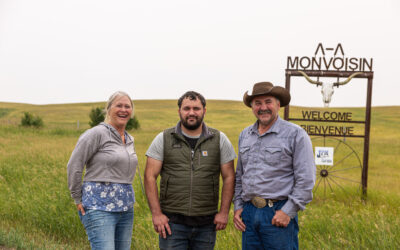
JPM Farms in Canada quietly gained recognition for its dedication to environmental sustainability and quality cattle. The Monvoisin family earned the 2023 CAB Canadian Commitment to Excellence award for their outstanding results and partnership with Duck Unlimited, showcasing their commitment to improving the land, cattle and family daily.

Progressive quality

I first “met” Chuck Backus in the early 2000s. It was before we had a blog so we used the email list then called BLACK-INK. I still have the exchanges but of course can’t find them… Anyway (as he and I both say a lot) the retired Arizona State University provost with a 40,000-acre ranch wanted to convert his desert-based herd to high-quality, high-percentage Angus.

Few believed he could do that, even before we saw how tough the environment is. “It’s 22 square miles of rocks, cactus and mountains that we call pastures, but we have animals that do well in these conditions,” he says, noting the frequent day-long rides to monitor that.

C
Chuck often hosts groups for educational presentations on the Quarter Circle U.

We all admired the drive. By the time Angus Media President Eric Grant and I stopped in to capture his story in 2013, nobody could doubt the success. But Chuck wasn’t done, still isn’t.

A couple of days ago, capping off a year of cooperation in our Following the Calves series, Chuck and Judy, his wife and partner of 59 years, accepted one of the highest honors from the Certified Angus Beef brand: Progressive Partner. Click that link to read all about it.

Their Quarter Circle U Ranch near Apache Junction is the home of highly focused and applied innovation. They keep their eyes on a vision of ideal cattle, using science and technology to keep getting better each year. As a benchmark 10 years ago, the first load of ranch calves finished in Texas made 50% low Choice but only one made CAB, and by 1% of a marbling score.

In March, we wrote about the steers he sent to Oklahoma, promising a report later: well, 95.4% of them qualified for CAB, and most of them Prime.

That seems hard to beat, but the moving target now includes much greater efficiency. I’m sure there’s going to be more to write about and learn from on the Quarter Circle U.

The Quarter Circle U has been 100% solar only for several decades.

At the CAB Annual Conference in Tucson this past weekend, the 650 other partners from around the world applauded Chuck’s video comments.

“Ranching relates the person in all of our complexity to the real world, animal and earth kingdom that we live in. We have come from a million years of gathering tribes to farmers and sustaining communities and civilization.”

Though evolution has distanced humans from their food suppliers, he aims to close the gap.

At the end of the day, I enjoyed refreshments with Chuck, Judy and manager Dean Harris in 2013.

“I have a personal drive to leave the world a little better than I found it. Ranching combines improving mother earth with the quality of the products that come from it. That quality is much better, either because of my direct contribution or setting an example that others could use to pursue goals.”

We call that a progressive attitude from a friend of the brand, the planet and everything on it.

Let’s keep building tomorrow together!

–Steve

PS–That opening shot shows Chuck and Judy Backus accepting the 2016 CAB Progressive Partner Award Sept. 24 in Tucson, with CAB Supply Development Director Justin Sexten, left, and President John Stika, right.


Catch up on Chuck’s whole story with these posts:

Our “Following the Calves” series also takes you to Florida and Nebraska in these installments:

You may also like

Going Above and Beyond

Going Above and Beyond

It’s a normal day near Hudson, Colorado for the Walter family, yet the view is uniquely awe-inspiring for visitors who have never stepped foot on a ranch. As cows come in closer visitors take in the far-reaching pastures and breath-taking mountain views. For the Walter Family, there’s no better backdrop to introduce people to the place where beef begins.

Progress, Not Perfection

Progress, Not Perfection

It’s a labor of love, obvious in the way she lights up explaining their family’s 33-year effort to proactively adapt Angus cows to their land. A lifetime of telling stories from the pasture or kitchen has resonated with nonfarm consumers as much as fellow ranchers. “Everything we do is about cattle, but it’s also about family and connecting our kids to the land and to the cattle,” Debbie Lyons-Blythe says.

Like Father, Like Daughter

Like Father, Like Daughter

For Hands, there’s no short answer to anything. Problems are approached with thoughtful consideration to every possible outcome. Solutions are executed with care. It’s more than a suggestion on how to treat everything from people to cattle to equipment, it’s simply the Triangle H way. They work to be the best in everything they do – a mindset that he’s passing on to his daughter.
Corah honored by Feeding Quality Forum


by Steve Suther

Seven years ago when Larry Corah suggested adding a people element to the Feeding Quality Forum (FQF) he helped launch in 2006, he certainly didn’t expect to be a recipient of the Industry Achievement Award one day.

Now “mostly retired,” Corah was an easy choice for the FQF committee, which moved to honor one who served the beef community – from ranch to consumer – for more than 50 years.

He grew up in North Dakota in the 1950s, when technology was reshaping agriculture. His parents attended school to 8th grade, but they never stopped learning on a farm that included a small feedlot. The family cooperated in many Extension research trials to see how electricity, silage unloaders and hybrid seeds could make life better.

Corah loved to learn by doing, whether in animal science at North Dakota State University, as a local county Extension agent in 1964 or digging into the feedlot side for his Master’s in ruminant nutrition at Michigan State University. There, he met an Australian guest lecturer who made an irresistible offer a couple of years later.

Soon Corah, with wife Mary and two children, were living on the southeastern edge of the Outback for two years while he served as technical advisor for an Australian program to develop a cattle feeding industry.

Coming back in 1970, Corah worked in Extension in Minnesota before the family moved to Laramie, Wyo., while the young scientist earned a PhD in bovine reproductive physiology. In 1974, they moved to Manhattan, Kan., to stay.

He joined Kansas State University as a feedlot specialist, with a first mission of traveling the state to meet people and see the booming industry.

“I had seen 1,000-head feedlots, but not the 20- and 30,000-head operations,” Corah recollects. “The first time I saw a pit full of high-moisture corn, I said ‘what the heck is that?’”

He established relationships quickly, helping each new contact think about what they’d like to know with K-State’s assistance. He felt a kinship with each cooperator as they sought to adapt new technologies to their feedyards.

Corah also developed a little-used summer internship program into a network of a dozen committed young people placed at leading yards across the feeding belt.

“Not only did we get a lot of science done, but it was a good training ground for students,” he says.

The feedlot specialist became beef section leader at K-State in 1979 and head of cow-calf research in 1985, becoming the first Wildcat to earn the Extension Achievement Award from the American Society for Animal Science in 1987.

For all the cooperative research Corah was getting done, across 20 years he also mentored a wave of 30 graduate students who went on to take leading positions in the beef industry, academia and allied industry.

His easy-going personality helped him build a thick Rolodex of industry contacts over the years, and those helped launch his own “retirement” careers. Corah left Extension after 25 years to head up producer education at the newly unified National Cattlemen’s Beef Association in 1997.

There he established strategies and programs as a foundation of NCBA efforts to this day, including an expanded Cattlemen’s College.

In 1998, when former grad students with the Certified Angus Beef ® (CAB®) brand suggested their mentor to lead the company’s outreach to ranchers and cattle feeders, Corah signed on as vice president of supply development, based in Manhattan, Kan.

The next year, he and new staff members that included current CAB president John Stika launched the CAB Feedlot Partners program, and later teamed up with allied industry sponsors to hold the first FQF seminars in Nebraska and Texas.

Always looking ahead more than back, Corah predicts the growing trend of individual cattle management will lead to more of a “supply chain focus, where feedyards will really target a lot of their production” toward specific value-adding programs and brands.

“The fact that we put cattle on feed for 100 to 150 days of a high-concentrate diet creates a really intense flavor profile that has established our beef as not only something that the U.S. consumer wants, but globally it positions us,” Corah says.

These are exciting times for a career teacher and student of the industry.

“It amazes me how dramatically we’ve changed cattle,” Corah says. From breed makeup to performance gains, their evolution didn’t leave carcass quality behind.

“Today nearly 70% of the cattle grade Choice or Prime and CAB acceptance rates – years ago we set a target at 30% and thought that’s just unachievable,” he notes. “Now we’re seeing weeks and months where we’re doing that.”

 The many who reach out to congratulate Corah will likely hear the disclaimer, “I’ve always been surrounded by talented people.”

Those would invariably reply they owe much of their own industry achievements simply to being on the same team.

Corah will accept the award just prior to the noon CAB brand lunch in Grand Island, Neb., Aug. 23 and two days later in Amarillo, Texas.

The meetings are sponsored by Zoetis, Roto-mix, Feedlot magazine, Micronutrients and CAB.

Online registration is available at www.feedingqualityforum.com, or contact Marilyn Conley at 800-225-2333 or mconley@certifiedangusbeef.com.

You may also like

From the Ground Up

From the Ground Up

Benoit Angus Ranch, a seedstock operation that markets more than 150 bulls annually, is a multi-generation family business with sons Doug and Chad now heavily involved. Focused on serving the commercial cattleman, the Benoits built a reputation for high-quality cattle that perform on the ranch, in the feedyard and on the rail. With always-improving cattle to support that renown, and the will to back it up, Benoit Angus Ranch earned the CAB 2023 Seedstock Commitment to Excellence Award.

Future Focused Business

Future Focused Business

Pilot partners in CAB’s Ranch to Table program, these North Dakota ranch families took some of the market volatility into their own hands in April 2022. Their leap of faith provides high-quality beef options for their communities and diversifies their income. Now they sell their finished cattle, as well as those of their customers, through Dakota Angus, a direct-to-consumer beef business.

Building Bonds

Building Bonds

A dozen members of the Meijer communications team arrived to experience, first hand, how the beef they sell in their stores is raised. They touched and felt and tasted and smelled every aspect of the cattle business from the delicious flavor of Certified Angus Beef ® ribeyes to the slippery sensation of you-know-what on their shoes. Questions of every nature were asked and answered by true cattlemen and champions for CAB, Bruce, Scott and Andrew Foster.

Simply innovative

Steak packaging, quality, label win honors


by Hannah Johlman

If there’s an easier way to home-grill the best steaks – and the search continues at Greeley’s Colorado Premium Beef, which brought Truly Simple™ to market this year – it’s hard to imagine.

But it’s easy to see why the concept featuring the Certified Angus Beef ® (CAB®) brand just won honors: First Place in Refrigerated & Frozen Foods magazine “Top 5 Best New Retail Products” contest.

The center-cut, closely trimmed 4-ounce, 1½-inch-thick pairs of steaks are pre-portioned and packaged to toss on the grill and serve as dinner for two in 8 minutes.

“We combined years of consumer beef research with Colorado Premium’s inherent steak cutting experience to come up with this truly innovative product,” says company president Kevin LaFleur.

Provided with easy cooking instructions and recipes, the label answers any questions consumers may have and promises precision from nutrition and calorie counts right down to consistently delicious results.

“A lot of people are really intimidated when it comes to cooking steaks, so our instructions are easy to follow,” says LaFleur. “That dramatically increases the chance of serving an amazing steak.”

The company’s Truly Simple brand partners with CAB to help all consumers, but especially “millennials, boomers and the nutritionally conscious,” he adds.

Center-cut rib eye, strip loin, sirloin, rib cap, flat iron and beef tips are the six choices in the product line, all offered as two servings per 8-ounce package.

LaFleur points out benefits to retailers and consumers alike.

“At the store level, retailers can age the beef 21 days in the case in the same package,” he says. “Consumers can freeze the items in the package, or serve a delicious, nutritious entrée in 8 minutes. Vacuum-sealed packaging also makes for easy cleanup.”

“Consumer demand for great-tasting beef continues to rise,” says Tracey Erickson, vice president of marketing for CAB. “With these products, customers can enjoy the beef’s complete package of great taste, nutrition and convenience in a satisfying portion size.”

You may also like

How to Face Evolving Demands

How to Face Evolving Demands

In the rapid changing space of sustainability, finding clarity on what to do is challenging. At the 2021 Feeding Quality Forum, Dr. Kim Stackhouse-Lawson offered insights on what can be expected of producers moving forward.

Change is a good thing

Change is a good thing

From the moment his boots hit the dirt on the way to the barn, to switching off the lights and locking the door of the Hickory House Restaurant, Jonathan Perry is committed to the beef business. The 2021 CAB Chairman brings a unique perspective to the table. By day, he’s a cattleman. By night, he’s a meat cutter.

One tour at a time

One tour at a time

Telling their story to the cattle curious was awkward at first for John and Gaye Pfeiffer. Now, they look forward to hosting hundreds of people every year, sharing everything about the beef cattle life cycle and why they choose Angus cattle on their central Oklahoma farm. Their dedication to teaching and connecting with those further down the supply chain earned them the 2021 CAB Ambassador Award.