
Sysco Highlights the Value of Beef Quality Assurance

By Briley Richardfreelance writer for Certified Angus Beef

March 25, 2026

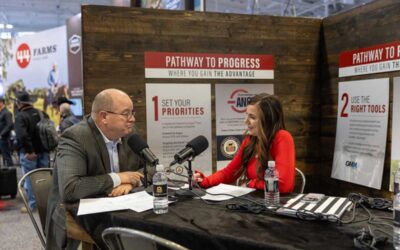
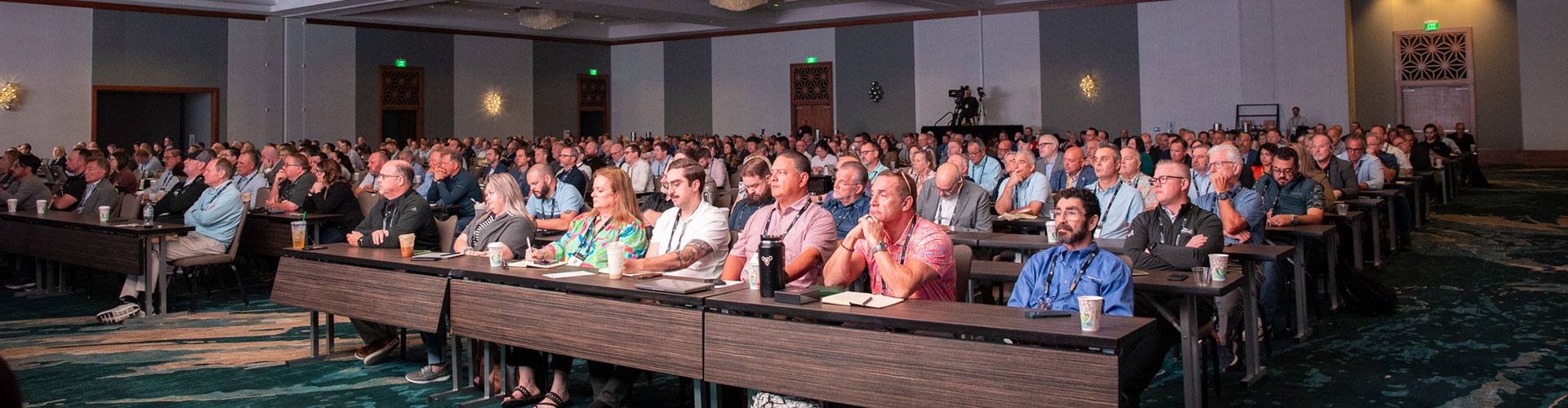
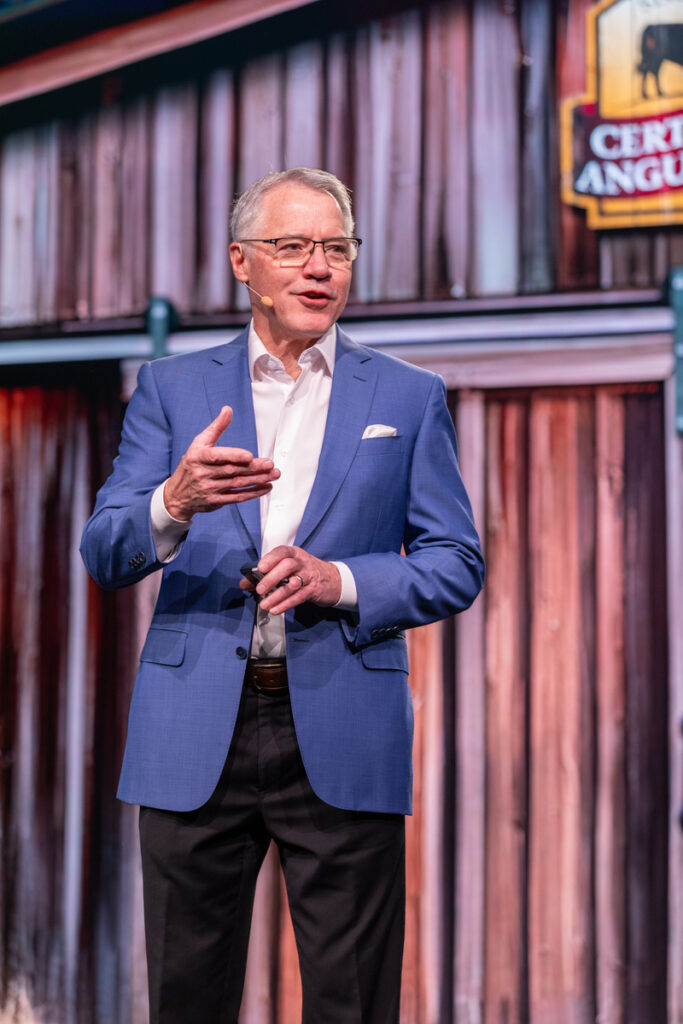
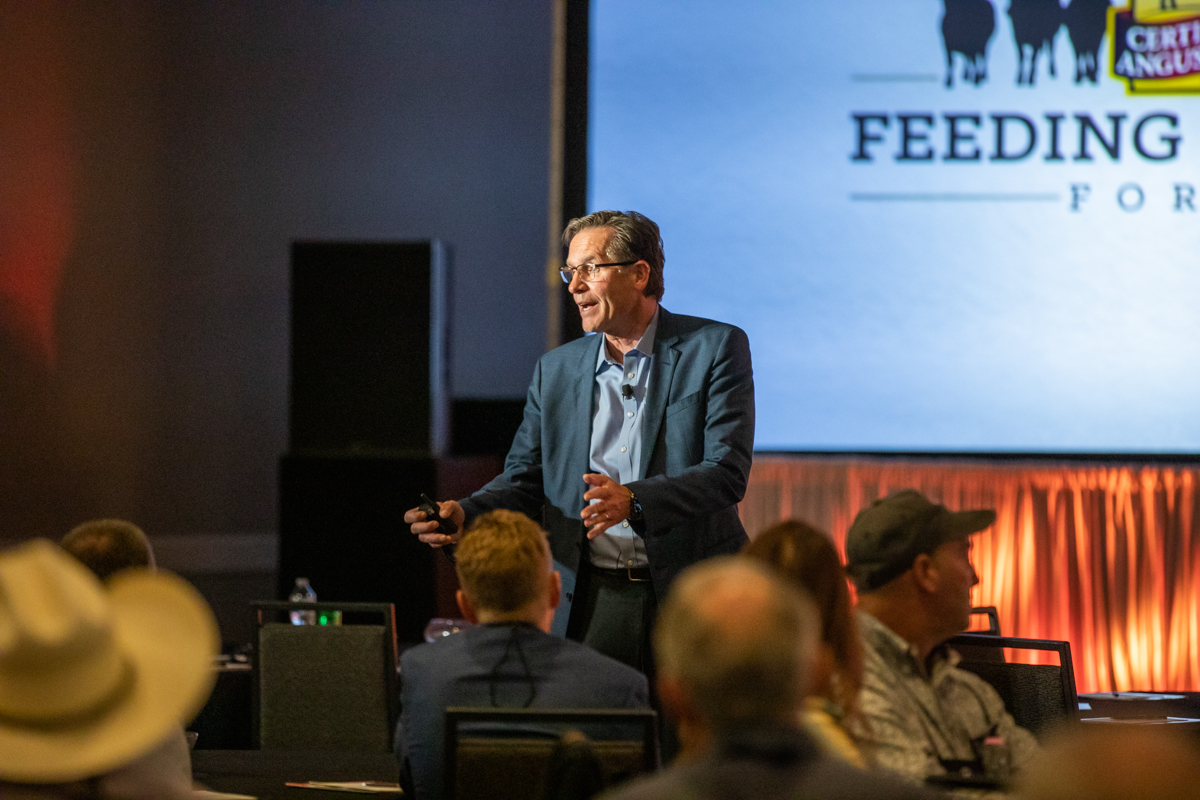
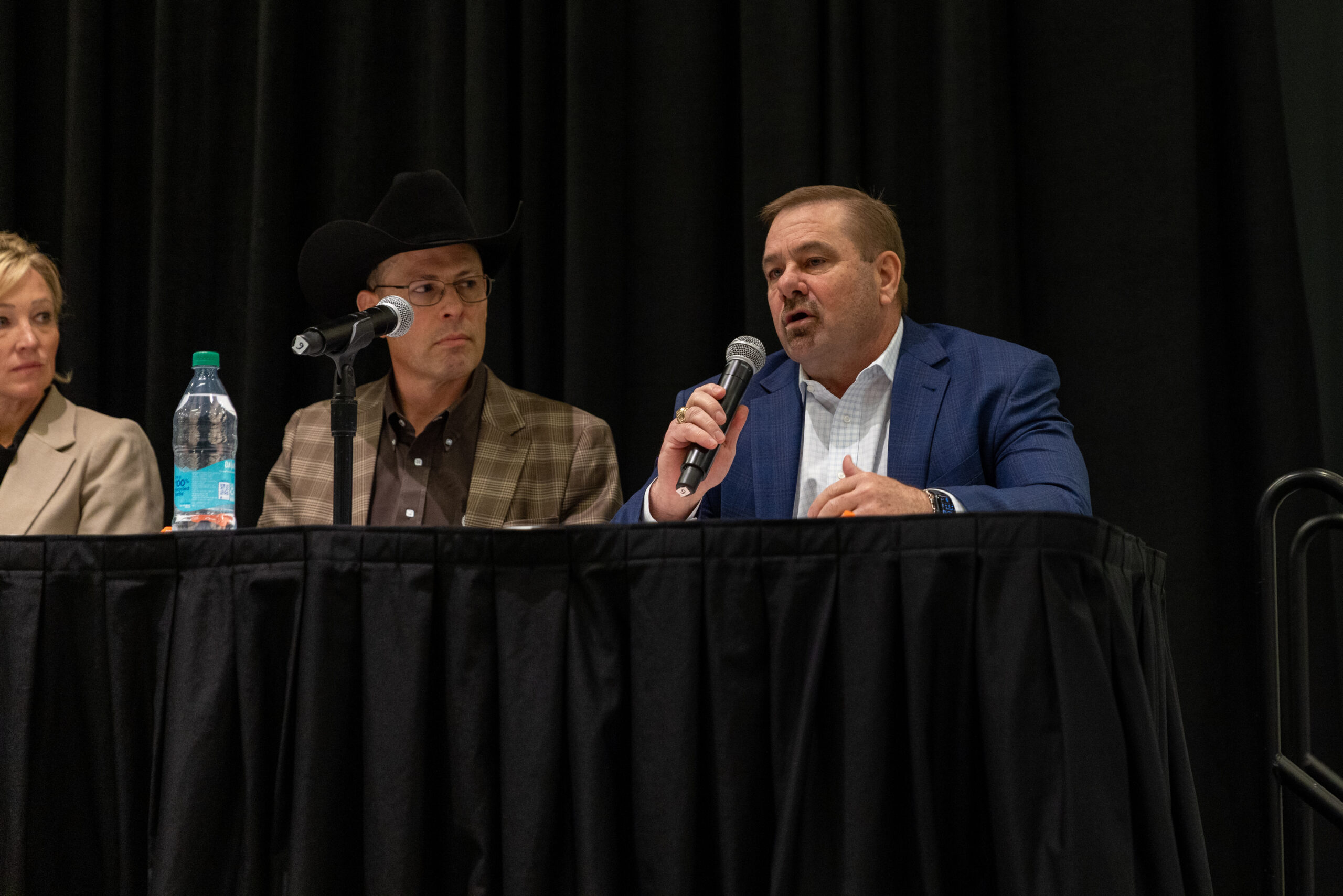
The best beef is raised the right way. This message was reinforced by remarks from Joe Don Eilers, vice president of merchandising for Sysco, who spoke as a panelist at the Beef Quality Assurance (BQA) Producer Forum during Cattle Con 2026. 

Representing one of the nation’s largest foodservice distributors, Eilers shared how best practices in cattle care and beef production influence beef product, ultimately reaching the plates of restaurants and kitchen tables of consumers. 

“At the end of the day, quality beef is a safe, wholesome product for our participants to use,” Eilers said, adding the ultimate goal is delivering a mouth-watering steak that keeps customers coming back for more. 

Industry collaboration is key to delivering this eating experience, and programs like BQA help ensure consistency from pasture to plate. For decades, BQA has provided science-based guidelines and education to help family farmers and ranchers improve cattle care, product quality and consumer confidence. 

“We believe in the value that the BQA program has brought to the industry for decades,” Eilers said. “That mission to bring knowledge about best practices and innovations to producers across the industry has resulted in a better product that we’re able to purchase and ultimately serve to consumers.” 

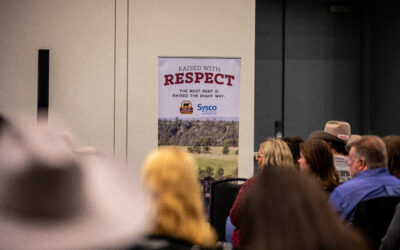
The commitment to cattle care and continuous improvement is also reflected in the Raised with Respect™ program, a partnership between (CAB) and Sysco, now in its third year. The initiative helps expand awareness of BQA principles while supporting educational resources for ranchers and additional collaboration across universities, extension systems and industry partners. 
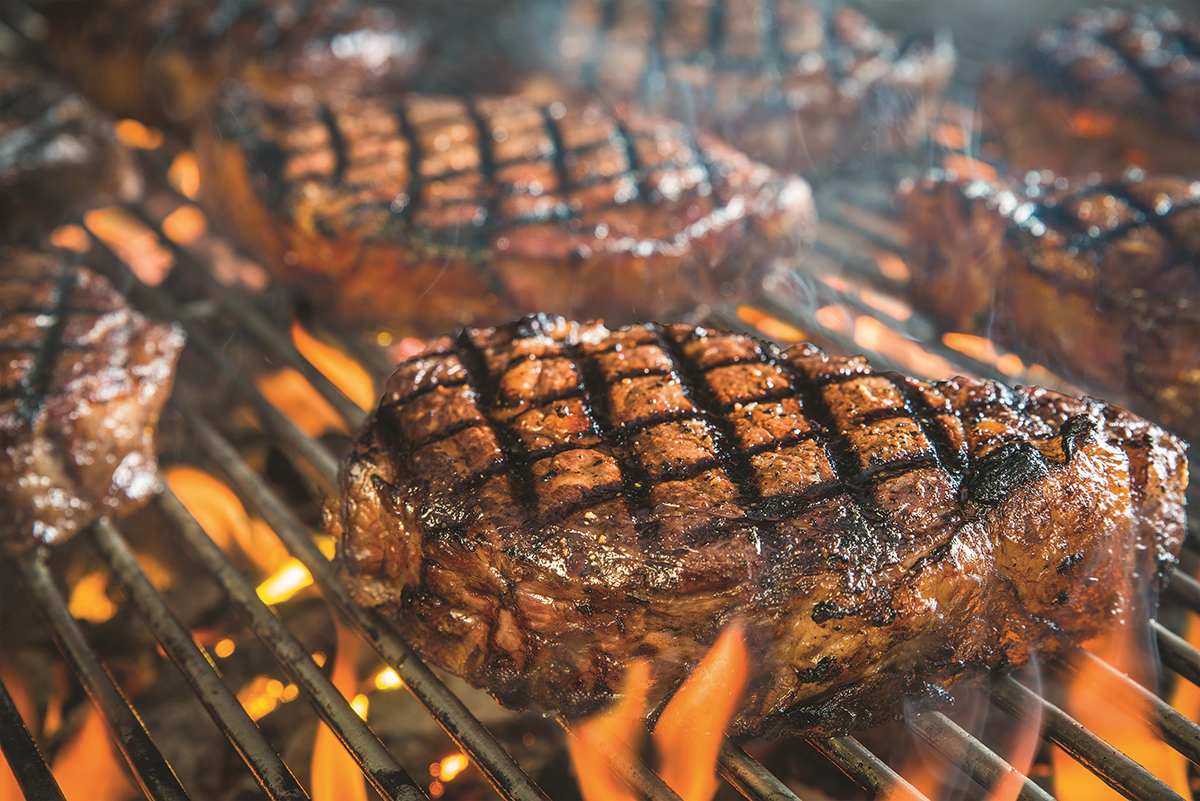
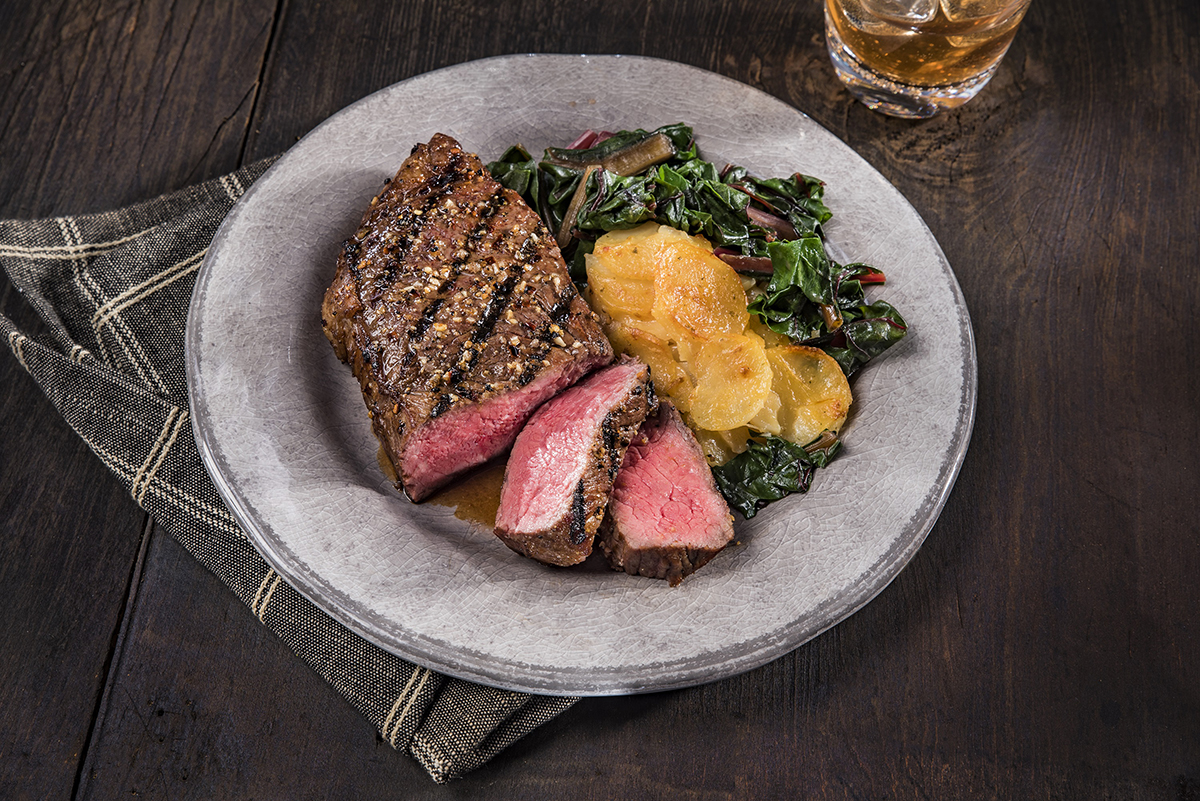
raw Certified Angus Beef ® steaks

“This campaign is really about bringing another level of awareness to the work BQA has done over the years,” Eilers said, “and creating more opportunities to communicate what can be improved in beef production.” 

The commitment to advancing best practices and helping to ensure beef demand recently earned Sysco national recognition; National Cattlemen’s Beef Association named the company the 2026 BQA Marketer of the Year at Cattle Con. This award highlights leaders who go above and beyond to promote BQA and support responsible cattle care across the beef industry. 

“As a primary producer-facing program, BQA has been providing guidelines and resources to help cattlemen improve their cattle and resulting beef for decades,” said Josh White, senior executive director of producer education and sustainability for NCBA. “It’s exciting to see this work done on farms and ranches across the country and also lends value for how a large beef seller, like Sysco, tells the beef production story.” 

For Eilers, those efforts also help build trust with consumers who want greater transparency about how their food is raised. 

“Customers and consumers today want more and more information about the products they’re buying and eating,” he said. “The BQA program really helps us talk about best practices around animal husbandry and environmental stewardship, and that builds confidence in the beef producers raise.” 

You may also like
Certified Angus Beef Launches New Podcast

Certified Angus Beef Launches New Podcast

Certified Angus Beef Launches New Podcast By Certified Angus Beef April 8, 2026 Ever wondered how Certified Angus Beef (CAB) got its start—or how the brand continues to drive demand for Angus genetics today? The CAB Bite podcast will answer those questions and more....
Protecting Brand Integrity

Protecting Brand Integrity

Protecting the brand’s integrity has been a core pillar since 1978. Integrity is so foundational that the brand was built around the premise: with integrity, nothing else matters, and without it, nothing else matters.
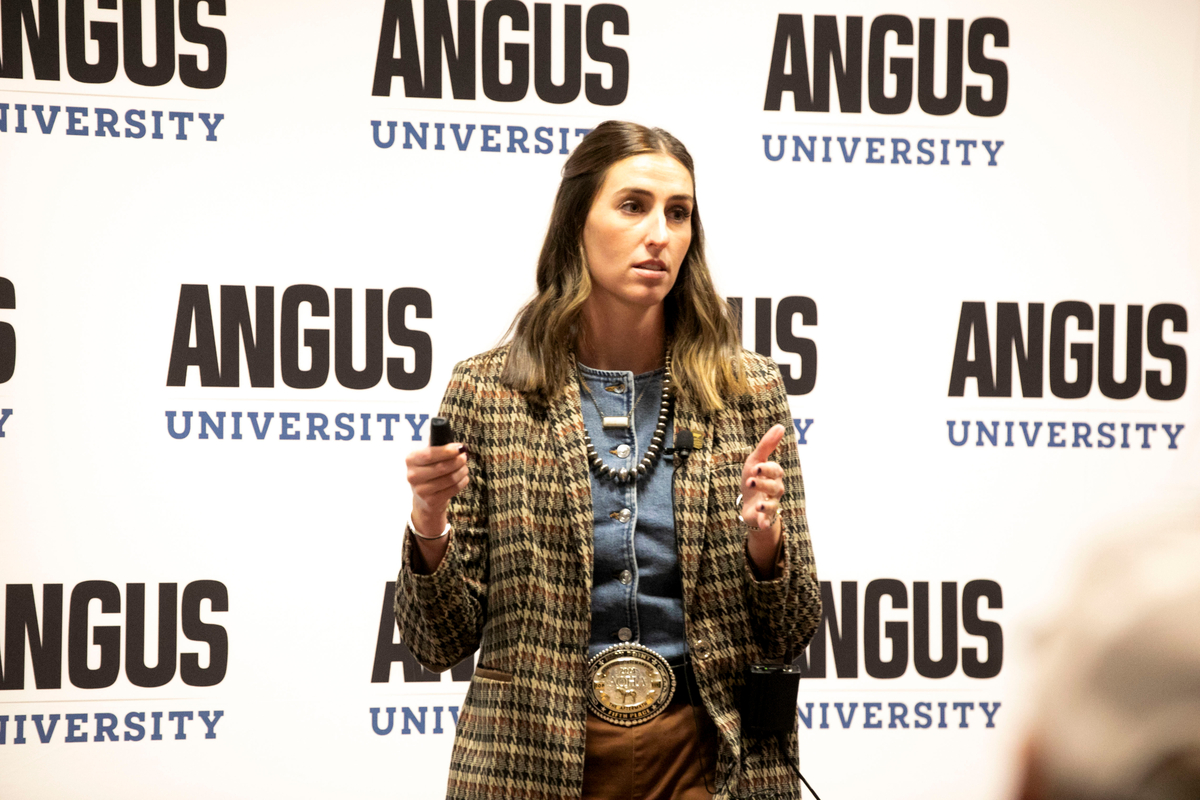
Hugh Aljoe talking about land stewardship at Angus University 2025

Healthier Soils and Stronger Herds

Noble Research Institute shared data-backed management practices for land stewardship.

by Briley Richard, freelance writer

December 18, 2025

Every grazing decision leaves a mark on the land and affects the herd that depends on it.

Effective land stewardship goes beyond isolated practices, requiring an understanding of how each decision affects forage growth, cattle performance and long-term stocking rates. When land is the foundation of the business, producers are more likely to invest time and resources into managing it intentionally.

Certified Angus Beef’s Kirsten Nickles, Ph.D., and Hugh Aljoe, director of ranches, outreach and partnerships at Noble Research Institute, discussed land stewardship practices at the 2025 Angus Convention in Kansas City, Mo., in November.

Kirsten Nickles presenting at Angus University

Caption: Certified Angus Beef’s Kirsten Nickles, Ph.D., introduces the land stewardship session focused on intentional grazing management and long-term resource resilience during Angus University at the 2025 Angus Convention in Kansas City, Missouri.

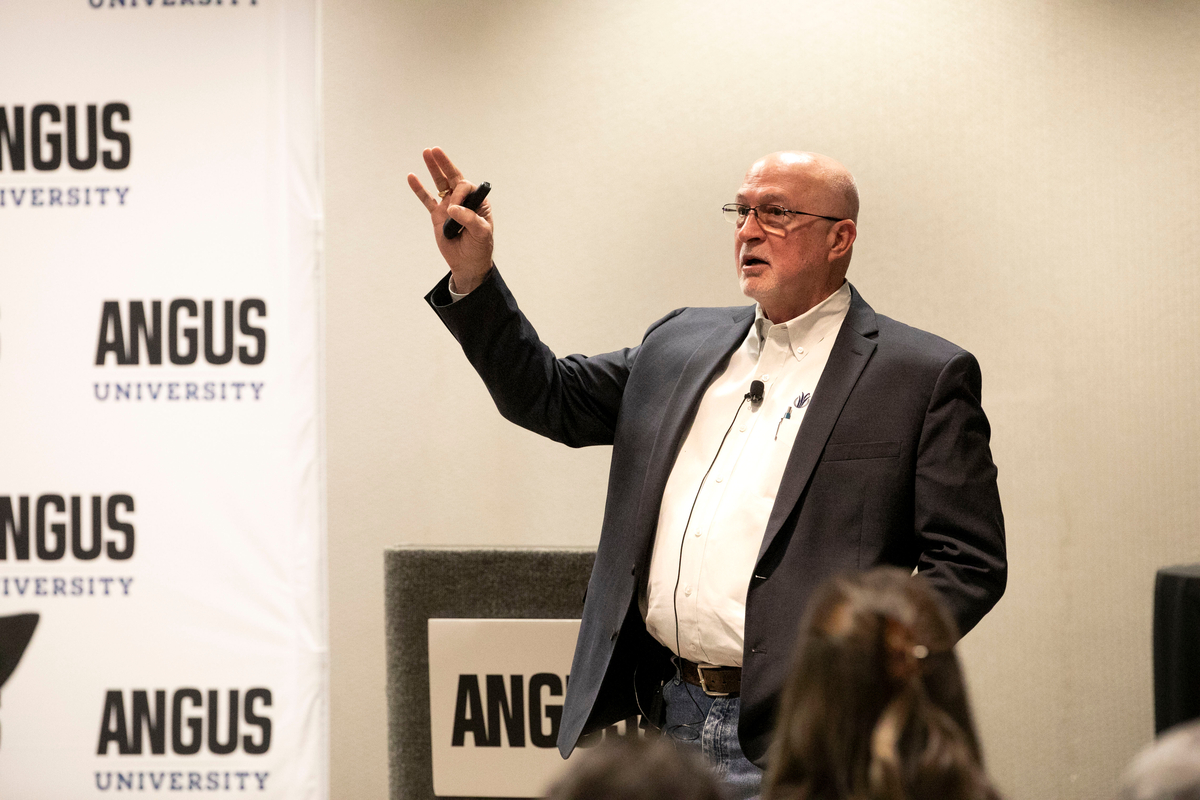
Hugh Aljoe presenting at Angus University

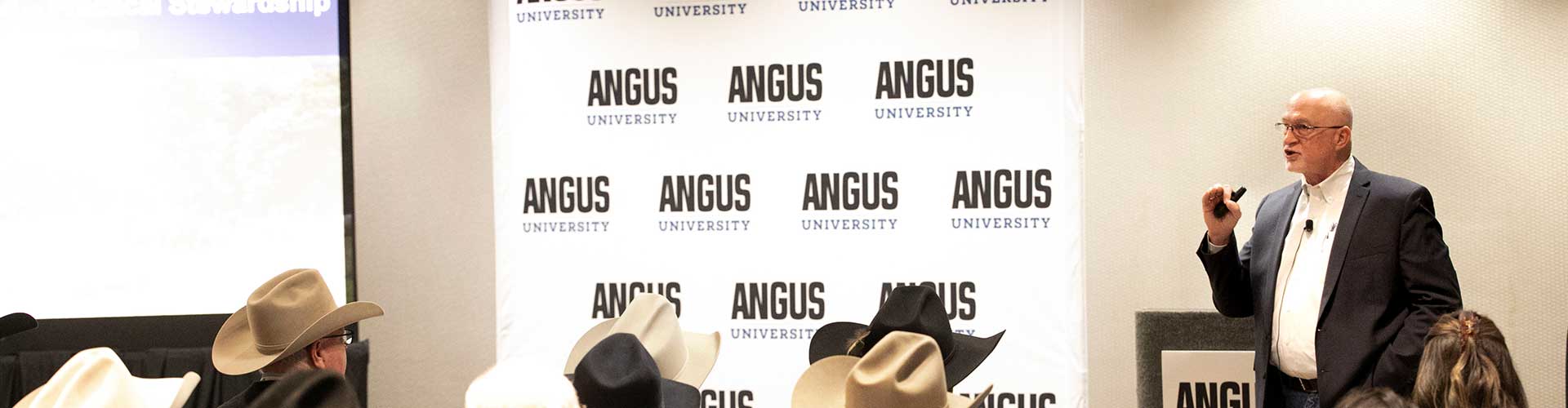
Caption: Hugh Aljoe, Noble Research Institute, shares insights on data-backed land stewardship practices during an Angus University session at the 2025 Angus Convention in Kansas City, Missouri.

“When we start thinking about land stewardship, think about the legacy of the land,” Aljoe said. “All of us want to be more profitable. All of us would like to see our land improve. But how do we go about intentionally making it happen?”

Aljoe expressed how management directly affects soil biology, forage recovery and carrying capacity. Concepts such as maintaining adequate residual forage, shortening grazing periods and extending recovery periods were explained as essential tools for producers who seek to protect and improve their resources.

“We want to minimize the disturbance, and we want to minimize the impact,” Aljoe said. “If we’re going to be grazing, we want to graze for a short period of time.”

Noble Research Institute research shows how adaptive grazing can dramatically increase grazing days. In the study, cattle moved daily or multiple times per day produced significantly more available forage compared to herds rotated less frequently.

“I’m getting 43 percent more grazing days through this methodology over our prescriptive [grazing] approach, which is a good rest rotation,” Aljoe said. “That’s where the power of applied adaptive grazing really begins.”

Angus cows grazing

What are the first steps someone can take to move toward more sustainable land stewardship? First, evaluate your stocking rate as the most critical decision made each year. Key drivers of profitability and land resilience include managing below carrying capacity and adjusting numbers based on rainfall variability.

Using a region’s typical rainfall pattern, Aljoe explained that producers often plan around an average, which rarely occurs. Some years come in well above and others fall short, meaning forage supply varies more than many expect. The goal is to understand the range of rainfall across many seasons and adjust stocking numbers so the herd stays in harmony with what the land can produce.

Tools that track soil health and grazing patterns reveal how small changes influence forage recovery and long-term productivity. By documenting pasture conditions, tracking decisions and assessing outcomes, you can better identify opportunities to strengthen both land and herd performance.

“Ranch management begins with intentional land stewardship, and its applied practices that align with soil health principles,” Aljoe said. “So how do you know when they’re messing up? Which one is the weakest ecosystem process that needs to be addressed first? That’s what you get a taste of as you go into these Land Stewardship modules.”

Noble Research Institute, in collaboration with Certified Angus Beef, offers a free online Land Stewardship course designed for producers looking to strengthen their land management practices. The course teaches you how to achieve healthier soil, more resilient grazing land and greater profitability through better land management, reducing inputs and optimizing natural resources. Learn more at https://cabcattle.com/land-stewardship/.

You may also like

Certified Angus Beef Launches New Podcast

Certified Angus Beef Launches New Podcast

Certified Angus Beef Launches New Podcast By Certified Angus Beef April 8, 2026 Ever wondered how Certified Angus Beef (CAB) got its start—or how the brand continues to drive demand for Angus genetics today? The CAB Bite podcast will answer those questions and more....

Sysco Highlights the Value of Beef Quality Assurance

Sysco Highlights the Value of Beef Quality Assurance

Sysco Highlights the Value of Beef Quality Assurance By Briley Richard, freelance writer for Certified Angus Beef March 25, 2026 The best beef is raised the right way. This message was reinforced by remarks from Joe Don Eilers, vice president of merchandising for...

Annual Conference Audience

Keep the Supply Coming

Certified Angus Beef talks supply and demand dynamics, recognizes ranchers at Annual Conference.

by Lindsay Runft

October 7, 2025

Quantity and quality, the yin and yang to Certified Angus Beef ® brand product supply. While overall cattle herd numbers are down, carcass weights are up. And so is the overall quality for carcasses moving through packing plants. That’s the harmony for Certified Angus Beef (CAB), and a theme of the 2025 CAB Annual Conference.

A record-high 800 registrants from 17 countries gathered in Austin, Texas, to learn more about the Certified Angus Beef ® brand, become inspired by the culinary work of chefs and pitmasters, and celebrate sales and production success. But at the forefront: supply and demand, a reflection of the chaotic past year, and preparing for what’s ahead.

In his annual State of the Brand, CAB President John Stika, noted that the forecast for CAB’s annual sales volume looks to be one of the strongest years for the brand. That said, it’s not been without some peaks and valleys.

“The reality is that it’s [sales volume changes] more of a reflection of the price, supply and trade dynamics that we’ve seen,” Stika said. “They have created uncertainty in the market that we’ve dealt with, and are going to continue to deal with.”​

Beef Bash BBQ 2025 at Annual Conference

Beef in the Box

Marking the 25th time to speak at CAB Annual Conference, Randy Blach, chief executive officer at CattleFax, provided market analysis and insights for the beef industry. When it comes to overall supply, Blach said that we are currently in “the eye of the storm.” CattleFax’s 2025 forecast came to fruition: low herd numbers and high prices. Blach said then that prices were expected to peak approximately one year before the absolute low in supply.

Looking to next year, CattleFax forecasts that we will reach our beef production low at 25.7 billion pounds, largely because of the Mexico border closure and tariff levels on the markets where we import lean beef. Because of the New World screwworm threat, feeder cattle imports from Mexico are expected to be down more than one million head from a year ago—provided that the border stays closed through 2025.

“The market isn’t short on tonnage or supply, it’s short on cattle,” Blach said.

With a value system based on weight and quality, there has been incentive for cattle producers to keep feeding cattle longer. And that’s had a positive effect on beef tonnage numbers.

Currently, steer and heifer slaughter—the source of high-quality fed beef production—is down 43,000 head of cattle per week versus 2022,  when this cattle cycle reached its peak. The Mexico border closure has had an impact on those numbers, too. On a typical weekly basis, approximately 25,000 feeder cattle cross the border from Mexico.

Blach said that futures markets will anticipate the low in supply, with prices usually reaching their peak before we hit the supply low. The market could stay elevated, but it is currently higher due to tariffs and the lack of international market access.

Deferred live cattle futures have been in the driver’s seat of the markets. After the markets closed in early July, and with the Mexican border closed and Brazilian tariffs in place, deferred live cattle futures contracts (Dec., Feb., April) went up about $30 per hundredweight. That resulted in $60 per hundredweight in feeder cattle prices and calf prices up about $100 per hundredweight.

“The market has had one heck of a run,” Blach said.

But for the million-dollar question: when will it reach its peak? Because of the chaotic times, economists have not been able to predict that.

Secondary to market-related questions, the next question is, “When will the herd rebuild start, or has it already?”

A herd rebuild has begun—albeit slowly, Blach said. Partially because of 8% interest rates, this cattle cycle’s rebuild will be slower than the last. According to CattleFax, commercial cow slaughter is down 30% and replacement heifers are estimated to be up 300,000 head.

But what about the beef on dairy population? With 9.5 million dairy cows and 28-29 million beef cows, the total cow herd is increasing. It is estimated that beef-on-dairy cattle slaughter is 4-4.5 million head, or 18% of total fed slaughter.

Blach noted that production for all proteins—beef, pork and poultry combined—is record high. And per capita red meat and poultry consumption is up, too. Consumers currently have an abundance of protein choices.

Randy Blach speaking at Annual Conference 2025

Consumer Demand is Rocking

“Supply has been flat, but prices have gone up,” Blach said. “What’s that tell you? Demand is rocking!”

With stability through spring and summer, beef demand is at a 40-year high.

“Beef is not just having a moment,” Anne-Marie Roerink, 210 Analytics, said. “It is growing a momentum and we’re seeing very high consumption of beef across all areas of the country, all demographics.”

Talking consumer behavior, Roerink explained the difference between consumption and demand. Demand is the desire to purchase beef, whereas consumption is permissibility and affordability.

No surprise to those at the meat counter, retail beef prices are $1/lb. higher now versus one year ago. Blach said that retail prices could still go up to $9.50-$9.75 per pound. But with beef at record-high prices, retail pounds have grown 6-7%, according to 210 Analytics research.

Consumer mindset on the “permissibility” of beef—if consumers feel good about consuming the protein—has shifted positively. As a beef community, we have moved the needle on communicating about attributes like animal care, environmental sustainability and nutrition.

“Beef has gone from villain to vital,” Roerink said.

That’s music to the ears of cattle producers. Demand for high-quality beef ensures profitability at the ranch. And it’s worth $1,070 per head according to CattleFax data.

Consumers continue to send the signal not only for quality beef, but Prime.

Cattle producers have responded. Earlier this year, USDA Prime production grew to 12%, outpacing USDA Select for several consecutive weeks. The trend was reflected at the brand, too. A record-high 13% of Certified Angus Beef ® brand carcasses graded Prime this past year.

“That’s not just progress; that’s proof that quality is winning,” Stika said. “It’s what allows us to be firmly committed to Certified Angus Beef ® brand Prime as a growth strategy, even in the face of tighter supplies and higher prices.”

Angus Families Recognized

For their commitment to progress and the pursuit of high-quality beef production, seven Angus ranching families were recognized at Annual Conference.

  • Seedstock Commitment to Excellence: Tehama Angus Ranch
  • Commercial Commitment to Excellence: Willis Ranch
  • Feedyard Commitment to Excellence: 4K Cattle, LLC
  • Sustainability: Means Ranch Company
  • Progressive Partner: Zybach Angus
  • Ambassador: Maplecrest Farms
  • Canadian Commitment to Excellence: Cross Cattle Company

Beef Bash

From feedyard and ranchers to processors, food distributors, retail and restaurants, Annual Conference brings together all sectors of the beef supply chain. The event provides sessions for retail and foodservice, focusing on strategies for brand sales success.

Other events included the #BeefBash25 BBQ, featuring licensed pitmasters, a ranch tour at 2 Bar C Ranch in Luling, Texas, and a golf tournament and live auction that raised more than $157,000 for the Colvin Scholarship Fund.

Navy SEAL Commander, Rorke Denver, inspired attendees with lessons from the battlefield. Reflecting on the chaos of war missions, Denver said that for team leaders, “calm is contagious.” Denver also urged cattlemen and end-users to reject complacency and continually seek ways to improve their position.

It’s sage advice for the beef industry, with chaotic markets, the challenges of a tightening supply, and an ever-present need for premium beef that meets consumer demand.

Calm is contagious, and keep the high-quality beef coming.

You may also like

Certified Angus Beef Launches New Podcast

Certified Angus Beef Launches New Podcast

Certified Angus Beef Launches New Podcast By Certified Angus Beef April 8, 2026 Ever wondered how Certified Angus Beef (CAB) got its start—or how the brand continues to drive demand for Angus genetics today? The CAB Bite podcast will answer those questions and more....

Sysco Highlights the Value of Beef Quality Assurance

Sysco Highlights the Value of Beef Quality Assurance

Sysco Highlights the Value of Beef Quality Assurance By Briley Richard, freelance writer for Certified Angus Beef March 25, 2026 The best beef is raised the right way. This message was reinforced by remarks from Joe Don Eilers, vice president of merchandising for...

Feeding Quality Forum panel

Data-Driven Progress and Partnerships

Industry leaders identify winning premium-capturing strategies at Feeding Quality Forum.

by Kylee Sellnow

September 9, 2025

Carcass quality, consumer demand and the power of producer-packer partnerships—an opportunity for Prime success in today’s cattle feeding market.

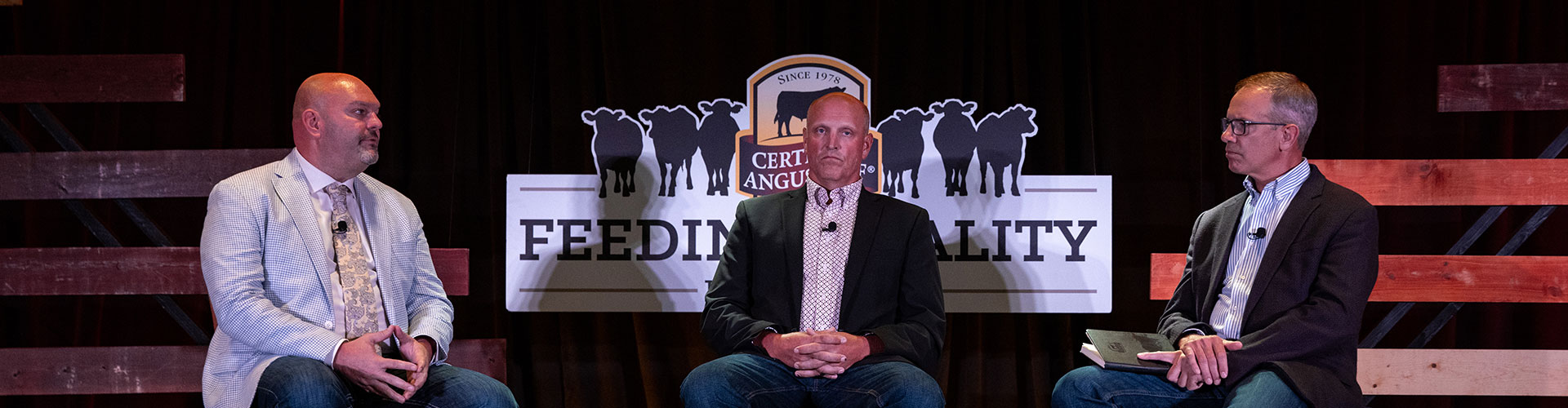
Certified Angus Beef’s (CAB) Paul Dykstra was joined by Dallas Knobloch, 4K Cattle LLC, and Travis Thomas, Upper Iowa Beef, for a panel discussion at the 2025 Feeding Quality Forum in Rochester, Minn. in August.

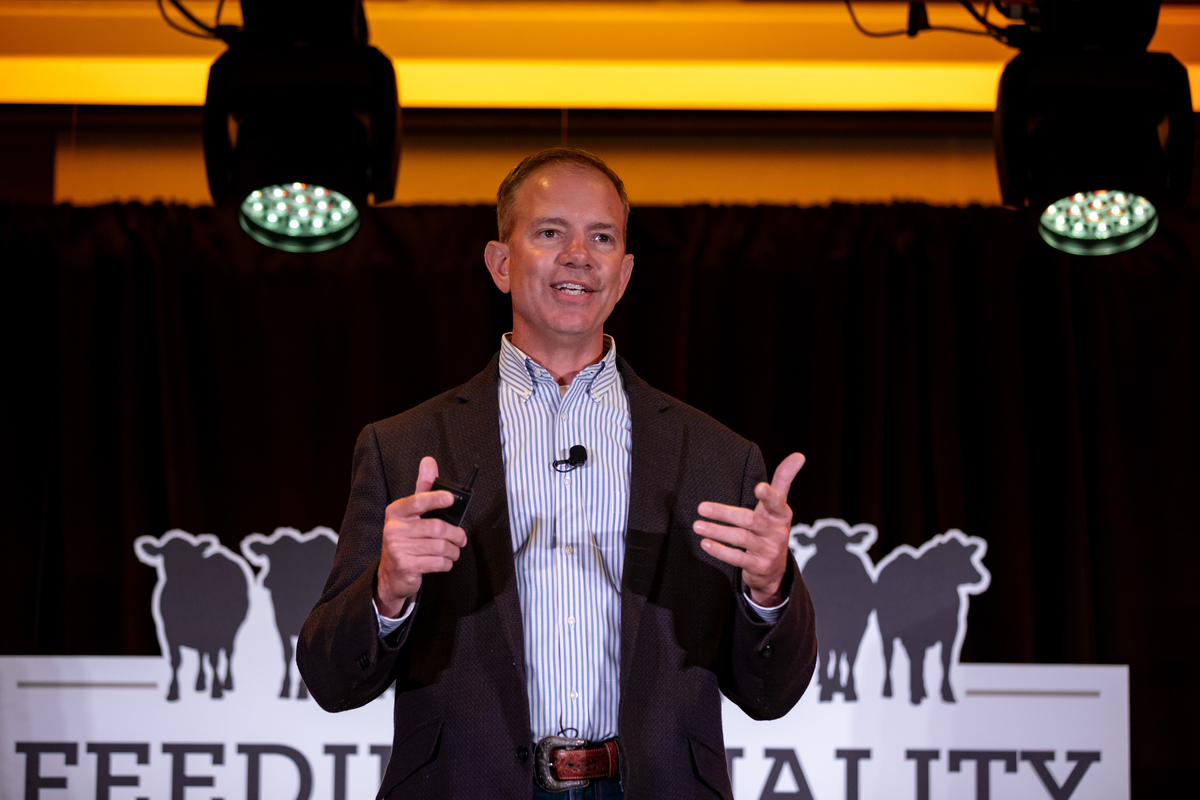
Dykstra shared market insights, starting with signals that 2025 will hit a new record-high of Prime-grade carcasses driven by genetics, management and market conditions.
Paul Dykstra speaking at Feeding Quality Forum

Caption: Paul Dykstra walks through market insights, highlighting the position producers are in to capture Prime premiums.

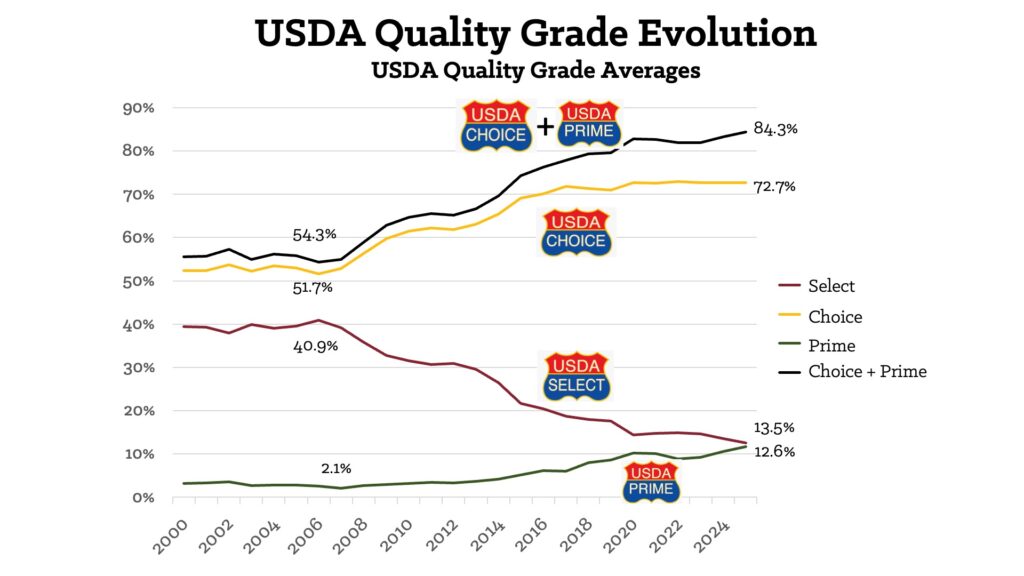
USDA Prime accounts for 12.6% of carcasses today, with combined USDA Choice and Prime reaching 84%. While higher quality cattle flood the market, the Select supply continues to drop.

As Prime rates rise, so do yield grade 4s and 5s, prompting discussions on balancing quality with efficiency.

“Carcass weight has gone up significantly this year, yet data shows us that it is not required for a Prime carcass to be heavier,” Dykstra said. “In 2024, Prime carcasses only weighed two pounds heavier on average versus their premium Choice counterparts.” (CAB Consist Study)

USDA Quality Grade Evolution

The same study shows backfat measurements are up, with Prime averaging 0.71 inches and premium Choice, 0.64 inches in 2024.

Quality grid premiums reached higher in the last year, too. Late 2024, USDA Prime premium averages reached $289.54 per head, CAB averaged $135.24, and Choice followed at $90.80.

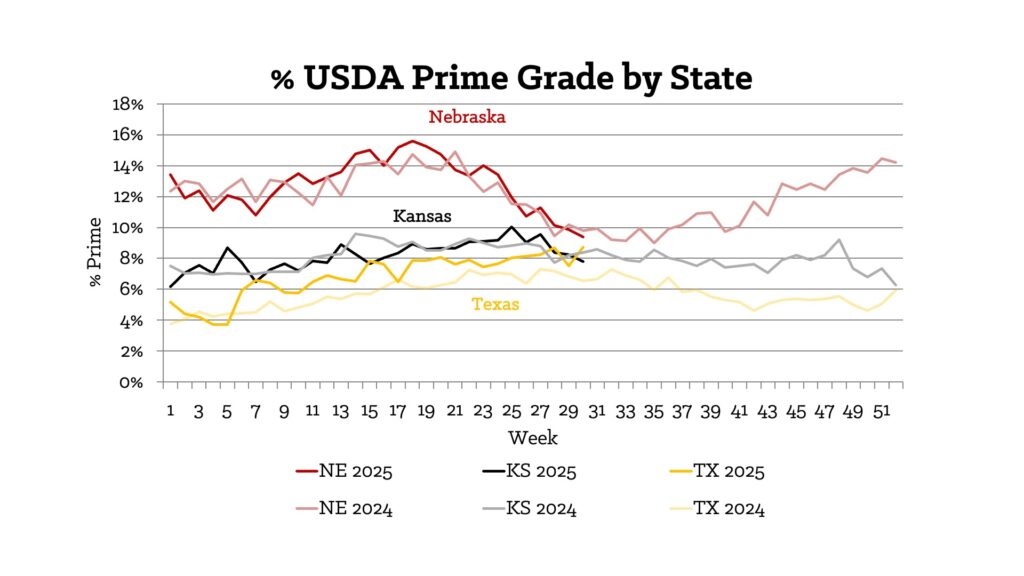
Northern states like Nebraska, Iowa and Minnesota lead in Prime carcass percentages in 2025 with Texas carcasses showing notable year-over-year improvement. Quality premiums are reflected regionally, with Iowa/Minnesota sharing $7.31 and Nebraska $6.75, respectively, August 2024 to August 2025, according to USDA data.

USDA Prime by State

Market Reward

Industry-wide progress starts at the ranch and relies heavily on the balance of management and genetics. It helps when there are market targets that reward everyone.

“Certified Angus Beef has helped us add value and gotten us this far,” Knobloch said. “But it takes discipline to stay true to making a product the consumer wants and not just keep feeding that steer.”

While cattlemen continue to see the reward for their commitment to quality, consumers are demanding more. Despite inflation, consumers continue to prioritize taste and freshness over price, reinforcing the value of high-quality beef.

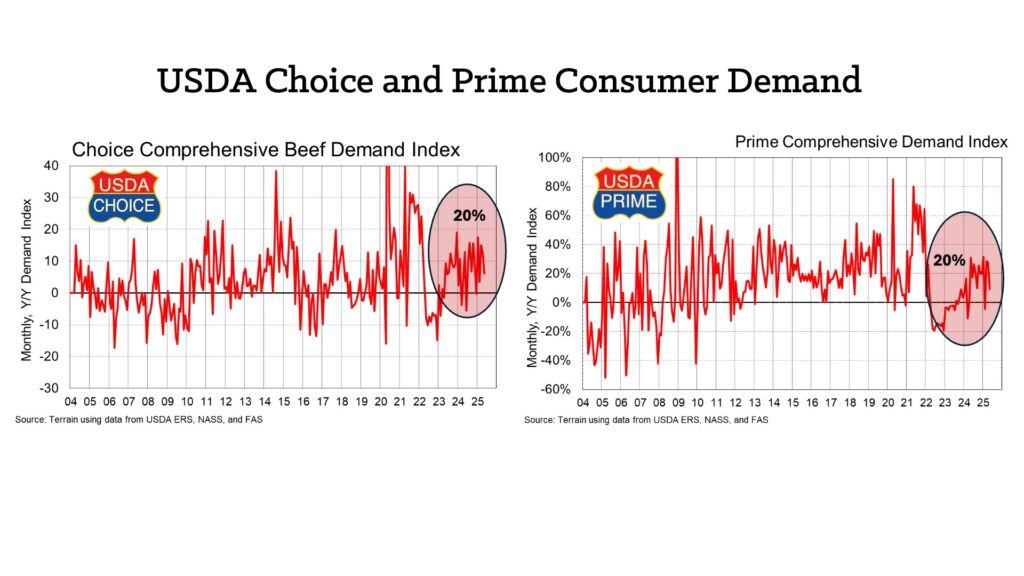
USDA Choice and Prime Consumer Demand

“The consumer is voting for quality with their dollar,” Dykstra noted. USDA and Terrain data show Prime beef demand remains strong amidst historically high prices at retail.

The index shows USDA Prime demand has risen 20 percent year-over-year, while Choice demand stays just under the same threshold. 

The data-driven approach to carcass grading and marketing is helping producers reduce variability and capture more premiums. Thomas emphasized transparency and feedback loops with cattle producers as essential tools for improving quality.

“I can’t ask you to make the cattle better if I don’t give you the information on the backside to help you do that,” Thomas said.

Knobloch echoed the value of feedback, highlighting the role of disciplined feeding and genetic selection in achieving high Prime rates without excessive backfat.

“It’s not just about price. It’s about getting everything else right first, at least the variables we can control,” said Knobloch. He uses carcass data and shares it back with his cow-calf producers to help guide bull selection and herd health.

He noted that ranchers he’s worked with have been able to diagnose heart-health issues and remove those bulls from their programs. “That wouldn’t have happened if they were just hauling those cattle to the sale barn.”

Relationships across the entire supply chain matter. Especially for a Prime target.

Thomas and Knobloch agreed that there have been key drivers when aiming higher than Choice.

First, use carcass data from packers to help guide genetic and feeding strategies. Second, address herd health protocols and stress management early to set the stage for success on the rail. Third, managing by group and environment leads to a more uniform set of cattle to market.

Dykstra added using genomic tools like AngusLinkSM will accelerate progress in the feedyard, and on the ranch.

Knobloch wants to have more retained ownership in his yard because this gives ranchers a “literal stake in where their product goes,” shaping how their feedyard rewards quality improvements.

Discussions at Feeding Quality Forum reaffirmed the industry’s commitment to quality, transparency and innovation. With record Prime rates and strong consumer demand, producers who invest in genetics, health and relationships are positioned to drive progress and capture premiums.

The 2025 Feeding Quality Forum was sponsored by Alltech, AngusLink, NCBA Cattlemen’s Education Series sponsored by National Corn Growers Association, Diamond V, Drovers, FeedLot, Rabo AgriFinance, Select Sires, Selko, and Upper Iowa Beef. 

Find more event coverage at FeedingQualityForum.com.

You may also like

Certified Angus Beef Launches New Podcast

Certified Angus Beef Launches New Podcast

Certified Angus Beef Launches New Podcast By Certified Angus Beef April 8, 2026 Ever wondered how Certified Angus Beef (CAB) got its start—or how the brand continues to drive demand for Angus genetics today? The CAB Bite podcast will answer those questions and more....

Sysco Highlights the Value of Beef Quality Assurance

Sysco Highlights the Value of Beef Quality Assurance

Sysco Highlights the Value of Beef Quality Assurance By Briley Richard, freelance writer for Certified Angus Beef March 25, 2026 The best beef is raised the right way. This message was reinforced by remarks from Joe Don Eilers, vice president of merchandising for...

cowboy silhouettes moving cows

More Than Steak and Potatoes

Resonating with today’s beef consumer takes more than taste.

by Morgan Boecker

March 2023

Yesterday’s steak and baked potato is today’s beef brisket from the restaurant downtown. The food scene is changing, driven by a new age of consumers who want more. They seek new flavors and attributes on the packaging, but still expect beef to taste great.

“We can do all the things in the world,” said Danette Amstein, principal at Midan Marketing and sixth-generation rancher. “But ultimately if it’s not going in their cart or it’s not on their order at the restaurant then it doesn’t really matter.”

Consumers today think about food differently. They don’t know how livestock are raised, so they’re concerned about animal welfare, what the animal eats, the environment and so on, Amstein said.

“Our consumer has changed significantly over the years and some of them don’t even think about steak when they think about beef,” she said.

The great thing about our product is its ability to be utilized across the entire carcass to meet these new expectations.

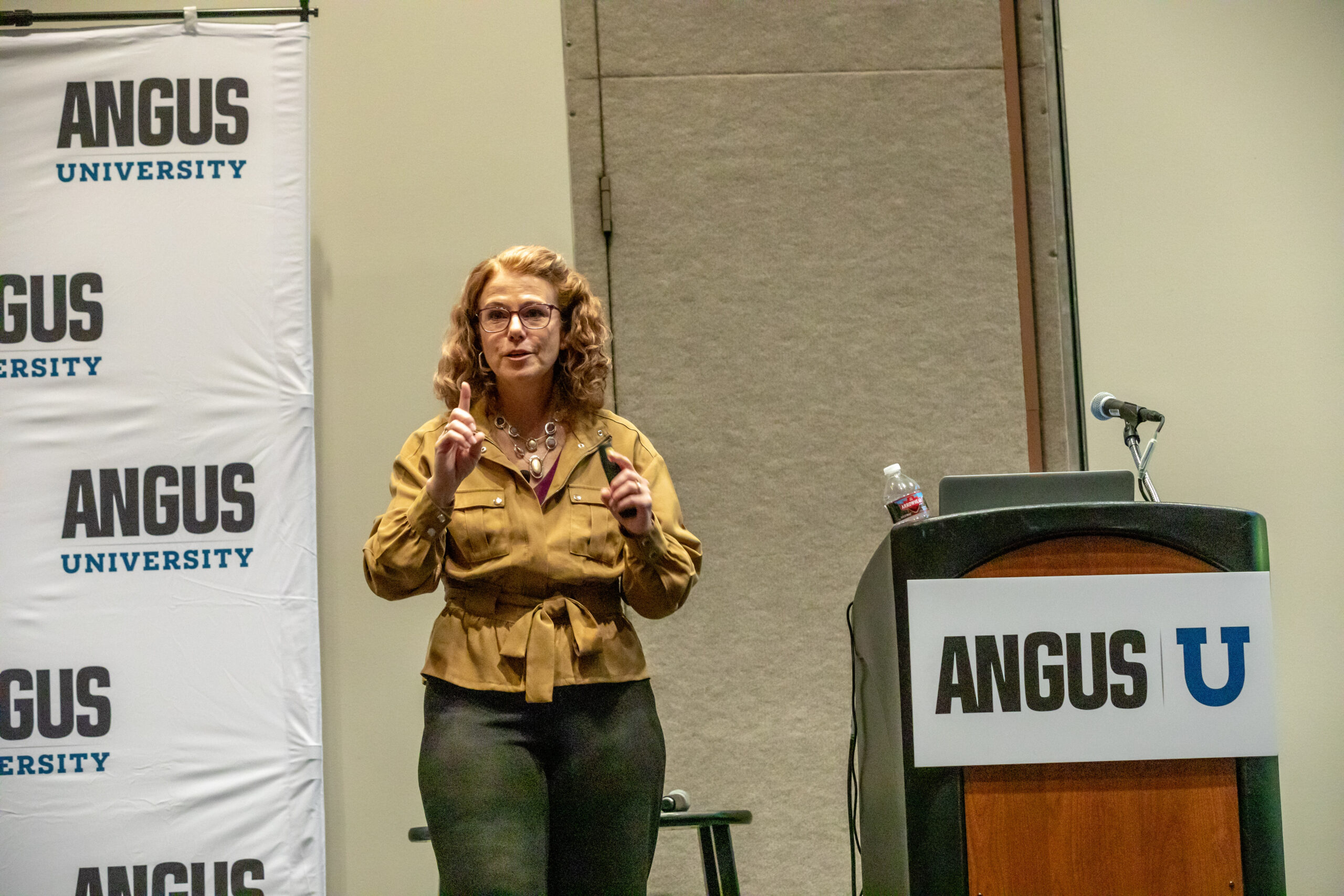
Danette Amstein at Angus Convention 2022

As a sixth-generation rancher, Danette Amstein applies Midan Marketing’s research to share her family’s ranch on social media. “Stop being afraid to show your story.”

Today’s Consumer

Midan Marketing serves as a conduit for sharing with cattlemen what consumers are seeking. Diving into different categories of consumers, they want more than just meat and potatoes and that changes across categories and generations.

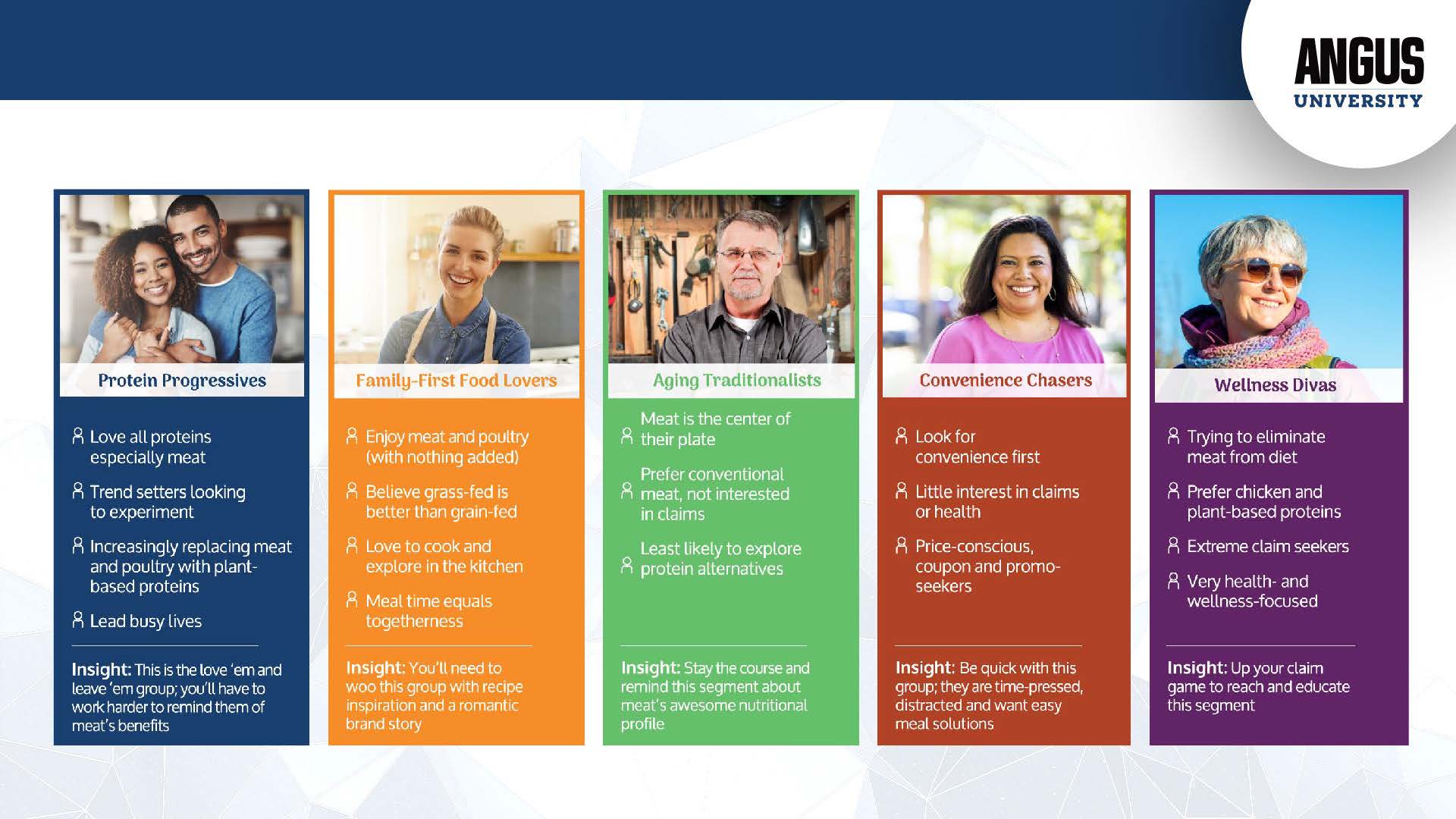
Consumers can be split into five categories, but the COVID-19 pandemic influenced how and where people consumed food. According to the Meat Consumer Segmentation 2.1 survey in September 2020, there were 39% convenience chasers, 20% protein progressives, 18% family-first food lovers, 16% aging traditionalists and 8% wellness divas.  

Another component of meeting consumer satisfaction are generational differences and the upcoming Gen Zs, which are generally anyone born after 1997.

“They’re (Gen Z) adventurous eaters and they’re going to try anything,” Amstein said. “If they like it, they’ll stick to it. Food is social, so they’re easily influenced by their friends.”

Gen Zs are also the biggest group of online shoppers and are curious about animal welfare and nutrition, too.

Each year the population becomes more multicultural, which translates to more flavors and varieties of food on the plate. That gives the beef supply chain more opportunities to capitalize on beef’s versatility, Amstein said.

How do we get each segment to think about beef? “We need products that fit across all of these,” she said.

Consumer categories, Midan Marketing 2022

It’s up to beef brands to create messaging for beef to meet the needs of each of the five categories of meat consumer. (Data from the Midan Marketing Meat Consumer Segmentation 2.1 Survey, September 2020)

Uncontrollable Factors

Major disruptors have swept through the market, bringing more changes to how consumers shop based on circumstances out of their control.

The COVID-19 pandemic made consumers more comfortable cooking at home. Pre-pandemic, only 50% of people would eat meals at home; in March 2022 that number rose to 82%. From the same Meat Consumer Tracker survey, purchasing meat online went from just 14% before COVID-19 to 47% following.

There is an additional dynamic at play today that the industry has experienced in the past: inflation.

With inflation the highest it’s been in 20 years, 82% of consumers are concerned with higher food prices hitting their wallets, Amstein said.

When the price of goods increases, shoppers change their purchasing habits. In the 2022 Meat Consumer Tracker survey, 56% of consumers said they will seek less expensive protein options, 55% said they will freeze meat/chicken more often, and 40% said they’ll purchase more ground beef.

With these new behaviors during high inflation, the beef industry should focus on sharing unique, less expensive cuts of beef and ways to better utilize leftovers at home, she said.

Looking back at how the industry survived the 2008 recession, Amstein said communicating value is a big deal. Sometimes it’s just the sticker price, but other times it’s everything else—taste, quality, how it’s raised—that beef brings to the table. 

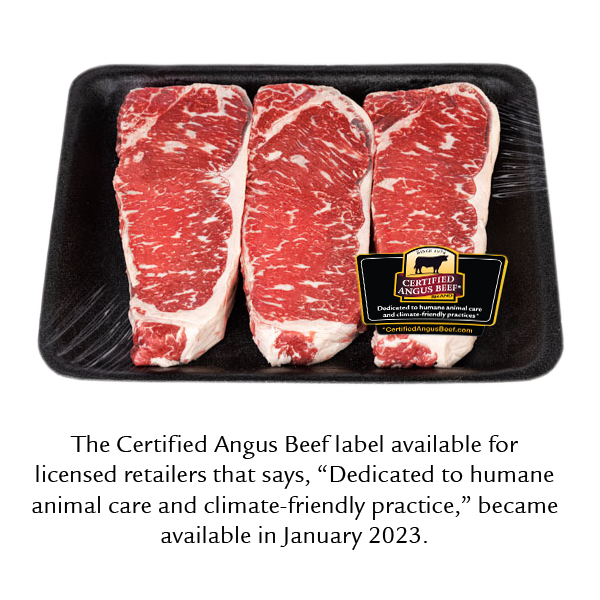
CAB meat label for animal care and climate

Translating Values at the Meat Case  

Communicating that value is where beef brands can leverage production practices to tell consumers how their beef is raised, so they can feel good about purchasing it for their families. But first, our industry needs to know what quality means to those buying the product.

In the 2022 Beef Attributes Research Study, consumers ranked 28 different claims on packages for quality. The No. 1 choice was USDA Prime, but only 52% of respondents thought it was the highest quality. It was followed by USDA Choice, which is most commonly found at a grocery store, Amstein said. Only 30% of consumers considered Angus beef high quality.

“There is a very direct correlation here between the word ‘Angus’ and generations,” she said. Baby Boomers know the Certified Angus Beef ® brand story, and they think Angus means quality, but that recognition decreases with other generations.

This becomes especially relevant at retail. Walking through the grocery store, 94% of the meat case has some form of beef branding and it has changed how consumers think about brands, she said.

If we’re trying to reach the adventurous Gen Z shoppers, there should be marketing messages that communicate how the versatility of beef meets that need.

In a 2021 Gallup survey, farmers and ranchers earned 57% on the trust scale. “That’s high and we have to hold onto that by communicating what’s happening at the ranch,” she said.

“Because as the world gets tipsy turvy, they want that reassurance that what we are raising for them is what we are eating. That what we are raising is good. We’re not cutting corners and we’re taking good care of the animals,” Amstein said. “The best way we know to do that is to leverage brands.”

To be successful and share a stronger story, we’ll all have to get out of our comfort zone to brand, label and market beef, Amstein said. “It really is all about the message.”

Applying the Research to the Certified Angus Beef ® brand   

As aging traditionalists shrink in their share of consumers, a younger generation is growing at the checkout counter. To continue being the leading beef brand, CAB must offer a product that goes beyond taste.

The most direct way to communicate with consumers is through marketing claims. CAB now offers its licensed retailers a marketing label that says “Dedicated to Humane Animal Care and Climate-friendly Practices” to offer a feel-good factor and address customers’ top concerns.

This is only possible with additional information from the beef production sector. That’s why CAB considers accredited programs such as Beef Quality Assurance (BQA) a baseline for cattle care practices and an effective way to standardize animal welfare. Certifications such as BQA can be used to communicate what’s happening at the ranch to care for cattle to generate stronger trust in farmers and ranchers. To learn more, visit CutTheBull.info.

Additionally, CAB created the Working Grasslands Conservation Initiative to support consumers’ environmental concerns. Working with Ducks Unlimited, CAB is collecting data to show how cattle are part of a healthy ecosystem.

While the foundation that CAB was founded hasn’t changed–creating demand for registered Angus cattle­–additional information creates value for today’s beef consumer.


Information in this story was presented at Angus University during the 2022 National Angus Convention.

This story was originally published in the March 2023 Angus Journal

You may also like

Certified Angus Beef Launches New Podcast

Certified Angus Beef Launches New Podcast

Certified Angus Beef Launches New Podcast By Certified Angus Beef April 8, 2026 Ever wondered how Certified Angus Beef (CAB) got its start—or how the brand continues to drive demand for Angus genetics today? The CAB Bite podcast will answer those questions and more....

Sysco Highlights the Value of Beef Quality Assurance

Sysco Highlights the Value of Beef Quality Assurance

Sysco Highlights the Value of Beef Quality Assurance By Briley Richard, freelance writer for Certified Angus Beef March 25, 2026 The best beef is raised the right way. This message was reinforced by remarks from Joe Don Eilers, vice president of merchandising for...

Feeding Quality Forum

From insights to solutions

Feeding Quality Forum shares perspective on future demands

by Morgan Boecker

September 22, 2021

Years of progress in efficiency and genetics may not be enough to satisfy the demands put on cattle producers moving forward.  

That was the message from speakers at the 2021 Feeding Quality Forum, hosted by Certified Angus Beef (CAB) Aug. 24 to 25 in Fort Collins, Colo. They say there’s more demand for beef than ever, new challenges, too.  

Sustainability  

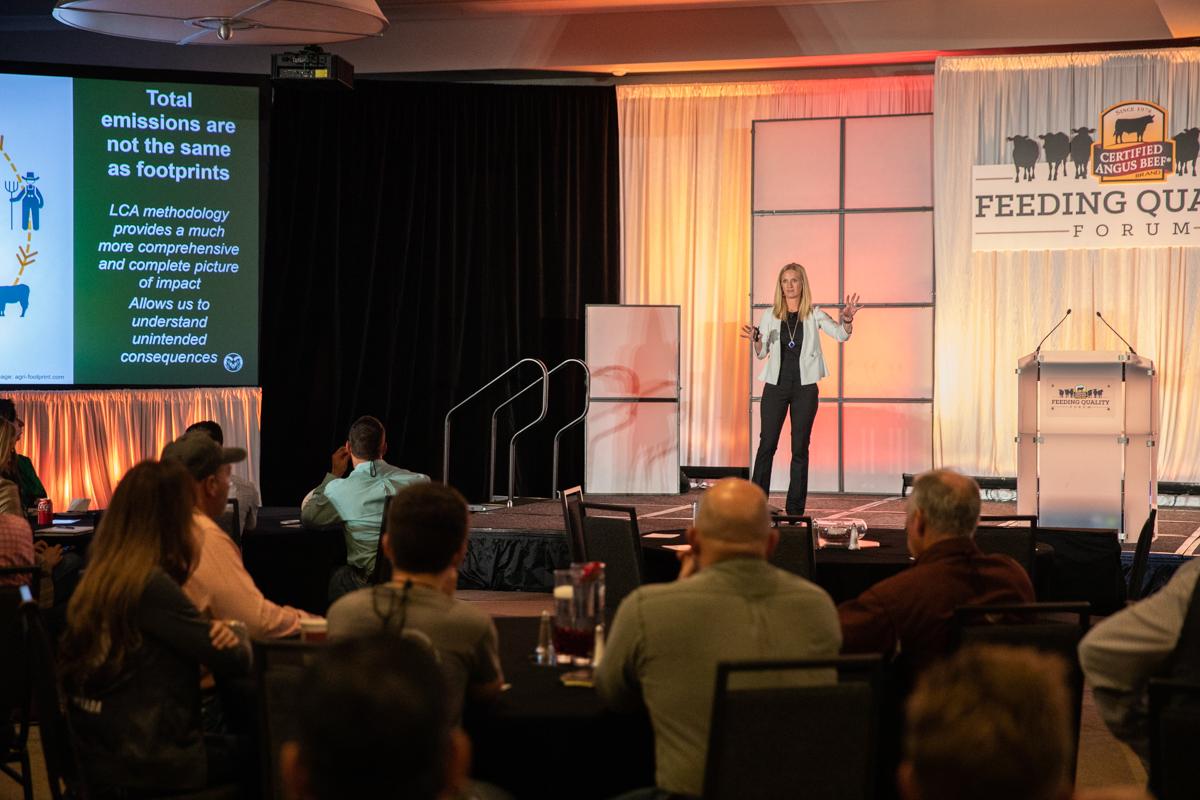
Sustainable beef production was at the forefront of conversations, with a caveat: emotion and science are on equal footing, noted Kim Stackhouse-Lawson, director of AgNext at Colorado State University (CSU). Data concludes beef can be a sustainable product, but often consumers are faced with a polarizing narrative that challenges their values and emotions towards animals. “Emotion wins every time” when it comes to a food brand, she said.   

“The beef industry still has an incredible story to tell from an impact on a product-produced basis,” she shared. “But we’re starting to lose control of that narrative because overall emissions are still increasing.”  

Stackhouse-Lawson said livestock’s contribution to total U.S. greenhouse gas emissions (GHG) is only 3.8%. But that’s up 20.7% since 1990.  

This evolving landscape of customer expectations directs regulatory changes. It’s why JBS joined other beef processing companies and announced a climate goal to reach global Net Zero GHG emissions by 2040.  

“This wasn’t just an idea on a whim of something that we wanted to do,” said Nikki Richardson, head of communications for JBS USA. “I think that the sky is the limit when it comes to identifying ways to have collaborative projects and things in place where we’re benefiting producers and ultimately getting closer to reach our goal.” 

The ambitious goal will require working together.  

For now, Stackhouse-Lawson said cattlemen should focus on land management and improving efficiencies around performance. 

Technology gives producers that opportunity, said Justin Sexten, strategic and product lead for Performance Livestock Analytics, a part of Zoetis.  

When managing more than one pen, not one single animal represents the average, yet decisions are made in groups to increase average performance. 

From a sustainability perspective, some cattle in a pen may need additional resources. However, in most cases all animals receive the same resources, whether or not they’re needed.  

“We have to find a way to manage from an individual perspective,” he said. 

Feeding Quality Forum Kim Stackhouse-Lawson

Global Impact 

Dan Basse, president at AgResource Company, said China’s bout with African Swine Fever reduced that country’s pig population, and therefore more beef moved into the country. This year’s beef exports to China are at 10-year highs, despite exponentially higher costs to get it there.  

Basse said managing feed costs will be difficult for beef producers. Severe drought challenges in the U.S., Russia, Brazil and Argentina have brought a shortage of corn in the world, even though world corn trade is still strong.  

“I don’t think corn prices are going back to anything with a sub-five in front of it for the years to come,” Basse said. 

On the bright side, beef demand is the highest in more than a decade. More disposable income, thanks to COVID-19 relief, means consumers are eating more beef.  

“The long term for cattle looks really quite extraordinary and bullish for the next couple of years,” he said. 

Beef Supply  

If you’re on the sale side of that equation, more demand means higher prices. To those buying beef, that means it’s getting more difficult to source product. 

“The customers think that we have printed menus that are disposable because of COVID,” said Dale Zimmerman, owner of two North Dakota restaurants. “It’s because we don’t know what we’re going to have in the cooler that day.” 

Victoria Philips, president of Lombardi Brothers Meats, agreed: “Our biggest issue is definitely the supply.” Her business model is constantly shifting due to inconsistent supplies. 

When restauranteurs cannot get their regular product, Philips and her team help them find beef and develop creative ways to apply it on menus. In many cases, price point is no longer the biggest obstacle, she said. 

“Our job is to make sure we get the product restaurants need,” she said. “And that can change overnight.”

Feeding Quality Forum Dan Basse

Clint Walenciak, CAB director of product services, and Daniel Clark, CAB meat scientist, shared data from nearly eight million Angus-type fed cattle to see how increasing hot carcass weights (HCW) affect CAB acceptance.  

“We see HCW at 40- to 50-pound swings to 70-pound or greater swings between those seasonal lows to seasonal highs,” Walenciak said, noting 20 pounds is a big adjustment within 12 months.   

Black-hided cattle must meet 10 carcass specifications to qualify for the brand. The data revealed a positive trend between HCW and marbling, but also with ribeye size and backfat (the four CAB specifications most missed).  

“When average fed cattle HCW gets above 900 pounds, we’re going to start kicking out more and more cattle,” Clark explained. “Below 850 pounds, then the cattle probably just aren’t reaching their genetic potential.”  

The pandemic created a backlog of fed cattle where feedyards saw what happens when cattle have more days on feed, and consequently higher HCW. The use of feeding technologies, such as ractopamine, abruptly stopped for cattle with no guaranteed slaughter date.  

That came with the unintended consequence of helping researchers answer questions cattle feeders otherwise may never have tested. Just feeding cattle longer can have the same response as feeding beta agonists for lean gain the last month of the feeding period.  

Brad Johnson, meat scientist at Texas Tech University, shared survey results that ractopamine usage is not back to pre-pandemic levels and is not expected to return. In a future market with stricter requests, he warned not to give up on technology yet.  

“I’m not just talking about implants,” Johnson said. “All technology, data management and maybe some natural feed additives that can improve marbling and reduce GHG emissions.”  

The future will be about finding good relationships, sound science and sharing a story that resonates, said Keith Belk, CSU head of animal science department.  

“You can’t do a good job of addressing industry issues with research or educating the next generation of students unless you have good partners to work with,” Belk said.

For more event coverage, visit FeedingQualityForum.com. 

You may also like

Certified Angus Beef Launches New Podcast

Certified Angus Beef Launches New Podcast

Certified Angus Beef Launches New Podcast By Certified Angus Beef April 8, 2026 Ever wondered how Certified Angus Beef (CAB) got its start—or how the brand continues to drive demand for Angus genetics today? The CAB Bite podcast will answer those questions and more....

Sysco Highlights the Value of Beef Quality Assurance

Sysco Highlights the Value of Beef Quality Assurance

Sysco Highlights the Value of Beef Quality Assurance By Briley Richard, freelance writer for Certified Angus Beef March 25, 2026 The best beef is raised the right way. This message was reinforced by remarks from Joe Don Eilers, vice president of merchandising for...

Nebraska feedyard

Where premiums are earned

Understanding beef carcass value

by Kylee Kohls

March 29, 2021

A Choice carcass is worth more than Select, but if cattlemen are looking to add value across the entire carcass, only one brand does that.

Cattlemen joining a March webinar hosted by the Certified Angus Beef ® (CAB®) brand learned about that and more while discovering the sources of premiums they earn for their best cattle.

For decades, those who aim to raise high-quality cattle have kept an eye on the Choice/Select spread. The CAB/Choice spread? That’s next level.

“The purpose of the brand is to add value to Angus cattle,” said Paul Dykstra CAB assistant director of supply management and analysis. “The $17.57-per-hundredweight (cwt.) premium over Choice is absolutely at the heart and soul of our very purpose and our mission statement.”

Diana Clark, CAB meat scientist, co-hosted the webinar where the duo walked through market benchmarks, brand specifications and the value it adds across the entire carcass.

Last year, it all added up to a CAB wholesale premium value of $154.61 per head above Choice and more than $246 above Select.

AngusLink fed steer

The 2020 beef supply

Dykstra said 15.5 million Angus-type and eligible cattle were evaluated at licensed packing facilities in 2020, with 35.9% certified to carry the brand’s logo.

“That’s been the success story of the industry,” he said. “In the last 20 years or so, the amount of improvement in cattle accepted into the Certified Angus Beef brand, and really the carcass merit that has driven that trend in those eligible cattle.”

With more than 35 licensed partners in North America, CAB penetrates more than 85% of the fed-cattle packing base, Dykstra said. Overall, 58% of fed cattle and 69% of beef type cattle were eligible based on hide color in 2020.

Beneath a black hide

Diana ClarkCattle with a predominantly black hide are then marked with blue ink on the hock of the hanging carcass at the packing plant. Later, chilled carcasses are evaluated to see if they can meet 10 science-based specifications and go into beef boxes that carry the CAB brand logo.

“The goal behind these specifications is to provide high-quality beef in a consistent manner for all our customers,” Clark said.

Standing beside a hanging side of beef with the primal cuts outlined in tape, Clark provided in-depth explanations on why each specification matters and how it’s measured for the most consistent quality.

She engaged virtual guests from the CAB Culinary Center and added colorful examples such as the calpain enzyme acting like Pac-Man on the quest to break down toughness dots so beef gains tenderness while aging.

Weight matters

Looking at the CAB/Choice spread, Dykstra noted the simple formula: Weight x Value Spread = $154.61 per head above Choice on the 2020 average carcass weight of 880 pounds (lb.).

The wholesale value advantage incentivizes packers to pay what have been generally increasing premiums for carcasses that meet the brand’s specifications. Last year, cattle feeders got roughly $45 per head on average for a CAB qualifier over the cash price for the week.

Breaking that CAB/Choice spread down by primal cut, he explained how CAB provides a 7.4% premium over Choice.

“When it comes to value distribution, weight matters,” he said. “But where are we driving the most value?” Details provided answers.

The loin is only third-heaviest primal cut at 21.3% or 187 lb. in 2020 average weight, but it brings the most value to the carcass, offering a $65.99/head CAB brand premium over Choice.

The round carries 22.3% of the weight and adds a $14.95/head CAB premium while the rib contributes a $29.81/head premium from 11.4% of the carcass weight.

paul dykstra“For a brisket, the Certified Angus Beef premium actually adds $10.35/cwt. to the spread over Choice,” Dykstra said. “We sure wish the brisket weighed more with that premium. But with 44 lb. and 5% of total carcass value, it still contributes almost $5 per head on the cutout.”

Adding value across the carcass, CAB provides premiums to the chuck and plate primals, compared to the Choice grade, which adds nothing.

The chuck carries the most weight in the carcass at 29.6% (260 lb.), offering a $30.73/head CAB premium over Choice or Select, he said. Coming in at only 7.1% of the carcass weight (62 lb.), the plate earns $7.31 of the $154.61 total CAB premium.

Rounding out the carcass, Dykstra noted the flank, lightest primal at 30 lb. or 3.4% of the carcass, still adds $1.43/cwt. to the total average CAB premium carcass value.

As quality continues to trend up and more cattle qualify for the brand, the CAB/Choice spread may gain ground on the old Choice/Select metric as an industry standard. Along the way, the brand will keep working with all partners from pasture to plate, adding value to every cut and premiums for Angus cattlemen.

To watch more of any of the recent webinars hosted by the CAB Cattleman Connection team, visit cabcattle.com/webinars.

You may also like

Certified Angus Beef Launches New Podcast

Certified Angus Beef Launches New Podcast

Certified Angus Beef Launches New Podcast By Certified Angus Beef April 8, 2026 Ever wondered how Certified Angus Beef (CAB) got its start—or how the brand continues to drive demand for Angus genetics today? The CAB Bite podcast will answer those questions and more....

Sysco Highlights the Value of Beef Quality Assurance

Sysco Highlights the Value of Beef Quality Assurance

Sysco Highlights the Value of Beef Quality Assurance By Briley Richard, freelance writer for Certified Angus Beef March 25, 2026 The best beef is raised the right way. This message was reinforced by remarks from Joe Don Eilers, vice president of merchandising for...

feedyard cattle

Playing to win: Grid marketing opens door to premiums

by Morgan Boecker

February 10, 2020

angus steer

Learning to play chess in later life isn’t easy, but it’s not impossible.

Grid marketing finished cattle is similar. It’s not intuitive, but it’s a learnable risk management tool.

“Maintaining ownership through the cattle feeding period and selling on the rail is an opportunity to recapture the input costs and hopefully improve our bottom line,” said Paul Dykstra, Certified Angus Beef ® (CAB®) assistant director of supply management and analysis. “The key is to align genetics, management and performance with the seasonal trends.”

At a January webinar, he said producers can target cow herd genetics toward the factors driving value in the supply chain. Backfat and marbling have differing value implications at the packing plant and can be selected in different directions in the herd.

Prime beef production is at record high, while Select beef share is declining (Figure 1)–consumers are paying to keep high-quality beef on the table.

Figure 1 Spreads and Cutouts

Grid marketing 101

Profit on the grid depends on beating industry averages for quality and yield grades.

Fed cattle sell by formula, contract or spot-market bids. Live or carcass weight-based pricing formats are often dependent on region.

Grid marketing sets a starting price according to a carcass-value base, then figures premiums and discounts to each carcass. Overall yield, or dressing percentage, converts live to carcass price.

“The average dressing percentage of 63.5% is pretty standard for the industry,” Dykstra said, but grids may vary and the number is affected by mud, gut fill, external fat, muscling, gender and age.

A below average dressing percentage may be overcome by having better-than-average carcass premiums.

Cattle with the most fat usually have the least muscle and red-meat yield. “That combination works against us,” Dyskstra said.

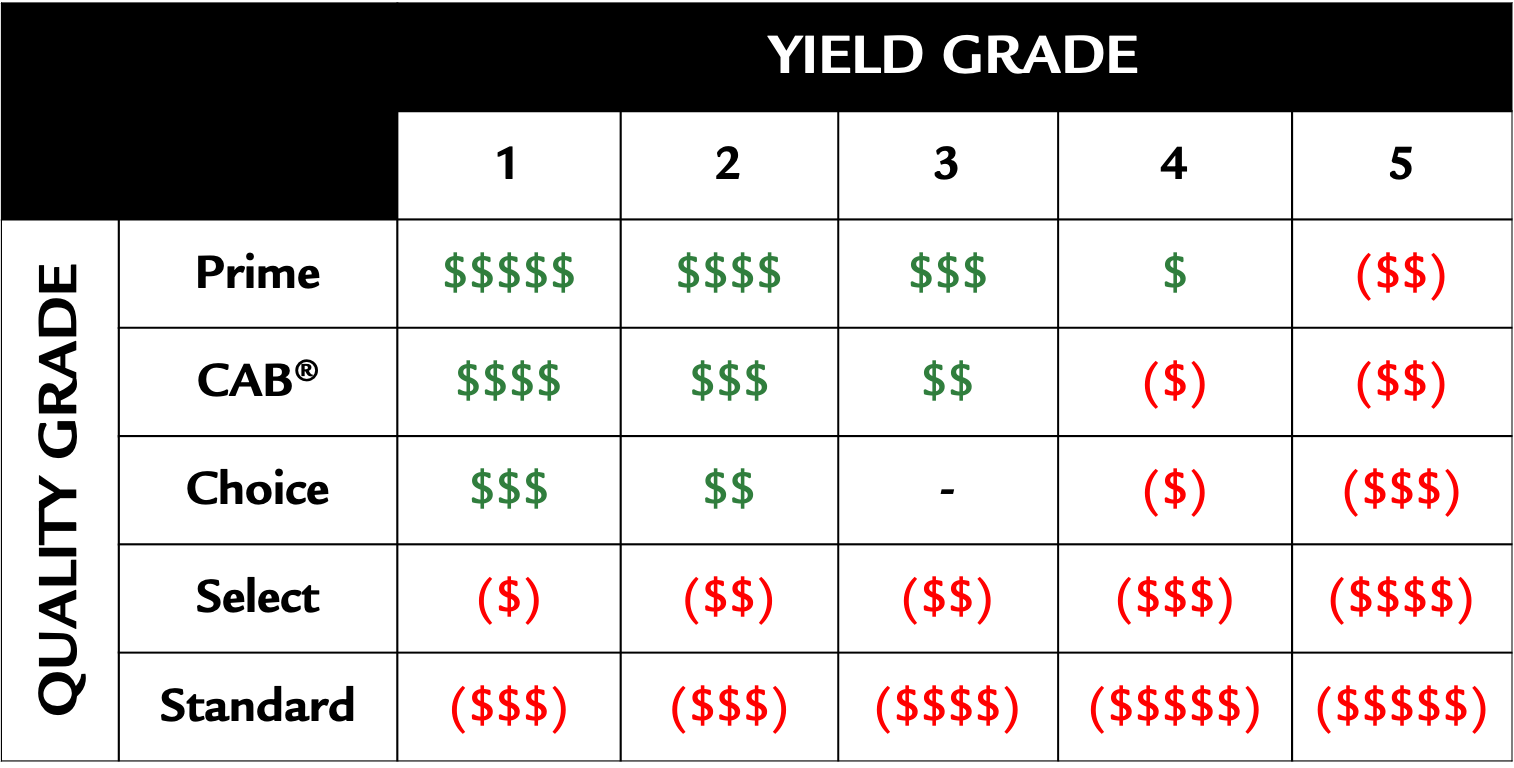
Packers pay the most for the rare combination of Prime quality and YG 1, and they greatly discount carcasses falling at the opposite end of the grading table (Figure 2).

grid premiums and discounts table

Cattle sold on the grid compete with the average percent Choice at the packing plant. Cattle are graded individually, but packers look at entire load average to determine if any cattle earn a premium.

The current U.S. average of near 70% Choice, with regional differences, means packers only pay the Choice premium for the share of cattle in the whole lot that exceed the plant average, Dykstra explained.

“Whether it’s 40 head or 150 head, the percentage of those cattle grading Choice matters,” he said.

The Choice/Select spread points to supply and demand for high-quality carcasses and determines the premium.

An average of 70% Choice leaves potential premiums on 30% of the load. If the Choice/Select spread is $10 per hundredweight (cwt.), multiply 10 by 30% to get $3/cwt premium for every Choice carcass in the load.

Typically spring and fall are ideal for capturing the most quality premiums, Dykstra said, but CAB carcass trends are impacted by seasonality to a lesser degree.

Even though 36% of all eligible black-hided cattle reached CAB last year, packers have paid higher premiums for the brand lately compared to when supplies were historically low.

“When we can sell more product and still keep a premium up there for cattle, that’s a great thing,” he said.

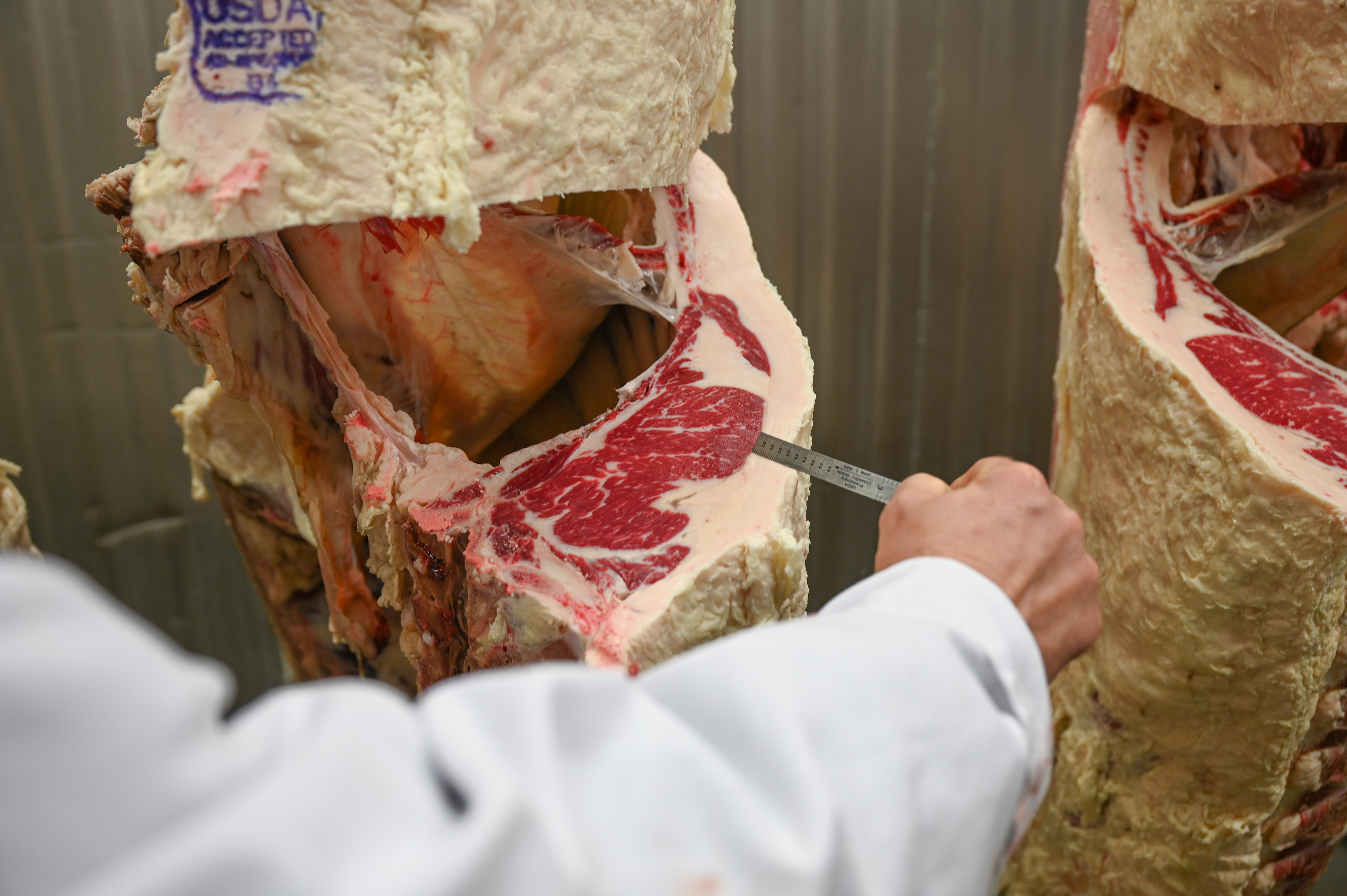
measuring backfat on carcass

Yield grade still matters

Yield grade is the other part of the equation.

Cattle reach their endpoint faster today than 20 years ago, increasing the average YG 4s to 12% last year with cases of 20% to 40%. The pandemic added to that as cattle feeders and packers worked through the backlog and cattle spent more time on feed.

While grids may incentivize YG 1 (recent average $5.43/cwt. premium), YG 2 is a reasonable target to maintain high grading carcasses, Dykstra said. YG 3 is par.

Yield Grade 4s and 5s now incur smaller discounts than in the early 2000s, he said, “evidence that packers have become more accustomed to a little extra fat thickness to achieve a desired quality grade.

“The premium for YG 2s averaged $2.42/cwt. last year,” Dykstra added. “We should have as many YG 2s as we can possibly get, keeping in mind that YG 1s with acceptable finish are difficult to achieve.”

Bring the data home

Dykstra posed the questions: How do commercial cattlemen pursue their share? What numbers need to be achieved to perform well and earn more money in grid marketing?

Start by evaluating traits in your cow herd and bull battery.

Backfat thickness indicates days on feed and total body fatness, while marbling affects quality grade–also the primary driver for carcasses qualifying for CAB. Backfat, hot carcass weight and ribeye area are other measures used to determine YG and CAB eligibility, Dykstra said.

The many moving pieces in grid marketing make it a bit of a chess game, but learning to play opens more opportunity for big wins.                                                                        

You may also like

Certified Angus Beef Launches New Podcast

Certified Angus Beef Launches New Podcast

Certified Angus Beef Launches New Podcast By Certified Angus Beef April 8, 2026 Ever wondered how Certified Angus Beef (CAB) got its start—or how the brand continues to drive demand for Angus genetics today? The CAB Bite podcast will answer those questions and more....

Sysco Highlights the Value of Beef Quality Assurance

Sysco Highlights the Value of Beef Quality Assurance

Sysco Highlights the Value of Beef Quality Assurance By Briley Richard, freelance writer for Certified Angus Beef March 25, 2026 The best beef is raised the right way. This message was reinforced by remarks from Joe Don Eilers, vice president of merchandising for...

flavor's secret ingredient, grill flame flavor

Flavor’s secret ingredient

Many factors create a good eating experience, but delivery is key

by Abbie Burnett

October 5, 2020

jerrad legako beef flavor science

A thunderstorm rolls in above the parched Great Plains with all the usual effects, but no rain. Disappointment, like a tender steak without flavor.

Just as it takes certain factors to produce a great rainfall, so it goes with flavor. To quell a drought, you need rain. To satisfy consumers, you need flavor. Hint: it’s in the marbling.

Texas Tech University meat scientist Jerrad Legako spoke to that point during the American Society of Animal Science conference earlier this year.

“No question, flavor is at least equivalent to tenderness in importance to the overall eating experience, if not a little more,” he said. That’s partly due to improved beef tenderness since the late 1980s.

But what is flavor, and how do we experience it?

It’s a complex combination, said Legako.

More than taste on the tongue, flavor takes in perceptions of texture and mouth feel. It’s “olfaction,” as the scientist evokes the world of smell, and chemical reactions on the tongue that perceive spiciness. Ambiance and prior experiences complete the impression.

All of these affect perceptions of flavor, but Legako’s team looks for a nuanced key to the best beef-eating experiences.

“With the sensitivity of the olfaction system, volatile compounds are incredibly important for our perceptions of flavor,” he said.

Volatile because they evaporate at room temperature, the organic compounds start as sugars, amino acids, lipids and thiamines, breaking down in beef’s aging, storage and cooking processes.

All but the fats are water soluble and provide basic tastes like sweet, sour, salty and bitter.

Then cookery enters with its Maillard reaction that reduces sugars and proteins to the volatile compounds like aldehydes we enjoy as a robust flavor profile. It’s how such flavors as nutty, roasted, garlicky, whiskey and honey get into browned foods like dumplings, cookies, biscuits, marshmallows—and steaks, of course.

“With time and temperature, you can kind of start to think about this as a chemistry equation,” Legako said. “You’re driving that reaction at different rates just depending on exposure time and the level of heat.”

grill flavor beef science

Lipids, the top contributor, produce flavor through oxidation, he said, citing Australian studies: “Fat is the delivery system.” Among beef cuts with varying fat levels, those with the most would always deliver more of the same volatile compounds.

To be clear, the flavor components fat delivers come not from the fat but from the effects of cookery on amino acids and sugars, Legako said.

“Yet they’re dissolving in that fat, retained in that high-fat sample and being delivered,” he said, “an increased sensory response or a more intense beef flavor through the greater delivery of those volatile compounds.”

Basically, fat serves as a reservoir to deliver flavor.

Legako and team tested this reaction across different cookery types, higher degrees of doneness and different grades of beef. The consistent find? The higher the grade, the better the flavor, increasing linearly from Standard to Prime.

“This is at least some support for marbling content in a way influencing volatile compound delivery,” Legako said.

For a good thunderstorm, you need moisture, instability and a lifting mechanism. For good flavor, you need aging and heat, but it takes ample marbling to really deliver. That starts on the ranch.​

You may also like

Purpose Follows Passion

Purpose Follows Passion

A chance opportunity. A change in career direction. And meat science was changed forever. Dr. Gary Smith originally had no plans to become a meat scientist. But thank goodness he did.

Certified Angus Beef Recognizes Beef Quality Research

Certified Angus Beef Recognizes Beef Quality Research

First-place honors go to Andres Mendizabal, an international student pursuing a Ph.D. in animal science at Texas Tech University. His research is titled, “The Accuracy of USDA Yield Grade and Beef Carcass Components as Predictors of Red Meat Yield.”

Not all good days are sunny and warm

Not all good days are sunny and warm

Stress of any kind affects performance and health, but also well-being and behavior, a special focus for CSU animal scientist Lily Edwards-Callaway. Her team’s literature review found shade benefits vary by location, structure type and the weather.

cab annual conference

Opportunity for beef progress continues

Record number join virtual Certified Angus Beef ® conference

by Crystal Meier

September 29, 2020

To those raising beef, this year’s opportunities might look similar to the past. But for those in the business of selling the protein? The horizon looks quite different.

More than 1,100 people from 27 countries gathered online for the Certified Angus Beef ® (CAB®) Annual Conference last week, a record attendance for the event, to explore the possibilities.

Ranchers, meat packers, distributors, grocers and restaurateurs together in a virtual room made the supply chain feel smaller, each seeking go-to-market strategies to deliver high-quality beef to consumers.

“As we look at the COVID-19 impact, it hasn’t necessarily changed consumer demand for quality beef,” said John Stika, CAB president. “It just changed dramatically where and how they look to access it.”

Even with a pandemic recession about, the brand will end 2020 with more than a billion pounds sold.

“You have to be amazed, when you think of what we’ve gone through, that demand would stay this strong,” said Randy Blach, CEO of CattleFax. “And we’ve done it basically with one hand tied behind our backs.”

When public health ordinances shifted diners from foodservice to retail, it created one positive unintended consequence: consumers got more comfortable in the kitchen.

john stika, cab annual conference

This creates retail opportunity, said Chris Dubois, senior vice president of protein for data analysis firm IRI. He encouraged marketers to marry tools with sales to keep beef at the top of the grocery list. CAB offers Roast Perfect, an app that shares how-tos, recipes and cooking inspiration.

Dubois said online food sales grew 50% to 60% this year, while meat e-commerce doubled.

“The retailers, processors and packers who get e-commerce right are going to have more success than those who ignore the trend,” he said. “This is where you’re really going to see the separation in the next three years.”

International business is slowly gaining momentum again, after an optimistic start to 2020.

“We feel like the fundamental demand for U.S. beef has remained quite strong in our key markets,” said Joe Schuele, vice president of communications for the U.S. Meat Export Federation. “For the global meat trade, especially high-end products to reach full potential, we need to return to normal economic activity.”

The brand continues to grow relationships, and highlighted personalized marketing tools such as French and Japanese versions of its logo and a new website for Spanish-speaking consumers, CertifiedAngusBeef.lat.

The CAB Prime brand extension offers another growth opportunity.

“Is there enough high-quality Prime in the marketplace to build a business around?” Blach asked. “The resounding answer is yes.”

Prime beef production used make up only 2% to 3% of beef, but now makes up nearly 10% of the annual supply from fed cattle, or 2.6 million Prime carcasses.

cab annual conference

In the past two decades, beef’s market share of consumer spending also grew. It makes up nearly half of the dollars spent on proteins compared to 40% in 1999.

Building on that momentum, CAB launched its consumer loyalty program in February. Steakholder Rewards invites customers to interact with the brand and earn rewards for beef purchases.  

While the foodservice division works harder than ever to sell much less, CAB facilitated discussions on keeping quality while cutting costs, offering up ideas such as live training, menu ideation and using value-added products.

“When I look at what the people are doing to drive their businesses forward during difficult times, whether cattlemen or restaurateurs, it’s really exciting,” Stika says. “And we’re just glad to be alongside them, helping to drive momentum.”

Remaining relevant in an ever-changing marketplace requires adaptation. Attendees learned about updates to the brand specifications and sustainability initiatives. CAB honored five cattle businesses for their commitment to quality, including the first-ever sustainability award, and they celebrate success in each segment of the business.

“This brand was started to create value for everyone that produces and touches it through the production and merchandising chain,” Stika said. “As I look at where we’re at today, I think we’ve been able to re-center on the things that are important to ensuring value moving forward for our partners.”

You may also like

Protecting Brand Integrity

Protecting Brand Integrity

Protecting the brand’s integrity has been a core pillar since 1978. Integrity is so foundational that the brand was built around the premise: with integrity, nothing else matters, and without it, nothing else matters.
Promising Quality in Angus

Promising Quality in Angus

Before Certified Angus Beef, consumers didn’t know what “Angus” meant. Angus meant little, except to its breeders. A strict adherence to quality through its 10 carcass specifications continues to serve as the foundation for maintaining the breed’s premium beef position in the marketplace and drives demand for registered Angus genetics.

The Angus Argument

The Angus Argument

There’s no denying CAB has helped dramatically expand the market share for registered Angus genetics. Arguably, that success has encouraged several other breeds to adopt a black hide color by incorporating registered Angus genetics into their breeding programs and registries.