

I’m So Lucky I Can’t Hardly Believe It!
There have been several people from India (and other far away places) who have recenlty lost loved ones in some kind of a revolution; they were murdered; perhaps a spouse or someone close to them who was unjustly disposed of by some radical group or far out religious group.This survivor, let’s call her Suri, a widow, has a multi-million dollar fortune she’s willing to share with me if I’ll just contact her with some bank account information. Sometimes her English and spelling isn’t so good, but the story sounds believable. And, it usually closes “with God’s peace” or something like that, so you know their heart is in the right place.
Or, how about that one that helps me to lose that stubborn belly fat? (Well, that’s nice, but I know what my problem is there……I just need to give up beer, fried foods, and corn chips.) But, hey, for $69, we can help you with that, no guarantees, of course (especially if I don’t give up the beer and chips!).
Or life insurance offers. Did you know, I can get 14 million dollars worth of life insurance for just pennies a day? WOW! I mean, now that is a DEAL!
Look! My credit rating has just gone up! That means I’m eligible for more debt! Yahoo! I’m so lucky, I can’t hardly believe it! Sure glad they are notifiying me…….
I hope by now you have been able to detect my sarcasm! Really! Do these people honestly believe I’m going to bite on these deals? How stupid do you think I am?
Well, there’s lots of other deals out there like that in the beef industry, although they may be masked with a little bit more class than most of those examples. My response to that is: SHOW ME THE DATA!
Our new DNA test, GeneMax(TM) has just that. We have done the field validation research that shows us it really does work! No snake oil salesman here. As a matter of fact, I was probably what my boss would call a “doubting Thomas” until we got the data back in. You see, I’m a pessimist (I prefer to call a “realist” LOL!) by nature. I should have been born in Missouri, because you gotta “show me!”.
Data on over 2,000 head of high-percentage Angus cattle show that the test works. From the much touted Tri-County Steer Carcass Futurity (TCSCF) program in Iowa, where full feedlot performance and carcass data was compiled, blood samples had been archived and we had the ability to go in and match that up to provide proof.

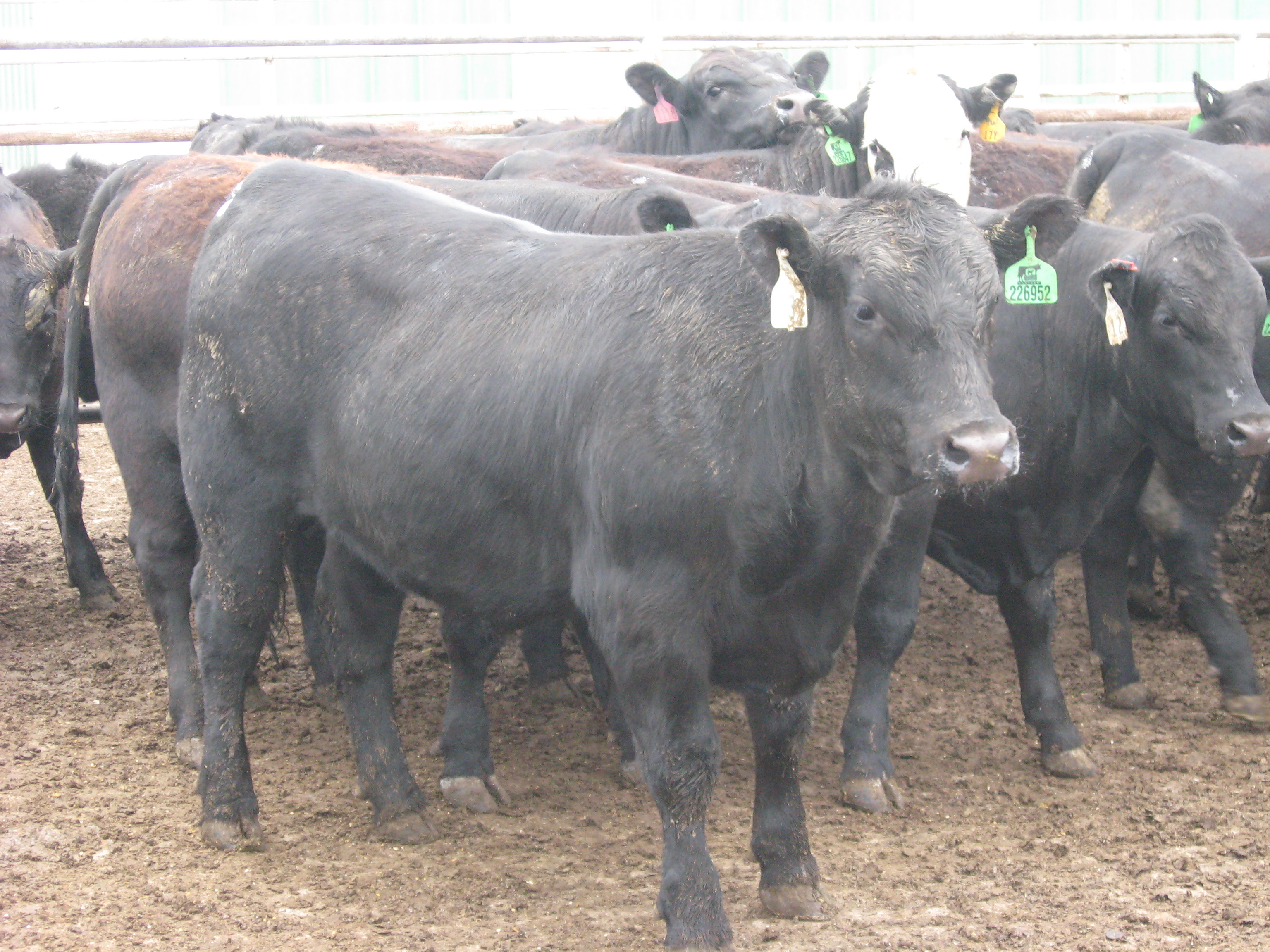
- This pen of 79 head of high-percentage Angus cattle were fed at McPherson County Feeders at Marquette, KS. All were tested using GMX.
The GMX test gives you three scores. However, the first is the most important. It is a score, from 1-100, that ranks individual animals against the base. So, a GMX score of 90 indicates that the animal is in the top 10% of the animals tested.This score is a composite for the measures of marbling and yearling gain. The other two scores are individual score for those same two traits. Those two scores are rankings as well; but are on a scale from 1-5 in each marbling and yearling gain. A “5” in marbling would mean that the animal ranks in the top 20% for marbling; conversely, a “1” would mean it ranked in the bottom 20% for that trait. Likewise for yearling gain. But the most important score to look at is the 1-100 score. So, you may have an animal with a score of 80 that has a marbling score of “5” and a gain score of “3”, or vice-versa.
In the TCSCF field validation study, the animals scoring a “5” in gain had a 0.25 lb average daily gain advantage over those that scored a “1”. Those with the highest overall GMX score, i.e., those above 90, had a 0.75 ADG over those that scored 10 or below, with ADG figures scaling down from that peak group to the bottom enders. Marbling scores likewise dropped, by 20 points from top scores to bottom scoring animals.
More news: This past winter and spring, we GMX tested 79 head of steers in the Kansas Angus Association Carcass Data Project. Here are some of the results:
The top third of the steers had an average GMX score of 83; the middle had a score of 73; and the bottom third had an average score of 33.
The top scoring cattle had a marbling score of 511; the middle were 496 and the bottom were 493, nearly a 20 point spread (as we saw in the TCSCF field validation study). The average daily gain for the top third was 4.10; middle 3.94; bottom 3.92. That is a difference of 0.18 lbs per head per day, or an extra 28 lbs of live weight to sell in a 160 day feeding period. In today’s market, that’s $35 more per head. For a $17.50 investment, that’s doubling your money. There was also a 9 percentage point increase in animals that qualified for the CAB brand, meaning extra dollars in your pocket, in this particular example.
Using the economic models, our data tells us that a 50 point spread in GMX scores between two groups of cattle results in a $33 per head return for a $ 17.50 investment on cattle fed for 200 days.
Folks, the data is there. You’re pretty lucky to hear about it here. I’m not going to send you an email. But I’d be glad to talk to you about the test. Find out more about what GMX technology can do for you by visiting our website at www.cabpartners.com.
~Gary
You may also like
From Decline to Dominance
Initiated from a simple yet visionary idea, and pursued through the grit and tenacity of Angus breeders seeking a better future for the breed and Association members, it’s no accident that Certified Angus Beef is where it is today.

Smitty’s Service on CAB Board
Lamb continues to find himself struck by just how far-reaching the Angus breed has become. The brand’s growing demand and rising prime carcasses left a strong impression. He hopes everyone recognizes the vital connection built between consumers and Angus producers. Humbled by the opportunity to serve, Lamb reflects on his time as chairman with gratitude.
Success, Despite Challenges
Today’s market is complex and competitive. The collective effort of stakeholders across the supply chain positions Certified Angus Beef to meet the record demand for premium beef moving forward. Signals across the beef industry are clear and Angus farmers and ranchers seeking high-quality genetics that deliver premium beef are producing a product in high demand.