
MARKET UPDATE
The fed cattle market has traded in a steady range around $235/cwt. live and $372/cwt. dressed in the past two weeks, roughly $10/cwt. lower than the late February high on a live basis.
The post-report adjustment to the harvested head count two weeks ago pulled that week’s total to a paltry 503,000 head. Last week’s recovery to 520,000 returned the harvested throughput to the lower end of the range seen in the previous four weeks, with an average of 524,000 head per week for the period.
The JBS – Greeley, Colo., plant remains closed for the third week now due to labor stoppages at that facility. This, combined with the general tightening of packer throughput, continues to impede harvest volume.
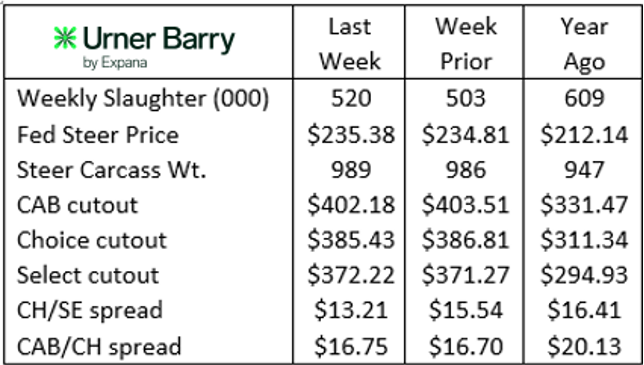
Meanwhile, feedyard cattle inventory currentness appears to be slipping further as combined steer and heifer carcass weights marked a new record high in the latest USDA report for the week of March 8. Steer weights matched their previous high, recorded in December at 989 lb. each, while heifers surpassed their December heaviest weight by 3 lb. to reach 903 lb. apiece.
Weighted average carcass weights for steers and heifers calculate to 955 lb., 43 lb. heavier than the same week last year. The added weight-per-head on 420,000 head of weekly fed cattle harvested is equivalent to an additional 18,900 head. More astonishingly, the latest weights are 67 lb. heavier than those from two years ago, equivalent to an additional 29,500 head at the recent harvest pace.
Carcass cutout values adjusted slightly lower over the past two weeks following an exceptional first-quarter run-up, during which the USDA Comprehensive cutout value increased 12.7% since January 1. The Comprehensive cutout, describing all grades for all delivery periods, reached $400/cwt. in mid-March, a tremendous 21% increase over the same week a year ago. A small correction is certainly understandable at the beginning of April, immediately before Good Friday and Easter holidays. However, packers do have some pricing power to leverage with their wholesale customers at these reduced harvest head counts.
SPRING CUTOUT CONFUSION
Seasonal shifts historically bring the year’s highest-quality, marbling-rich carcasses to packing plants in March. This phenomenon is often attributed to the finished cattle supply in this period being denser with yearlings than with calf-fed cattle, compared to other seasons.
Specific to March 2026, the share of USDA Select carcasses in packers’ coolers was disproportionally small. The beef sector’s rapid advance toward a 15% USDA Prime grade average in March came at the expense of Select, which dipped to a record-low 7.9% of the offering. This stands in stark contrast to the 12% Select gradeout in March 2025. Meanwhile, the Choice category remained unchanged this March at 73% of the mix, just as it was a year ago.
Last week, the USDA reported the Choice cutout dipping to a $5/cwt. discount to Select. Inversions of the Choice-Select spread, while extremely uncommon, tend to occur in the first quarter, when carcass quality grades are near their annual peak and spot market demand for the grilling season has yet to hit full stride.

There are end-users in the market, such as the institutional sector, that maintain a standing order specifically for the USDA Select product. This price-driven customer capitalized on an average $15/cwt. discount to Choice in the past two years. The recent shift to much tighter Select carcass supplies has narrowed the price gap, even momentarily inverting the Choice-Select spread due to the scarcity of Select carcasses.
Current quality grade trends are subject to seasonal change, but the long-term outlook suggests that the combination of genetics and management will continue to yield higher-quality carcass outcomes. Beef wholesalers are advising their traditionally Select-focused customers to move up to low Choice, given the evolution of the grade mix to a higher plane.
Product labeled simply as USDA Choice has increasingly been defined by carcasses that fall within the lower 1/3 of the Choice grade. This is due to overwhelming demand for Premium Choice-branded products, such as the Certified Angus Beef ® brand. Consequently, what’s left in the USDA Choice box looks much nearer to the marbling found in USDA Select than ever before.
Read More CAB Insider
Seasonal Carcass Impacts
An overriding theme across the past 18 months in the beef sector has been increased carcass weights. In general, fed steer and heifer carcasses averaging 25-30 lb. heavier year over year has been a net positive for the industry.
Margins Sqeeze, Markets Cool: What It Means for Fed Cattle
Focused marketing of a premium beef brand demands some attention to tracking price spreads across differing quality specifications. The USDA quality grade scale provides the domestic measuring stick by which the trade differentiates demand across the quality spectrum.
Rapid Decline in Select Carcasses
The steep upward price trajectory in the fed cattle market remains wholly supported on fed cattle remaining in tight supply and the tight grasp of cattle feeders keeping feedlot stays and carcass weights elevated. Weights continue to underpin beef production tonnage, cutting the harvest pace deficit for fed cattle.