Certified Angus Beef Recognizes Beef Quality Researchers
Mendizabal’s research on red meat yield earns the Dr. Bobby VanStavern Award.
by Savannah Peterson, Public Relations Intern
August 14, 2023
Certified Angus Beef created the Dr. Bobby VanStavern Award for Beef Quality Research to recognize and support student researchers focused on beef quality. This year, the brand recognizes Andres Mendizabal as the recipient and acknowledges other successful researchers for their contribution to improving beef quality.
The brand considers Dr. VanStavern the “Father of the Brand Specifications” because of his involvement in establishing the brand’s original carcass standards. After his passing in 2020, Certified Angus Beef wanted to continue his legacy by creating this award to honor students committed to improving beef quality.
“Dr. VanStavern was instrumental to the creation of the brand, so it is only fitting we continue our dedication to the highest quality beef by recognizing students whose research will help advance beef quality,” Certified Angus Beef Meat Scientist Daniel Clark, Ph.D. says. “This year’s applicants specifically outlined relevant and applicable research that will impact beef quality, and they deserve to be recognized.”
First-place honors go to Mendizabal, an international student pursuing a Ph.D. in animal science at Texas Tech University (TTU). His research is titled, “The Accuracy of USDA Yield Grade and Beef Carcass Components as Predictors of Red Meat Yield.”
“I assessed different cross-sections of a carcass to develop new techniques and models to predict red meat yield that could be used to produce market signals for the beef industry, resulting in new carcass composition and value predictions,” Mendizabal says.
Value discovery is always at the front of beef producers’ and packers’ minds and yield grade generates market signals and feedback for making production decisions. While lack of marbling is the No. 1 reason cattle don’t qualify for CAB, the brand recognizes Mendizabal’s research as a way to continue to improve the overall value of a beef carcass.
“As we continue to improve marbling and quality grade, identifying more accurate and precise ways to predict red meat yield only stands to benefit producers and the profitability of the entire industry,” Clark says.
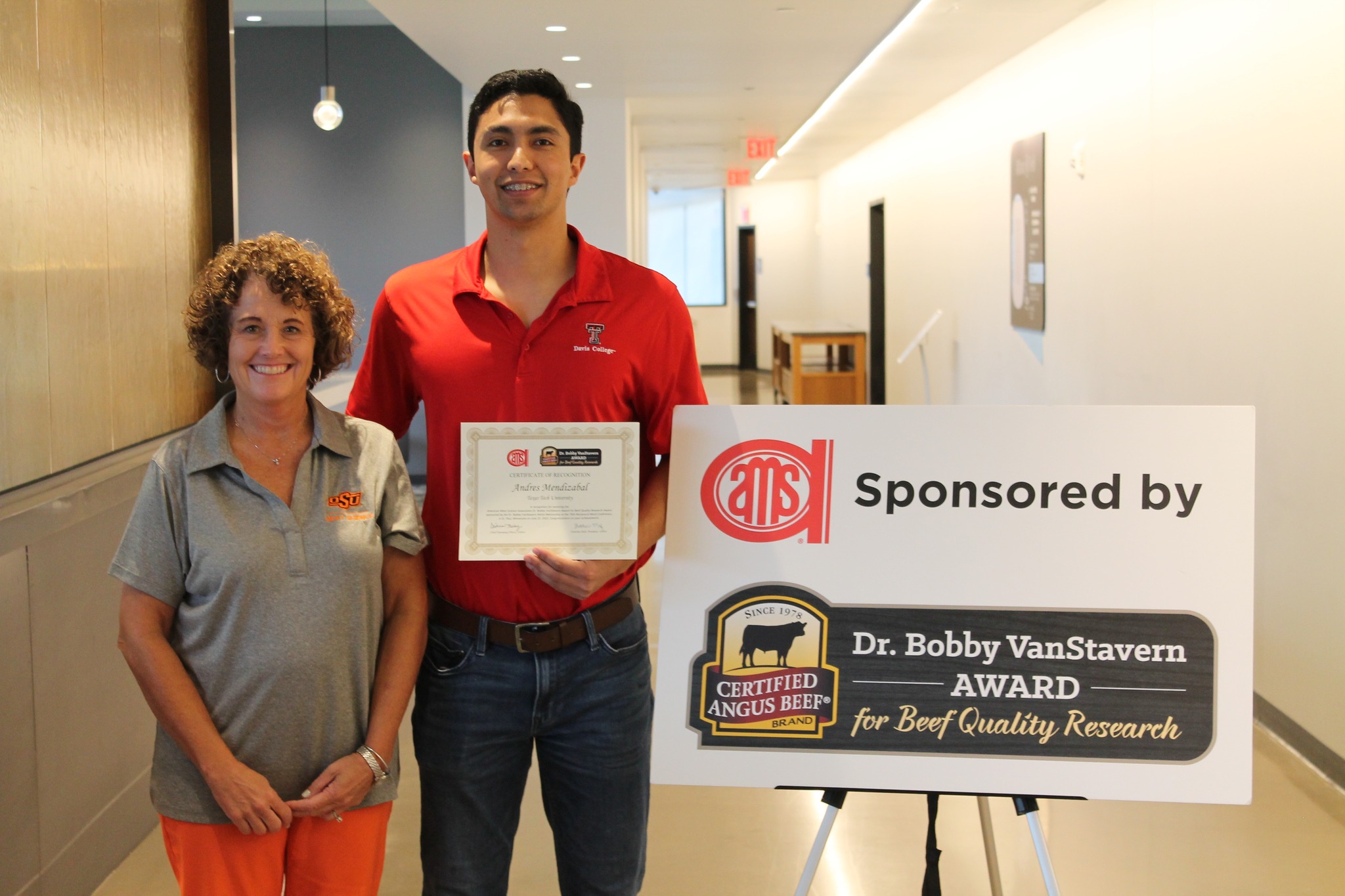
Caption: Gretchen Mafi, president of the American Meat Science Association, presented Andres Mendizabal the Dr. Bobby VanStavern Award during the Reciprocal Meats Conference.
Certified Angus Beef would also like to recognize other students who outlined research pertinent to the beef industry.
Jacob Bagby is a Masters student in meat science at TTU and his research, “Effect of Bloom Time on Preliminary Yield Grade, Ribeye Color, Ribeye Area, Marbling Score, and Calculated Yield Grade for the VBG-Smartcam and the VBG7L Grading Instruments,” evaluated the changes in camera assessments during different bloom times.
Colorado State University (CSU) Animal Science Masters Student Abbey Schiefelbein found potential pathways for trimmings of Suspended Fresh products as the trimmings are currently discarded. In her research, “The Effect of Incorporating Suspended Fresh Beef Trimmings on Ground Beef Retail Shelf-Life,” Schiefelbein hopes to reduce the cost of this trending premium product.
Alexander Norwood is an animal science Masters student at TTU. His research, “Evaluation of Current USDA Beef Yield Equation for Predicting Subprimal Yield and the Use of Cutout Data to Predict Lean, Bone, and Fat Percentages in Beef Carcass,” will be used to form new equations to predict the saleable yield of beef carcasses.
Melissa Davis is a Ph.D. candidate in animal science at CSU. Her research is titled “Benchmarking Current Pre-Slaughter Practices, Welfare Indicators, and Meat Quality Outcomes at Commercial Fed Cattle Processing Facilities in the United States.” Davis studied critical pre-slaughter management factors related to animal welfare and accessed its impact on meat quality to create a nationwide benchmark.
Master of Animal Science student at TTU, Tayler Hays, research titled, “Evaluation of Lubabegron Fed to Conventional Heifers and its Effects on Beef Palatability,” studied the products effects on palatability and dimensional changes to the Longissimus luborum of heifers fed this grow promoting technology.
The research by today’s students will affect the future of beef quality by generating insights for more efficient and accurate management at the ranch, feedyard, packer and beyond.
You may also like
$100,000 to Future Beef Leaders
Interest in quality beef production continues to grow. This year, the Colvin Scholarship Fund awarded $100,000 to 24 students across the country, helping them continue their education and prepare for careers that will contribute to the strength and advancement of the beef industry.
From Data to Dollars
The journey to produce high-quality beef presents market volatility and management challenges. But today, there are data, technology, tools and partners to identify the best value and how to attain it. At the 2026 Feeding Quality Forum, each speaker added to the same message on Aug. 4 and 5 in Amarillo, TX.
Curiosity Changed the Beef Industry
Dr. Del Miles built a career on asking better questions to inform smarter decisions. Throughout his career, he challenged assumptions, advanced science-based management and helped cattle feeders prevent problems before they started. His influence reaches beyond feedyards, shaping the way veterinarians, researchers and cattlemen think about herd health.